

114
roads or other noise sources (e.g. amusement centres, industrial factories) and the efficiency of
soundproofing. Silent nights are especially important since neurological disorders and indirectly
other diseases are frequent in a noisy environment.
According to a survey of the European
Environmental Agency, 24 h exposure to noise
with an average decibel of 65 disturbs even the
daytime rest of people and this affects around 120
million people in Europe while around 450 million people are exposed to a noise level of 55 decibel. The most significant noise source in cities is
road traffic and that is the dominant source of air
pollution as well, just like the number of road
accidents is significantly greater in a city with a
population more than one million (50 people/year
for 10,000 residents) than in smaller towns (typically 25 people/year for 10,000 residents).
All of the above damages could be reduced significantly with more appropriate urban traffic networks and “greener” traffic systems (Newman and
Kenworthy 2007). Densely populated cities with
relatively small radius (not greater than 5 km)
belong to the pedestrian city class. This means that
the city has diverse traffic types but the ratio of
pedestrians is high. The city centre of some cities
can be transformed to pedestrian centres like, for
example, London, New York, Sidney, Vancouver.
Public transport cities rely on tram, metro and
railway traffic. Most European cities and rich cities in Asia belong to this type. Of course, car traffic is busy in these cities as well, especially where
bypass roads have not been constructed yet and
no P + R car parks can be found.
Car cities extend over large areas with small
population density and most residents drive
50–100 km a day to their workplace and back.
Such cities are frequent in the USA, Canada and
Australia. Enormous energy consumption of traffic
is typical and thus air pollution is also significant.
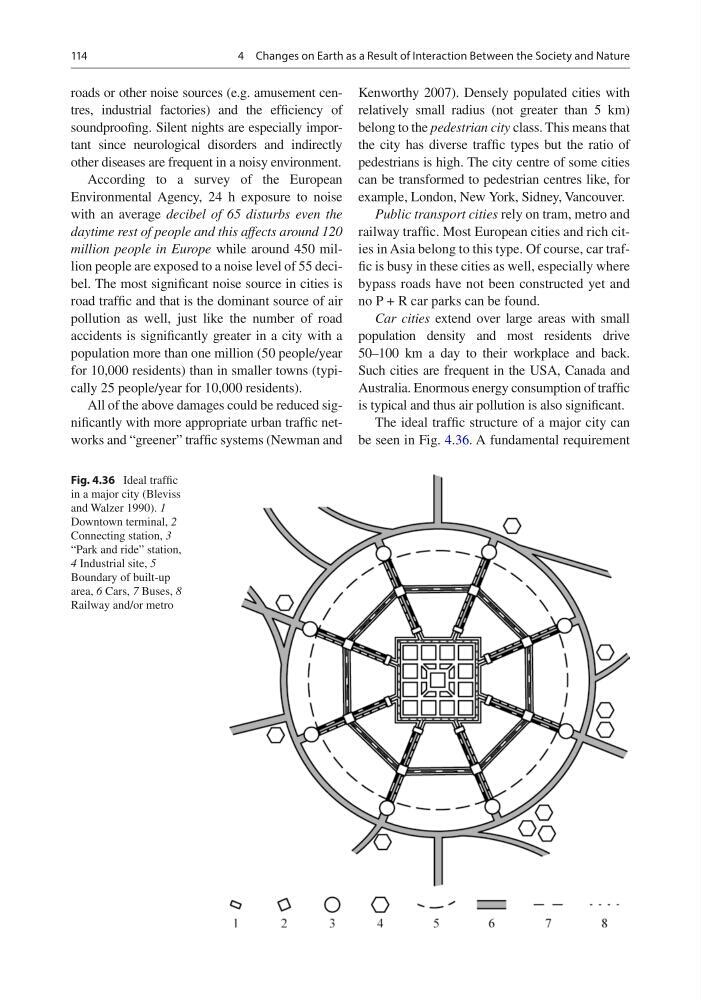
The ideal traffic structure of a major city can
be seen in Fig. 4.36. A fundamental requirement
Fig. 4.36 Ideal traffic
in a major city (Bleviss
and Walzer 1990). 1
Downtown terminal, 2
Connecting station, 3
“Park and ride” station,
4 Industrial site, 5
Boundary of built-up
area, 6 Cars, 7 Buses, 8
Railway and/or metro
4 Changes on Earth as a Result of Interaction Between the Society and Nature
roads or other noise sources (e.g. amusement centres, industrial factories) and the efficiency of
soundproofing. Silent nights are especially important since neurological disorders and indirectly
other diseases are frequent in a noisy environment.
According to a survey of the European
Environmental Agency, 24 h exposure to noise
with an average decibel of 65 disturbs even the
daytime rest of people and this affects around 120
million people in Europe while around 450 million people are exposed to a noise level of 55 decibel. The most significant noise source in cities is
road traffic and that is the dominant source of air
pollution as well, just like the number of road
accidents is significantly greater in a city with a
population more than one million (50 people/year
for 10,000 residents) than in smaller towns (typically 25 people/year for 10,000 residents).
All of the above damages could be reduced significantly with more appropriate urban traffic networks and “greener” traffic systems (Newman and
Kenworthy 2007). Densely populated cities with
relatively small radius (not greater than 5 km)
belong to the pedestrian city class. This means that
the city has diverse traffic types but the ratio of
pedestrians is high. The city centre of some cities
can be transformed to pedestrian centres like, for
example, London, New York, Sidney, Vancouver.
Public transport cities rely on tram, metro and
railway traffic. Most European cities and rich cities in Asia belong to this type. Of course, car traffic is busy in these cities as well, especially where
bypass roads have not been constructed yet and
no P + R car parks can be found.
Car cities extend over large areas with small
population density and most residents drive
50–100 km a day to their workplace and back.
Such cities are frequent in the USA, Canada and
Australia. Enormous energy consumption of traffic
is typical and thus air pollution is also significant.
The ideal traffic structure of a major city can
be seen in Fig. 4.36. A fundamental requirement
Fig. 4.36 Ideal traffic
in a major city (Bleviss
and Walzer 1990). 1
Downtown terminal, 2
Connecting station, 3
“Park and ride” station,
4 Industrial site, 5
Boundary of built-up
area, 6 Cars, 7 Buses, 8
Railway and/or metro
4 Changes on Earth as a Result of Interaction Between the Society and Nature