

112
areas. With the global warming this phenomenon
presents an increasing threat to city dwellers
(Probáld 2014).
Differences in temperatures are influenced by
other factors as well. Around 60% of the precipitation runs off very fast resulting in much less
evaporation than in natural conditions and thus
heat drawn from the environment will be smaller
as well. Snow cleared from the roads in the moderate climate zone also helps warming. As a
result of the above, the annual mean temperature
in a city could be 0.5–2 °C higher than that outside the city. On sunny, windless days the difference in temperature could be 5–6 °C. According
to Founda and Santamouris (2017), the mean
heat island intensity in Athens exceeds
10 °C. There are special warming centres within
the city like industrial factories, heating centres
in the case of releasing high amount of waste
heat. The much more balanced park climate differs from UHI significantly representing more
favourable natural conditions in the city generally with cleaner air as well. The greater the park
is the more its beneficial climate will be felt.
Karimi et al. (2018) called attention to that diseases induced by heat (sunstroke, heart and vascular events) are more frequent in “heat pockets”
developed in a city than in a cooler environment.
This phenomenon is especially severe in the USA
as many casualties related to the weather otherwise occur there due to the climatic conditions.
Further characteristic of urban climate is 10–
20% smaller wind speed and calms more frequent with a similar ratio. It has to be noted,
however, that in poorly designed housing estates
channelling is also frequent causing locally
stronger winds.
Due to precipitation flowing away rapidly and
the lack of soil surfaces capable of storing water
the relative moisture content of the air is 8–10%
smaller than in a natural environment. Cloudiness,
however, is greater (+5, +10) due to the presence
of more condensation cores and thus the frequency
of fog increases significantly. (The frequency of
fog in cities can be double that in the areas outside
the city during the winter.) A specific fog called
smog also appears in cities every so often due to
air pollution. The number of condensation cores
increases significantly in windless conditions and
due to strong solar radiation specific air chemical
processes take place in the polluted urban air.
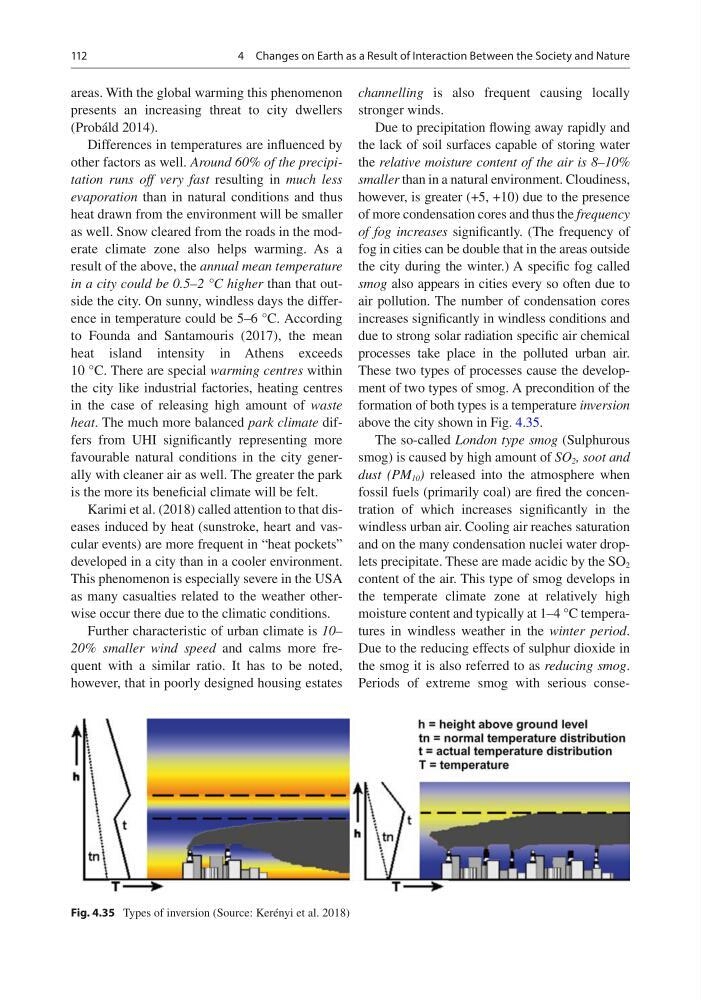
These two types of processes cause the development of two types of smog. A precondition of the
formation of both types is a temperature inversion
above the city shown in Fig. 4.35.
The so-called London type smog (Sulphurous
smog) is caused by high amount of SO 2 , soot and
dust (PM 10 ) released into the atmosphere when
fossil fuels (primarily coal) are fired the concentration of which increases significantly in the
windless urban air. Cooling air reaches saturation
and on the many condensation nuclei water droplets precipitate. These are made acidic by the SO 2
content of the air. This type of smog develops in
the temperate climate zone at relatively high
moisture content and typically at 1–4 °C temperatures in windless weather in the winter period.
Due to the reducing effects of sulphur dioxide in
the smog it is also referred to as reducing smog.
Periods of extreme smog with serious conseFig. 4.35 Types of inversion (Source: Kerényi et al. 2018)
4 Changes on Earth as a Result of Interaction Between the Society and Nature
areas. With the global warming this phenomenon
presents an increasing threat to city dwellers
(Probáld 2014).
Differences in temperatures are influenced by
other factors as well. Around 60% of the precipitation runs off very fast resulting in much less
evaporation than in natural conditions and thus
heat drawn from the environment will be smaller
as well. Snow cleared from the roads in the moderate climate zone also helps warming. As a
result of the above, the annual mean temperature
in a city could be 0.5–2 °C higher than that outside the city. On sunny, windless days the difference in temperature could be 5–6 °C. According
to Founda and Santamouris (2017), the mean
heat island intensity in Athens exceeds
10 °C. There are special warming centres within
the city like industrial factories, heating centres
in the case of releasing high amount of waste
heat. The much more balanced park climate differs from UHI significantly representing more
favourable natural conditions in the city generally with cleaner air as well. The greater the park
is the more its beneficial climate will be felt.
Karimi et al. (2018) called attention to that diseases induced by heat (sunstroke, heart and vascular events) are more frequent in “heat pockets”
developed in a city than in a cooler environment.
This phenomenon is especially severe in the USA
as many casualties related to the weather otherwise occur there due to the climatic conditions.
Further characteristic of urban climate is 10–
20% smaller wind speed and calms more frequent with a similar ratio. It has to be noted,
however, that in poorly designed housing estates
channelling is also frequent causing locally
stronger winds.
Due to precipitation flowing away rapidly and
the lack of soil surfaces capable of storing water
the relative moisture content of the air is 8–10%
smaller than in a natural environment. Cloudiness,
however, is greater (+5, +10) due to the presence
of more condensation cores and thus the frequency
of fog increases significantly. (The frequency of
fog in cities can be double that in the areas outside
the city during the winter.) A specific fog called
smog also appears in cities every so often due to
air pollution. The number of condensation cores
increases significantly in windless conditions and
due to strong solar radiation specific air chemical
processes take place in the polluted urban air.
These two types of processes cause the development of two types of smog. A precondition of the
formation of both types is a temperature inversion
above the city shown in Fig. 4.35.
The so-called London type smog (Sulphurous
smog) is caused by high amount of SO 2 , soot and
dust (PM 10 ) released into the atmosphere when
fossil fuels (primarily coal) are fired the concentration of which increases significantly in the
windless urban air. Cooling air reaches saturation
and on the many condensation nuclei water droplets precipitate. These are made acidic by the SO 2
content of the air. This type of smog develops in
the temperate climate zone at relatively high
moisture content and typically at 1–4 °C temperatures in windless weather in the winter period.
Due to the reducing effects of sulphur dioxide in
the smog it is also referred to as reducing smog.
Periods of extreme smog with serious conseFig. 4.35 Types of inversion (Source: Kerényi et al. 2018)
4 Changes on Earth as a Result of Interaction Between the Society and Nature