

110
Green surfaces are islands for life in a city.
Although their species composition is far from
that of natural ecological systems, their presence
in a settlement is beneficial in any case. Parks are
good for human nerves as well according to psychologists. A relaxing walk in the park nearby
after
work
is
especially
favourable
psychologically.
The above also suggests that the location of
the green surfaces, primarily that of parks with
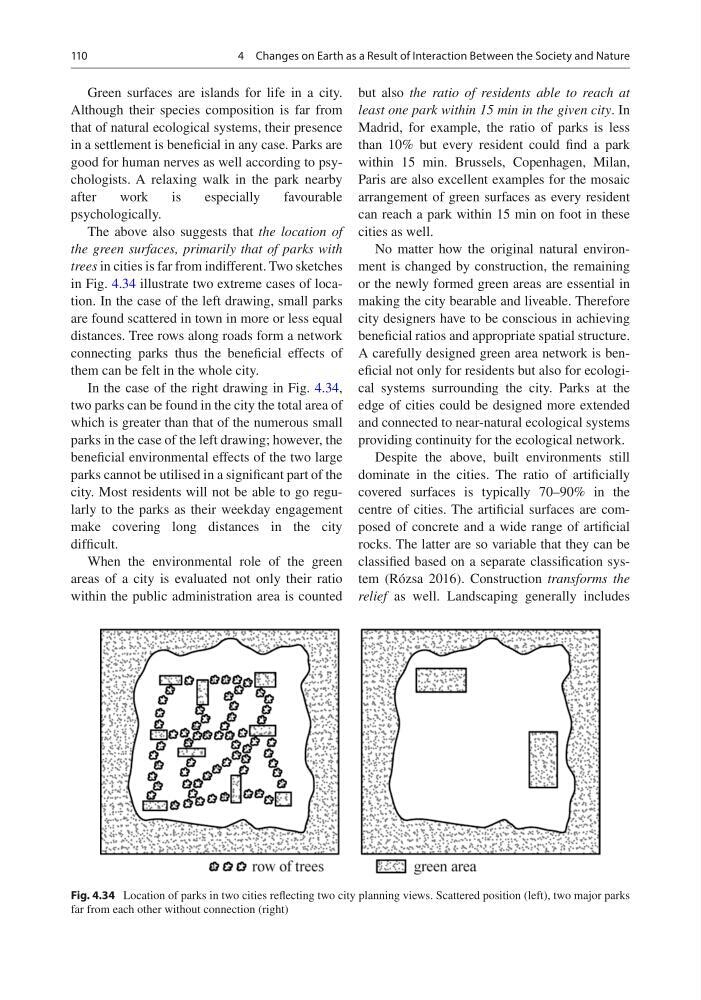
trees in cities is far from indifferent. Two sketches
in Fig. 4.34 illustrate two extreme cases of location. In the case of the left drawing, small parks
are found scattered in town in more or less equal
distances. Tree rows along roads form a network
connecting parks thus the beneficial effects of
them can be felt in the whole city.
In the case of the right drawing in Fig. 4.34,
two parks can be found in the city the total area of
which is greater than that of the numerous small
parks in the case of the left drawing; however, the
beneficial environmental effects of the two large
parks cannot be utilised in a significant part of the
city. Most residents will not be able to go regularly to the parks as their weekday engagement
make covering long distances in the city
difficult.
When the environmental role of the green
areas of a city is evaluated not only their ratio
within the public administration area is counted
but also the ratio of residents able to reach at
least one park within 15 min in the given city. In
Madrid, for example, the ratio of parks is less
than 10% but every resident could find a park
within 15 min. Brussels, Copenhagen, Milan,
Paris are also excellent examples for the mosaic
arrangement of green surfaces as every resident
can reach a park within 15 min on foot in these
cities as well.
No matter how the original natural environment is changed by construction, the remaining
or the newly formed green areas are essential in
making the city bearable and liveable. Therefore
city designers have to be conscious in achieving
beneficial ratios and appropriate spatial structure.
A carefully designed green area network is beneficial not only for residents but also for ecological systems surrounding the city. Parks at the
edge of cities could be designed more extended
and connected to near-natural ecological systems
providing continuity for the ecological network.
Despite the above, built environments still
dominate in the cities. The ratio of artificially
covered surfaces is typically 70–90% in the
centre of cities. The artificial surfaces are composed of concrete and a wide range of artificial
rocks. The latter are so variable that they can be
classified based on a separate classification system (Rózsa 2016). Construction transforms the
relief as well. Landscaping generally includes
Fig. 4.34 Location of parks in two cities reflecting two city planning views. Scattered position (left), two major parks
far from each other without connection (right)
4 Changes on Earth as a Result of Interaction Between the Society and Nature
Green surfaces are islands for life in a city.
Although their species composition is far from
that of natural ecological systems, their presence
in a settlement is beneficial in any case. Parks are
good for human nerves as well according to psychologists. A relaxing walk in the park nearby
after
work
is
especially
favourable
psychologically.
The above also suggests that the location of
the green surfaces, primarily that of parks with
trees in cities is far from indifferent. Two sketches
in Fig. 4.34 illustrate two extreme cases of location. In the case of the left drawing, small parks
are found scattered in town in more or less equal
distances. Tree rows along roads form a network
connecting parks thus the beneficial effects of
them can be felt in the whole city.
In the case of the right drawing in Fig. 4.34,
two parks can be found in the city the total area of
which is greater than that of the numerous small
parks in the case of the left drawing; however, the
beneficial environmental effects of the two large
parks cannot be utilised in a significant part of the
city. Most residents will not be able to go regularly to the parks as their weekday engagement
make covering long distances in the city
difficult.
When the environmental role of the green
areas of a city is evaluated not only their ratio
within the public administration area is counted
but also the ratio of residents able to reach at
least one park within 15 min in the given city. In
Madrid, for example, the ratio of parks is less
than 10% but every resident could find a park
within 15 min. Brussels, Copenhagen, Milan,
Paris are also excellent examples for the mosaic
arrangement of green surfaces as every resident
can reach a park within 15 min on foot in these
cities as well.
No matter how the original natural environment is changed by construction, the remaining
or the newly formed green areas are essential in
making the city bearable and liveable. Therefore
city designers have to be conscious in achieving
beneficial ratios and appropriate spatial structure.
A carefully designed green area network is beneficial not only for residents but also for ecological systems surrounding the city. Parks at the
edge of cities could be designed more extended
and connected to near-natural ecological systems
providing continuity for the ecological network.
Despite the above, built environments still
dominate in the cities. The ratio of artificially
covered surfaces is typically 70–90% in the
centre of cities. The artificial surfaces are composed of concrete and a wide range of artificial
rocks. The latter are so variable that they can be
classified based on a separate classification system (Rózsa 2016). Construction transforms the
relief as well. Landscaping generally includes
Fig. 4.34 Location of parks in two cities reflecting two city planning views. Scattered position (left), two major parks
far from each other without connection (right)
4 Changes on Earth as a Result of Interaction Between the Society and Nature