

Viruses and Some Other Proven and Suspected Foodborne Biohazards 729
and dried pepperoni and salami sausages were prepared; whereas virus was not recovered from the
partly cooked canned hams, they were recovered from hams after brining but not after heating. The
ASFV retained viability in the two sausage products following the addition of curing ingredients and
starters but were negative after 30 days. HCV also survived the addition of curing ingredients and
starter and retained viability even after 22 days.
The effect of heating on destruction of the foot-and-mouth virus was evaluated by Blackwell et al.
8
When ground beef was contaminated with virus-infected lymph node tissue and processed to an
internal temperature of 93.3
◦ C, the virus was destroyed. However, in cattle lymph node tissue, the
virus survived for 15 but not 30 minutes at 90
◦ C. In another study, the thermal destruction of foot-andmouth disease virus (FMDV) along with two others was achieved within 3 minutes at 67
◦ C, or at 3
minutes at 60
◦ C or 62
◦ C in a pig slurry.
108 The boiling of crabs was found sufficient to inactivate 99.9%
of poliovirus 1, and a rotavirus and an echovirus were destroyed within 8 minutes.
47 A poliovirus was
found to survive stewing, frying, baking, and steaming of oysters.
33 In broiled hamburgers, enteric
viruses could be recovered from 8 of 24 patties cooked rare (to 60
◦ C internally) if the patties were
cooled immediately to 23
◦ C.
99 No viruses were detected if the patties were allowed to cool for 3
minutes at room temperature before testing.
Hepatitis A Virus
Prior to the 1990s, there were more documented outbreaks of hepatitis A traced to foods than
any other viral infection. The virus belongs to the family Picornaviridae, as do the polio, echo, and
coxsackie viruses, and all have single-stranded RNA (ss RNA) genomes. The incubation period for
infectious hepatitis ranges from 15 to 45 days, and lifetime immunity usually occurs after an attack.
The fecal–oral route is the mode of transmission, and raw or partially cooked shellfish from polluted
waters is the most common vehicle food.
In the United States in 1973, 1974, and 1975, there were 5, 6, and 3 outbreaks, respectively, with 425,
282, and 173 cases. The 1975 outbreaks were traced to salad, sandwiches, and glazed doughnuts served
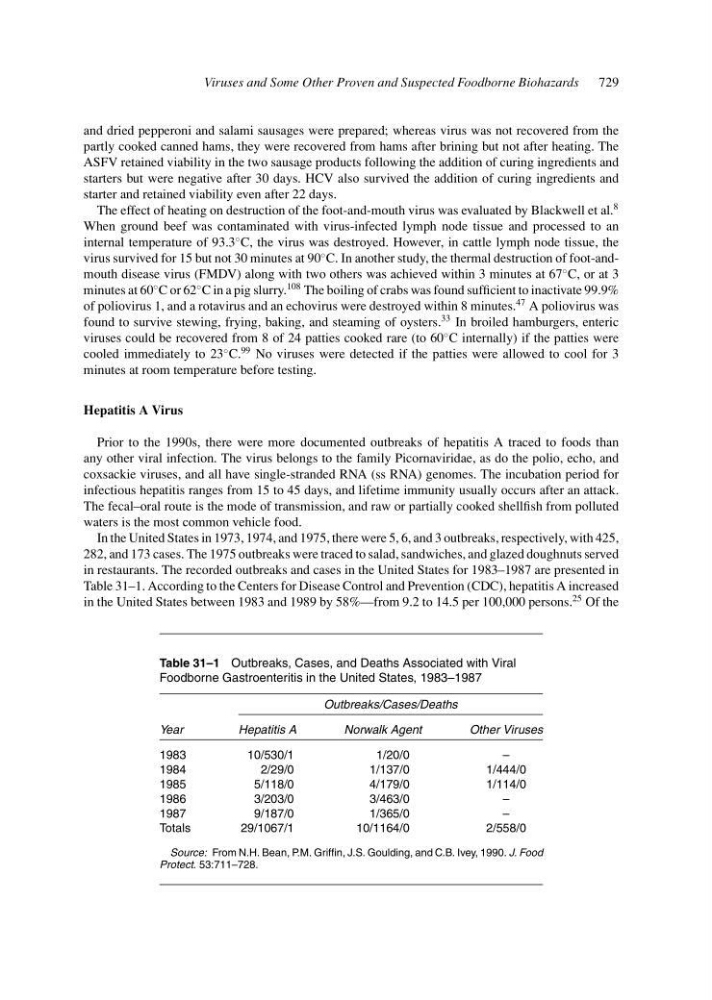
in restaurants. The recorded outbreaks and cases in the United States for 1983–1987 are presented in
Table 31–1. According to the Centers for Disease Control and Prevention (CDC), hepatitis A increased
in the United States between 1983 and 1989 by 58%—from 9.2 to 14.5 per 100,000 persons.
25 Of the
Table 31–1 Outbreaks, Cases, and Deaths Associated with Viral
Foodborne Gastroenteritis in the United States, 1983–1987
Outbreaks/Cases/Deaths
Year
Hepatitis A
Norwalk Agent
Other Viruses
1983
10/530/1
1/20/0
–
1984
2/29/0
1/137/0
1/444/0
1985
5/118/0
4/179/0
1/114/0
1986
3/203/0
3/463/0
–
1987
9/187/0
1/365/0
–
Totals
29/1067/1
10/1164/0
2/558/0
Source: From N.H. Bean, P.M. Griffin, J.S. Goulding, and C.B. Ivey, 1990. J. Food
Protect. 53:711–728.