

710 Modern Food Microbiology
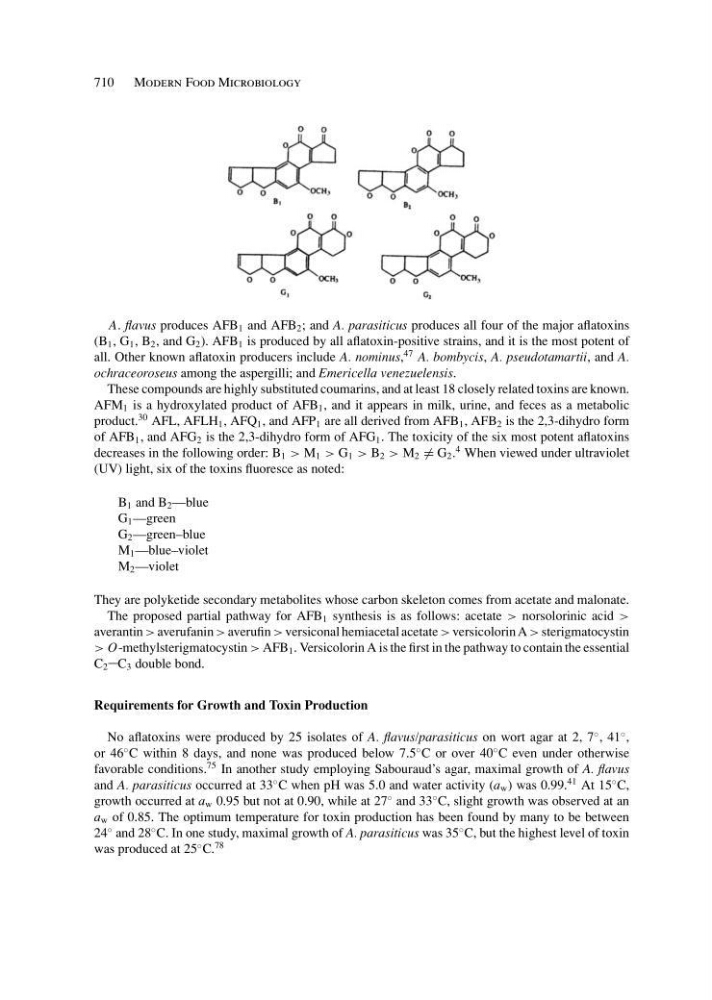
A. flavus produces AFB 1 and AFB 2 ; and A. parasiticus produces all four of the major aflatoxins
(B 1 , G 1 , B 2 , and G 2 ). AFB 1 is produced by all aflatoxin-positive strains, and it is the most potent of
all. Other known aflatoxin producers include A. nominus,
47 A. bombycis, A. pseudotamartii, and A.
ochraceoroseus among the aspergilli; and Emericella venezuelensis.
These compounds are highly substituted coumarins, and at least 18 closely related toxins are known.
AFM 1 is a hydroxylated product of AFB 1 , and it appears in milk, urine, and feces as a metabolic
product.
30 AFL, AFLH 1 , AFQ 1 , and AFP 1 are all derived from AFB 1 , AFB 2 is the 2,3-dihydro form
of AFB 1 , and AFG 2 is the 2,3-dihydro form of AFG 1 . The toxicity of the six most potent aflatoxins
decreases in the following order: B 1 > M 1 > G 1 > B 2 > M 2 = G 2 .
4 When viewed under ultraviolet
(UV) light, six of the toxins fluoresce as noted:
B 1 and B 2 —blue
G 1 —green
G 2 —green–blue
M 1 —blue–violet
M 2 —violet
They are polyketide secondary metabolites whose carbon skeleton comes from acetate and malonate.
The proposed partial pathway for AFB 1 synthesis is as follows: acetate > norsolorinic acid >
averantin > averufanin > averufin > versiconal hemiacetal acetate > versicolorin A > sterigmatocystin
> O-methylsterigmatocystin > AFB 1 . Versicolorin A is the first in the pathway to contain the essential
C 2 C 3 double bond.
Requirements for Growth and Toxin Production
No aflatoxins were produced by 25 isolates of A. flavus/parasiticus on wort agar at 2, 7
◦ , 41
◦ ,
or 46
◦ C within 8 days, and none was produced below 7.5
◦ C or over 40
◦ C even under otherwise
favorable conditions.
75 In another study employing Sabouraud’s agar, maximal growth of A. flavus
and A. parasiticus occurred at 33
◦ C when pH was 5.0 and water activity (a w ) was 0.99.
41 At 15
◦ C,
growth occurred at a w 0.95 but not at 0.90, while at 27
◦ and 33
◦ C, slight growth was observed at an
a w of 0.85. The optimum temperature for toxin production has been found by many to be between
24
◦ and 28
◦ C. In one study, maximal growth of A. parasiticus was 35
◦ C, but the highest level of toxin
was produced at 25
◦ C.
78