

Intrinsic and Extrinsic Parameters of Foods That Affect Microbial Growth
55
With regard to bacteria, psychrotrophic species and strains are found among the following genera
of those presented in Chapter 2: Alcaligenes, Shewanella, Brochothrix, Corynebacterium, Flavobacterium, Lactobacillus, Micrococcus, Pectobacterium, Pseudomonas, Psychrobacter, Enterococcus,
and others. The psychrotrophs found most commonly on foods are those that belong to the genera
Pseudomonas and Enterococcus (see Chapter 16). These organisms grow well at refrigerator temperatures and cause spoilage at 5–7
◦ C of meats, fish, poultry, eggs, and other foods normally held at
this temperature. Standard plate counts of viable organisms on such foods are generally higher when
the plates are incubated at about 7
◦ C for at least 7 days than when incubated at 30
◦ C and above.
Mesophilic species and strains are known among all genera presented in Chapter 2 and may be found
on foods held at refrigerator temperatures. They apparently do not grow at this temperature but do grow
at temperatures within the mesophilic range if other conditions are suitable. It should be pointed out
that some organisms can grow over a range from 0
◦ C to >40
◦ C. One such organism is Enterococcus
faecalis.
Most thermophilic bacteria of importance in foods belong to the genera Bacillus, Paenibacillus,
Clostridium, Geobacillus, Alicyclobacillus, and Thermoanaerobacter. Although not all species of these
genera are thermophilic, they are of great interest to the food microbiologist and food technologist in
the canning industry.
Just as molds are able to grow over wider ranges of pH, osmotic pressure, and nutrient content, they
are also able to grow over wide ranges of temperature as do bacteria. Many molds are able to grow
at refrigerator temperatures, notably some strains of Aspergillus, Cladosporium, and Thamnidium,
which may be found growing on eggs, sides of beef, and fruits. Yeasts grow over the psychrotrophic
and mesophilic temperature ranges but generally not within the thermophilic range.
The quality of the food product must also be taken into account in selecting a storage temperature.
Although it would seem desirable to store all foods at refrigerator temperatures or below, this is not
always best for the maintenance of desirable quality in some foods. For example, bananas keep better
if stored at 13–17
◦ C than at 5–7
◦ C. A large number of vegetables are favored by temperatures of about
10
◦ C, including potatoes, celery, cabbage, and many others. In every case, the success of storage
temperature depends to a great extent upon the relative humidity (RH) of the storage environment and
the presence or absence of gases such as CO 2 and O 3 .
Temperature of storage is the most important parameter that affects the spoilage of highly perishable
foods, and this fact has been emphasized by the work of Olley and Ratkowsky and their co-workers.
According to these investigators, spoilage can be predicted by a spoilage rate curve.
34 The general
spoilage curve has been incorporated into the circuitry of a temperature function integrator that reads
out the equivalent days of storage at 0
◦ C and thus makes it possible to predict the remaining shelf life
at 0
◦ C. It has been shown that the rate of spoilage of fresh poultry at 10
◦ C is about twice that at 5
◦ C,
and that at 15
◦ C is about three times that at 5
◦ C.
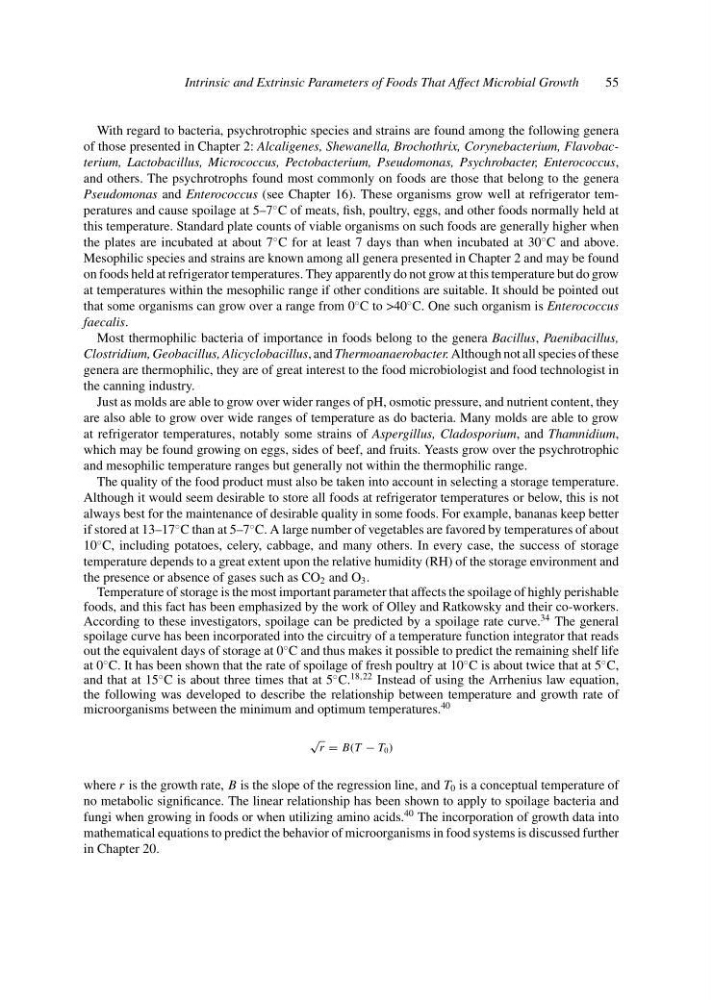
18,22 Instead of using the Arrhenius law equation,
the following was developed to describe the relationship between temperature and growth rate of
microorganisms between the minimum and optimum temperatures.
40
√
r = B(T − T 0 )
where r is the growth rate, B is the slope of the regression line, and T 0 is a conceptual temperature of
no metabolic significance. The linear relationship has been shown to apply to spoilage bacteria and
fungi when growing in foods or when utilizing amino acids.
40 The incorporation of growth data into
mathematical equations to predict the behavior of microorganisms in food systems is discussed further
in Chapter 20.
55
With regard to bacteria, psychrotrophic species and strains are found among the following genera
of those presented in Chapter 2: Alcaligenes, Shewanella, Brochothrix, Corynebacterium, Flavobacterium, Lactobacillus, Micrococcus, Pectobacterium, Pseudomonas, Psychrobacter, Enterococcus,
and others. The psychrotrophs found most commonly on foods are those that belong to the genera
Pseudomonas and Enterococcus (see Chapter 16). These organisms grow well at refrigerator temperatures and cause spoilage at 5–7
◦ C of meats, fish, poultry, eggs, and other foods normally held at
this temperature. Standard plate counts of viable organisms on such foods are generally higher when
the plates are incubated at about 7
◦ C for at least 7 days than when incubated at 30
◦ C and above.
Mesophilic species and strains are known among all genera presented in Chapter 2 and may be found
on foods held at refrigerator temperatures. They apparently do not grow at this temperature but do grow
at temperatures within the mesophilic range if other conditions are suitable. It should be pointed out
that some organisms can grow over a range from 0
◦ C to >40
◦ C. One such organism is Enterococcus
faecalis.
Most thermophilic bacteria of importance in foods belong to the genera Bacillus, Paenibacillus,
Clostridium, Geobacillus, Alicyclobacillus, and Thermoanaerobacter. Although not all species of these
genera are thermophilic, they are of great interest to the food microbiologist and food technologist in
the canning industry.
Just as molds are able to grow over wider ranges of pH, osmotic pressure, and nutrient content, they
are also able to grow over wide ranges of temperature as do bacteria. Many molds are able to grow
at refrigerator temperatures, notably some strains of Aspergillus, Cladosporium, and Thamnidium,
which may be found growing on eggs, sides of beef, and fruits. Yeasts grow over the psychrotrophic
and mesophilic temperature ranges but generally not within the thermophilic range.
The quality of the food product must also be taken into account in selecting a storage temperature.
Although it would seem desirable to store all foods at refrigerator temperatures or below, this is not
always best for the maintenance of desirable quality in some foods. For example, bananas keep better
if stored at 13–17
◦ C than at 5–7
◦ C. A large number of vegetables are favored by temperatures of about
10
◦ C, including potatoes, celery, cabbage, and many others. In every case, the success of storage
temperature depends to a great extent upon the relative humidity (RH) of the storage environment and
the presence or absence of gases such as CO 2 and O 3 .
Temperature of storage is the most important parameter that affects the spoilage of highly perishable
foods, and this fact has been emphasized by the work of Olley and Ratkowsky and their co-workers.
According to these investigators, spoilage can be predicted by a spoilage rate curve.
34 The general
spoilage curve has been incorporated into the circuitry of a temperature function integrator that reads
out the equivalent days of storage at 0
◦ C and thus makes it possible to predict the remaining shelf life
at 0
◦ C. It has been shown that the rate of spoilage of fresh poultry at 10
◦ C is about twice that at 5
◦ C,
and that at 15
◦ C is about three times that at 5
◦ C.
18,22 Instead of using the Arrhenius law equation,
the following was developed to describe the relationship between temperature and growth rate of
microorganisms between the minimum and optimum temperatures.
40
√
r = B(T − T 0 )
where r is the growth rate, B is the slope of the regression line, and T 0 is a conceptual temperature of
no metabolic significance. The linear relationship has been shown to apply to spoilage bacteria and
fungi when growing in foods or when utilizing amino acids.
40 The incorporation of growth data into
mathematical equations to predict the behavior of microorganisms in food systems is discussed further
in Chapter 20.