

Foodborne Animal Parasites 703
the mucosa. Anisakis is most often found in cases in Japan and the Netherlands; Pseudoterranova is
more often seen in North America.
Symptoms, Diagnosis, and Treatment
Symptoms of human anisakiasis may develop within 4–6 hours after consumption of infested fish, and
they consist of epigastric pain, nausea, and vomiting. In more severe cases, fever and bloody stools may
occur within 7 days after ingesting infective fish. If the worms penetrate the mucosa, an eosinophilic
granuloma may develop, or they may penetrate the gut wall and cause peritonitis. However, in the 23
North American cases through 1982, only 5 were caused by Anisakis sp., and only transient infection
occurred.
60 Among the four cases reported by Kliks,
60 symptoms consisted of mild stomach pain and
nausea from the time of ingestion up to 20 hours later, and worms were coughed up or found in the
mouth up to 2 weeks after consumption of the infective raw salmon.
The diagnosis of this syndrome is made difficult by the absence of eggs or other parts of the worms in
feces. Larvae in the intestinal tract can be viewed by endoscopy, and surgical resection of the affected
tissue can be carried out. Complement fixation and indirect immunofluorescence tests are of some
diagnostic value. Thiabendazole is an effective chemotherapeutic agent for treating this disease.
Prevalence and Distribution
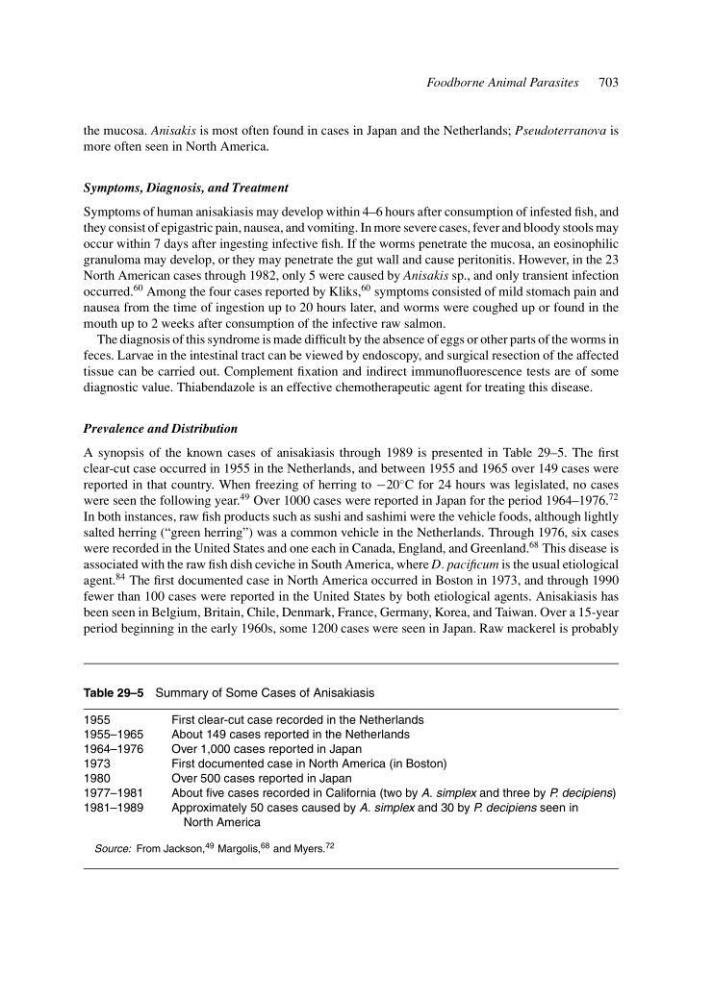
A synopsis of the known cases of anisakiasis through 1989 is presented in Table 29–5. The first
clear-cut case occurred in 1955 in the Netherlands, and between 1955 and 1965 over 149 cases were
reported in that country. When freezing of herring to −20
◦ C for 24 hours was legislated, no cases
were seen the following year.
49 Over 1000 cases were reported in Japan for the period 1964–1976.
72
In both instances, raw fish products such as sushi and sashimi were the vehicle foods, although lightly
salted herring (“green herring”) was a common vehicle in the Netherlands. Through 1976, six cases
were recorded in the United States and one each in Canada, England, and Greenland.
68 This disease is
associated with the raw fish dish ceviche in South America, where D. pacificum is the usual etiological
agent.
84 The first documented case in North America occurred in Boston in 1973, and through 1990
fewer than 100 cases were reported in the United States by both etiological agents. Anisakiasis has
been seen in Belgium, Britain, Chile, Denmark, France, Germany, Korea, and Taiwan. Over a 15-year
period beginning in the early 1960s, some 1200 cases were seen in Japan. Raw mackerel is probably
Table 29–5 Summary of Some Cases of Anisakiasis
1955
First clear-cut case recorded in the Netherlands
1955–1965
About 149 cases reported in the Netherlands
1964–1976
Over 1,000 cases reported in Japan
1973
First documented case in North America (in Boston)
1980
Over 500 cases reported in Japan
1977–1981
About five cases recorded in California (two by A. simplex and three by P. decipiens)
1981–1989
Approximately 50 cases caused by A. simplex and 30 by P. decipiens seen in
North America
Source: From Jackson, 49 Margolis, 68 and Myers. 72