

Foodborne Animal Parasites 701
Table 29–4 Required Period of Freezing at Temperatures
Indicated
Temperature (
◦ C)
Group 1 (days)
Group 2 (days)
−15
20
30
−23
10
20
−29
6
12
Note: Group 1 = less than 15.24 cm in depth; group 2 = more
than 15.24 cm in depth. From Sec. 18.10. Regulations Governing
the Meat Inspection of the United States Department of Agriculture
(9 CFR 18.10, 1960).
Source: From A.W. Kotula, K.D. Murrell, L. Acosta-Stein, L. Lamb,
and L. Douglass. J. Food Sci. 48:765–768; copyright c
1983 by
Institute of Food Technologists.
was evaluated by Childers et al.
20 Pork from experimentally infected pigs was used to prepare salami.
The trichinae larvae were completely destroyed at day 30 and thereafter in salami made with 3.33%
NaCl and given high-temperature (46.1
◦ C) fermentation treatment, irrespective of product pH. No
larvae were found in products made with 3.33% NaCl and given low-temperature fermentation after
30 days. In salami made with no salt, 25% of larvae were found at days 15–25, but none thereafter.
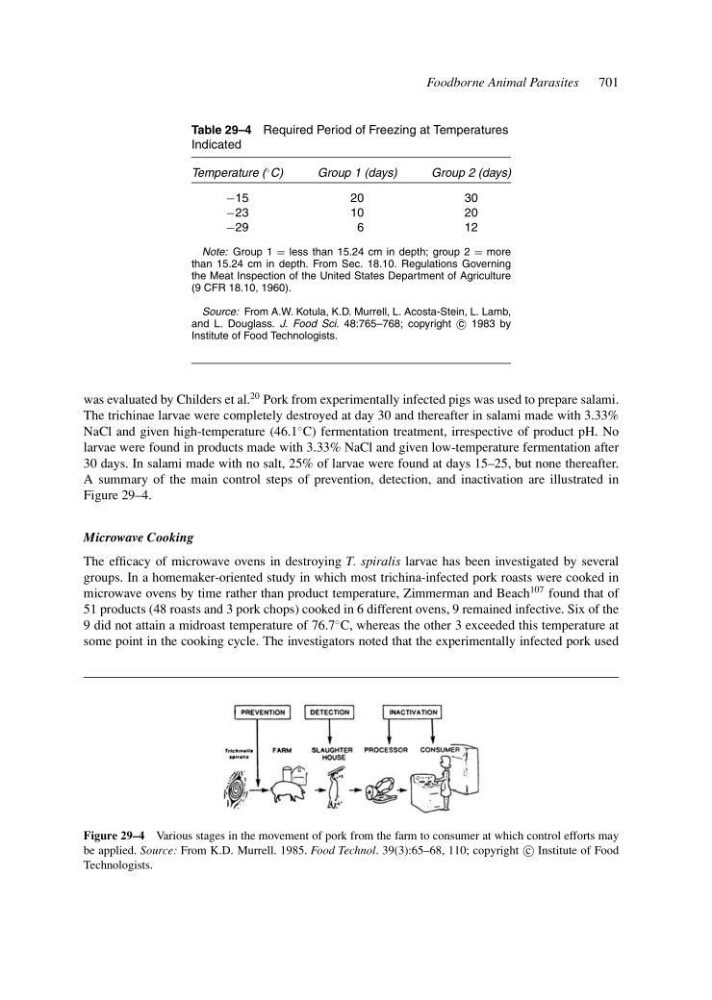
A summary of the main control steps of prevention, detection, and inactivation are illustrated in
Figure 29–4.
Microwave Cooking
The efficacy of microwave ovens in destroying T. spiralis larvae has been investigated by several
groups. In a homemaker-oriented study in which most trichina-infected pork roasts were cooked in
microwave ovens by time rather than product temperature, Zimmerman and Beach
107 found that of
51 products (48 roasts and 3 pork chops) cooked in 6 different ovens, 9 remained infective. Six of the
9 did not attain a midroast temperature of 76.7
◦ C, whereas the other 3 exceeded this temperature at
some point in the cooking cycle. The investigators noted that the experimentally infected pork used
Figure 29–4 Various stages in the movement of pork from the farm to consumer at which control efforts may
be applied. Source: From K.D. Murrell. 1985. Food Technol. 39(3):65–68, 110; copyright c
Institute of Food
Technologists.