

698 Modern Food Microbiology
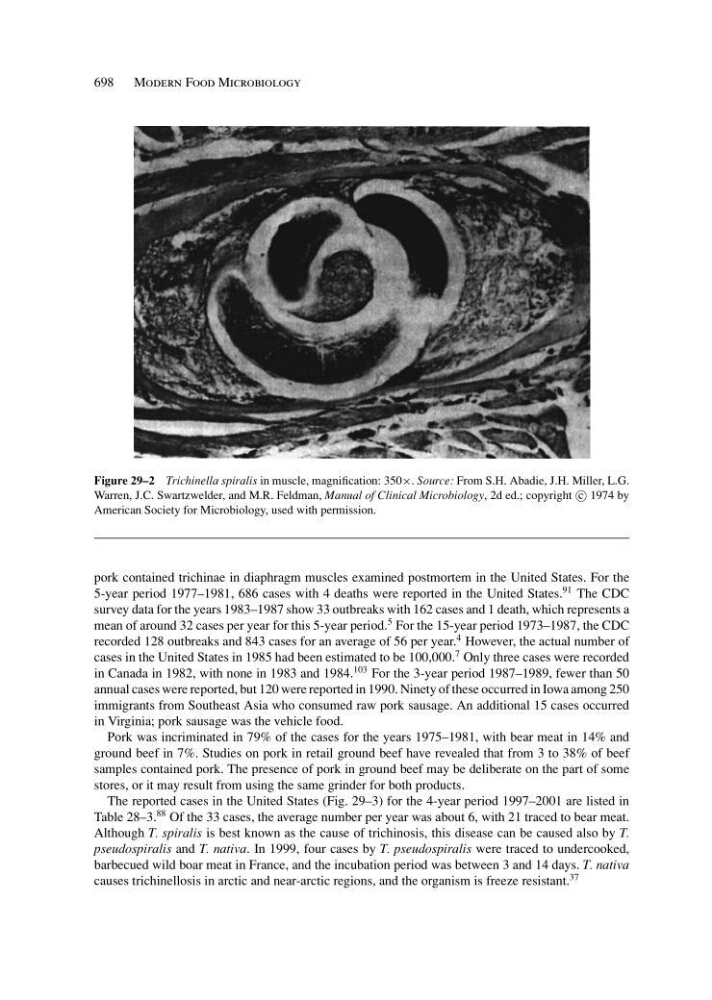
Figure 29–2 Trichinella spiralis in muscle, magnification: 350×. Source: From S.H. Abadie, J.H. Miller, L.G.
Warren, J.C. Swartzwelder, and M.R. Feldman, Manual of Clinical Microbiology, 2d ed.; copyright c
1974 by
American Society for Microbiology, used with permission.
pork contained trichinae in diaphragm muscles examined postmortem in the United States. For the
5-year period 1977–1981, 686 cases with 4 deaths were reported in the United States.
91 The CDC
survey data for the years 1983–1987 show 33 outbreaks with 162 cases and 1 death, which represents a
mean of around 32 cases per year for this 5-year period.
5 For the 15-year period 1973–1987, the CDC
recorded 128 outbreaks and 843 cases for an average of 56 per year.
4 However, the actual number of
cases in the United States in 1985 had been estimated to be 100,000.
7 Only three cases were recorded
in Canada in 1982, with none in 1983 and 1984.
103 For the 3-year period 1987–1989, fewer than 50
annual cases were reported, but 120 were reported in 1990. Ninety of these occurred in Iowa among 250
immigrants from Southeast Asia who consumed raw pork sausage. An additional 15 cases occurred
in Virginia; pork sausage was the vehicle food.
Pork was incriminated in 79% of the cases for the years 1975–1981, with bear meat in 14% and
ground beef in 7%. Studies on pork in retail ground beef have revealed that from 3 to 38% of beef
samples contained pork. The presence of pork in ground beef may be deliberate on the part of some
stores, or it may result from using the same grinder for both products.
The reported cases in the United States (Fig. 29–3) for the 4-year period 1997–2001 are listed in
Table 28–3.
88 Of the 33 cases, the average number per year was about 6, with 21 traced to bear meat.
Although T. spiralis is best known as the cause of trichinosis, this disease can be caused also by T.
pseudospiralis and T. nativa. In 1999, four cases by T. pseudospiralis were traced to undercooked,
barbecued wild boar meat in France, and the incubation period was between 3 and 14 days. T. nativa
causes trichinellosis in arctic and near-arctic regions, and the organism is freeze resistant.
37