

Foodborne Gastroenteritis Caused by Vibrio, Yersinia, and Campylobacter Species 667
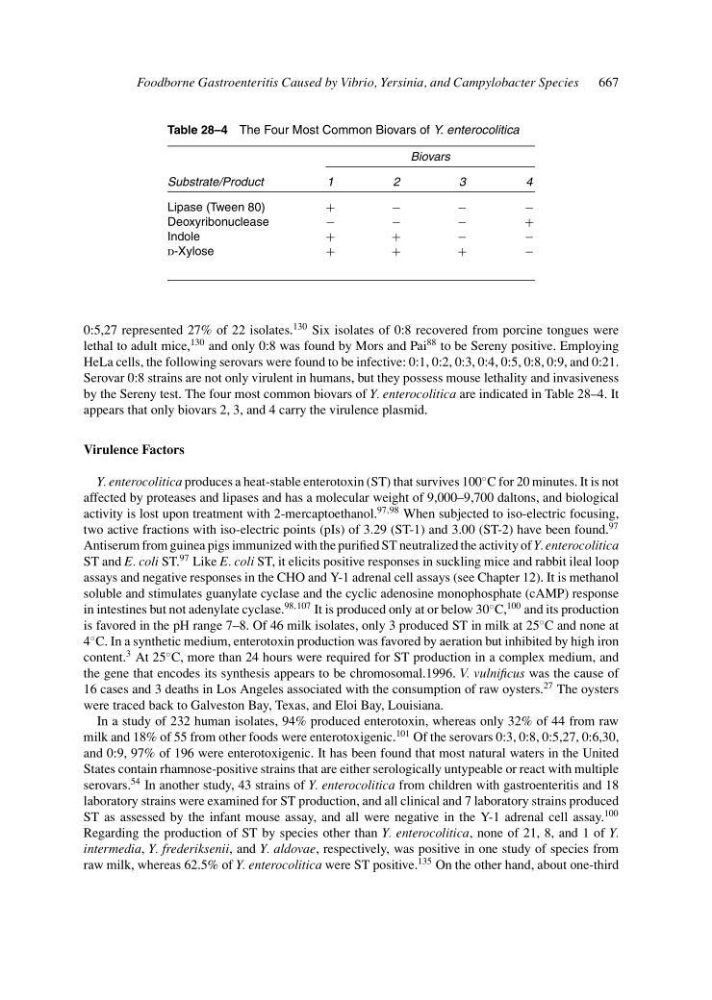
Table 28–4 The Four Most Common Biovars of Y. enterocolitica
Biovars
Substrate/Product
1
2
3
4
Lipase (Tween 80)
+
−
−
−
Deoxyribonuclease
−
−
−
+
Indole
+
+
−
−
d-Xylose
+
+
+
−
0:5,27 represented 27% of 22 isolates.
130 Six isolates of 0:8 recovered from porcine tongues were
lethal to adult mice,
130 and only 0:8 was found by Mors and Pai
88 to be Sereny positive. Employing
HeLa cells, the following serovars were found to be infective: 0:1, 0:2, 0:3, 0:4, 0:5, 0:8, 0:9, and 0:21.
Serovar 0:8 strains are not only virulent in humans, but they possess mouse lethality and invasiveness
by the Sereny test. The four most common biovars of Y. enterocolitica are indicated in Table 28–4. It
appears that only biovars 2, 3, and 4 carry the virulence plasmid.
Virulence Factors
Y. enterocolitica produces a heat-stable enterotoxin (ST) that survives 100
◦ C for 20 minutes. It is not
affected by proteases and lipases and has a molecular weight of 9,000–9,700 daltons, and biological
activity is lost upon treatment with 2-mercaptoethanol.
97,98 When subjected to iso-electric focusing,
two active fractions with iso-electric points (pIs) of 3.29 (ST-1) and 3.00 (ST-2) have been found.
97
Antiserum from guinea pigs immunized with the purified ST neutralized the activity of Y. enterocolitica
ST and E. coli ST.
97 Like E. coli ST, it elicits positive responses in suckling mice and rabbit ileal loop
assays and negative responses in the CHO and Y-1 adrenal cell assays (see Chapter 12). It is methanol
soluble and stimulates guanylate cyclase and the cyclic adenosine monophosphate (cAMP) response
in intestines but not adenylate cyclase.
98,107 It is produced only at or below 30
◦ C,
100 and its production
is favored in the pH range 7–8. Of 46 milk isolates, only 3 produced ST in milk at 25
◦ C and none at
4
◦ C. In a synthetic medium, enterotoxin production was favored by aeration but inhibited by high iron
content.
3 At 25
◦ C, more than 24 hours were required for ST production in a complex medium, and
the gene that encodes its synthesis appears to be chromosomal.1996. V. vulnificus was the cause of
16 cases and 3 deaths in Los Angeles associated with the consumption of raw oysters.
27 The oysters
were traced back to Galveston Bay, Texas, and Eloi Bay, Louisiana.
In a study of 232 human isolates, 94% produced enterotoxin, whereas only 32% of 44 from raw
milk and 18% of 55 from other foods were enterotoxigenic.
101 Of the serovars 0:3, 0:8, 0:5,27, 0:6,30,
and 0:9, 97% of 196 were enterotoxigenic. It has been found that most natural waters in the United
States contain rhamnose-positive strains that are either serologically untypeable or react with multiple
serovars.
54 In another study, 43 strains of Y. enterocolitica from children with gastroenteritis and 18
laboratory strains were examined for ST production, and all clinical and 7 laboratory strains produced
ST as assessed by the infant mouse assay, and all were negative in the Y-1 adrenal cell assay.
100
Regarding the production of ST by species other than Y. enterocolitica, none of 21, 8, and 1 of Y.
intermedia, Y. frederiksenii, and Y. aldovae, respectively, was positive in one study of species from
raw milk, whereas 62.5% of Y. enterocolitica were ST positive.
135 On the other hand, about one-third