

Foodborne Gastroenteritis Caused by Vibrio, Yersinia, and Campylobacter Species 665
Table 28–3 Species of Yersinia Associated with Y. enterocolitica in the Environment and in Foods,
and Minimum Biochemical Differences Between Them
Species
VP
∗
Sucrose
Rhamnose
Raffinose
Melibiose
Y. enterocolitica
+
+
−
−
−
Y. kristensenii
−
−
−
−
−
Y. frederiksenii
+
+
+
−
−
Y. intermedia
+
+
+
+
+
Y. bercovieri
−
+
−
−
−
Y. mollaretti
−
+
−
−
−
VP = Voges–Proskauer reaction; + = positive reaction; − = negative reaction.
Y. enterocolitica. First isolated in New York State in 1933 by Coleman,
54 this Gram-negative rod is
somewhat unique in that it is motile below 30
◦ C but not at 37
◦ C. It produces colonies of 1.0 mm or
less on nutrient agar, is oxidase negative, ferments glucose with little or no gas, lacks phenylalanine
deaminase, is urease positive, and is unique as a pathogen in being psychrotrophic. It is often present
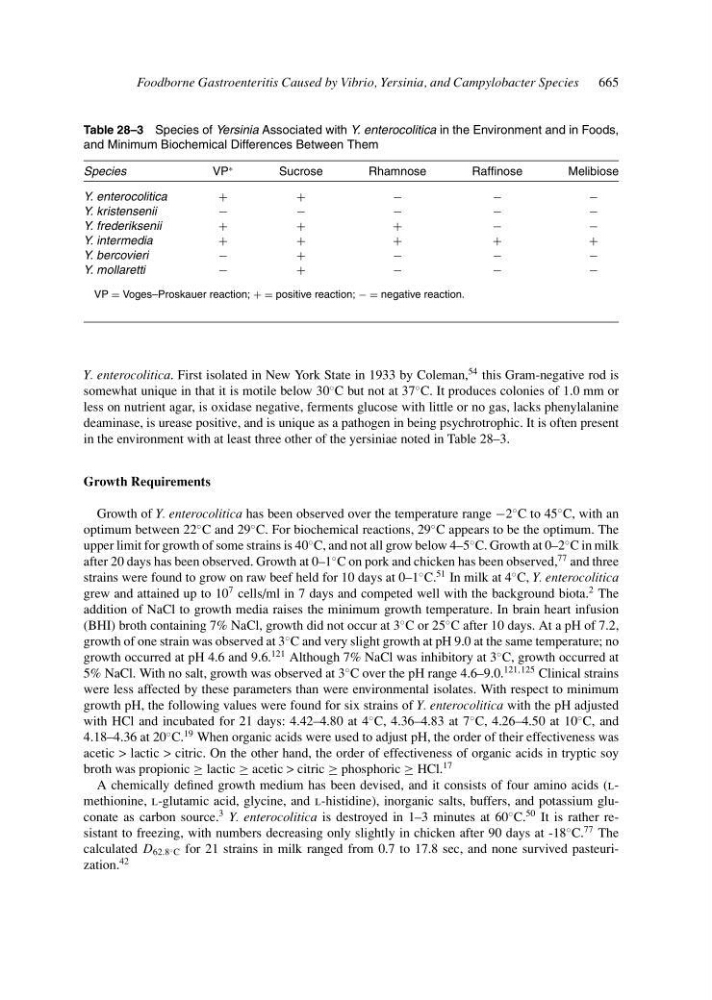
in the environment with at least three other of the yersiniae noted in Table 28–3.
Growth Requirements
Growth of Y. enterocolitica has been observed over the temperature range −2
◦ C to 45
◦ C, with an
optimum between 22
◦ C and 29
◦ C. For biochemical reactions, 29
◦ C appears to be the optimum. The
upper limit for growth of some strains is 40
◦ C, and not all grow below 4–5
◦ C. Growth at 0–2
◦ C in milk
after 20 days has been observed. Growth at 0–1
◦ C on pork and chicken has been observed,
77 and three
strains were found to grow on raw beef held for 10 days at 0–1
◦ C.
51 In milk at 4
◦ C, Y. enterocolitica
grew and attained up to 10
7 cells/ml in 7 days and competed well with the background biota.
2 The
addition of NaCl to growth media raises the minimum growth temperature. In brain heart infusion
(BHI) broth containing 7% NaCl, growth did not occur at 3
◦ C or 25
◦ C after 10 days. At a pH of 7.2,
growth of one strain was observed at 3
◦ C and very slight growth at pH 9.0 at the same temperature; no
growth occurred at pH 4.6 and 9.6.
121 Although 7% NaCl was inhibitory at 3
◦ C, growth occurred at
5% NaCl. With no salt, growth was observed at 3
◦ C over the pH range 4.6–9.0.
121,125 Clinical strains
were less affected by these parameters than were environmental isolates. With respect to minimum
growth pH, the following values were found for six strains of Y. enterocolitica with the pH adjusted
with HCl and incubated for 21 days: 4.42–4.80 at 4
◦ C, 4.36–4.83 at 7
◦ C, 4.26–4.50 at 10
◦ C, and
4.18–4.36 at 20
◦ C.
19 When organic acids were used to adjust pH, the order of their effectiveness was
acetic > lactic > citric. On the other hand, the order of effectiveness of organic acids in tryptic soy
broth was propionic ≥ lactic ≥ acetic > citric ≥ phosphoric ≥ HCl.
17
A chemically defined growth medium has been devised, and it consists of four amino acids (lmethionine, l-glutamic acid, glycine, and l-histidine), inorganic salts, buffers, and potassium gluconate as carbon source.
3 Y. enterocolitica is destroyed in 1–3 minutes at 60
◦ C.
50 It is rather resistant to freezing, with numbers decreasing only slightly in chicken after 90 days at -18
◦ C.
77 The
calculated D 62.8 ◦ C for 21 strains in milk ranged from 0.7 to 17.8 sec, and none survived pasteurization.
42