

658 Modern Food Microbiology
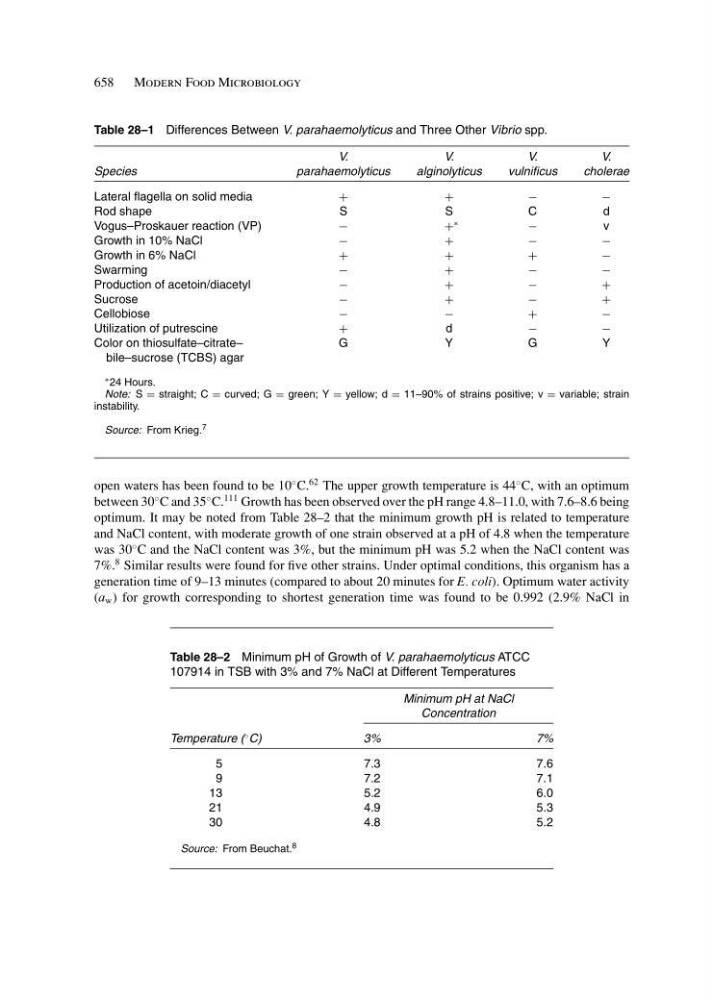
Table 28–1 Differences Between V. parahaemolyticus and Three Other Vibrio spp.
V.
V.
V.
V.
Species
parahaemolyticus
alginolyticus
vulnificus
cholerae
Lateral flagella on solid media
+
+
−
−
Rod shape
S
S
C
d
Vogus–Proskauer reaction (VP)
−
+
∗
−
v
Growth in 10% NaCl
−
+
−
−
Growth in 6% NaCl
+
+
+
−
Swarming
−
+
−
−
Production of acetoin/diacetyl
−
+
−
+
Sucrose
−
+
−
+
Cellobiose
−
−
+
−
Utilization of putrescine
+
d
−
−
Color on thiosulfate–citrate–
bile–sucrose (TCBS) agar
G
Y
G
Y
∗ 24 Hours.
Note: S = straight; C = curved; G = green; Y = yellow; d = 11–90% of strains positive; v = variable; strain
instability.
Source: From Krieg. 7
open waters has been found to be 10
◦ C.
62 The upper growth temperature is 44
◦ C, with an optimum
between 30
◦ C and 35
◦ C.
111 Growth has been observed over the pH range 4.8–11.0, with 7.6–8.6 being
optimum. It may be noted from Table 28–2 that the minimum growth pH is related to temperature
and NaCl content, with moderate growth of one strain observed at a pH of 4.8 when the temperature
was 30
◦ C and the NaCl content was 3%, but the minimum pH was 5.2 when the NaCl content was
7%.
8 Similar results were found for five other strains. Under optimal conditions, this organism has a
generation time of 9–13 minutes (compared to about 20 minutes for E. coli). Optimum water activity
(a w ) for growth corresponding to shortest generation time was found to be 0.992 (2.9% NaCl in
Table 28–2 Minimum pH of Growth of V. parahaemolyticus ATCC
107914 in TSB with 3% and 7% NaCl at Different Temperatures
Minimum pH at NaCl
Concentration
Temperature (
◦ C)
3%
7%
5
7.3
7.6
9
7.2
7.1
13
5.2
6.0
21
4.9
5.3
30
4.8
5.2
Source: From Beuchat. 8