

644 Modern Food Microbiology
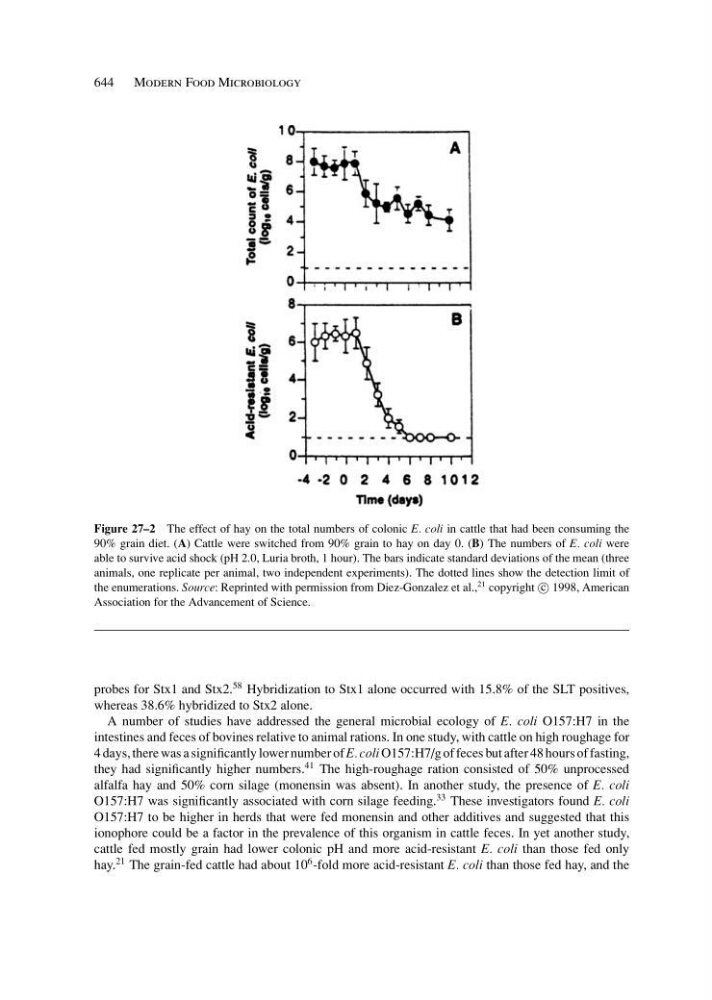
Figure 27–2 The effect of hay on the total numbers of colonic E. coli in cattle that had been consuming the
90% grain diet. (A) Cattle were switched from 90% grain to hay on day 0. (B) The numbers of E. coli were
able to survive acid shock (pH 2.0, Luria broth, 1 hour). The bars indicate standard deviations of the mean (three
animals, one replicate per animal, two independent experiments). The dotted lines show the detection limit of
the enumerations. Source: Reprinted with permission from Diez-Gonzalez et al.,
21 copyright c
1998, American
Association for the Advancement of Science.
probes for Stx1 and Stx2.
58 Hybridization to Stx1 alone occurred with 15.8% of the SLT positives,
whereas 38.6% hybridized to Stx2 alone.
A number of studies have addressed the general microbial ecology of E. coli O157:H7 in the
intestines and feces of bovines relative to animal rations. In one study, with cattle on high roughage for
4 days, there was a significantly lower number of E. coli O157:H7/g of feces but after 48 hours of fasting,
they had significantly higher numbers.
41 The high-roughage ration consisted of 50% unprocessed
alfalfa hay and 50% corn silage (monensin was absent). In another study, the presence of E. coli
O157:H7 was significantly associated with corn silage feeding.
33 These investigators found E. coli
O157:H7 to be higher in herds that were fed monensin and other additives and suggested that this
ionophore could be a factor in the prevalence of this organism in cattle feces. In yet another study,
cattle fed mostly grain had lower colonic pH and more acid-resistant E. coli than those fed only
hay.
21 The grain-fed cattle had about 10
6 -fold more acid-resistant E. coli than those fed hay, and the