

Foodborne Gastroenteritis Caused by Salmonella and Shigella
631
of S. Pullorum per chick, the chicks survived. However, chicks that were infected on the first day
and then treated with the lactic culture died four days later.
2 These authors concluded that the E.
faecium strain could prevent newly hatched chicks from S. Pullorum infections but it was not a good
therapeutic agent.
SHIGELLOSIS
The genus Shigella belongs to the family Enterobacteriaceae, as do the salmonellae and escherichiae.
Only four species are recognized: S. dysenteriae,S. flexneri,S. boydii, and S. sonnei. S. dysenteriae
is a primary pathogen that causes classic bacillary dysentery; as few as 10 cfu are known to initiate
infection in susceptible individuals. By applying data from two cruise ship outbreaks to a mathematical
model, it was estimated that the outbreaks could have been due to ingestion of a mean of 344 Shigella
cells per meal and 10.5 to 12 cells per glass of water.
17 Although this syndrome can be contracted
from foods, it is not considered to be a food-poisoning organism in the same sense as the other
three species, and it is not discussed further. Unlike the salmonellae and escherichiae, the shigellae
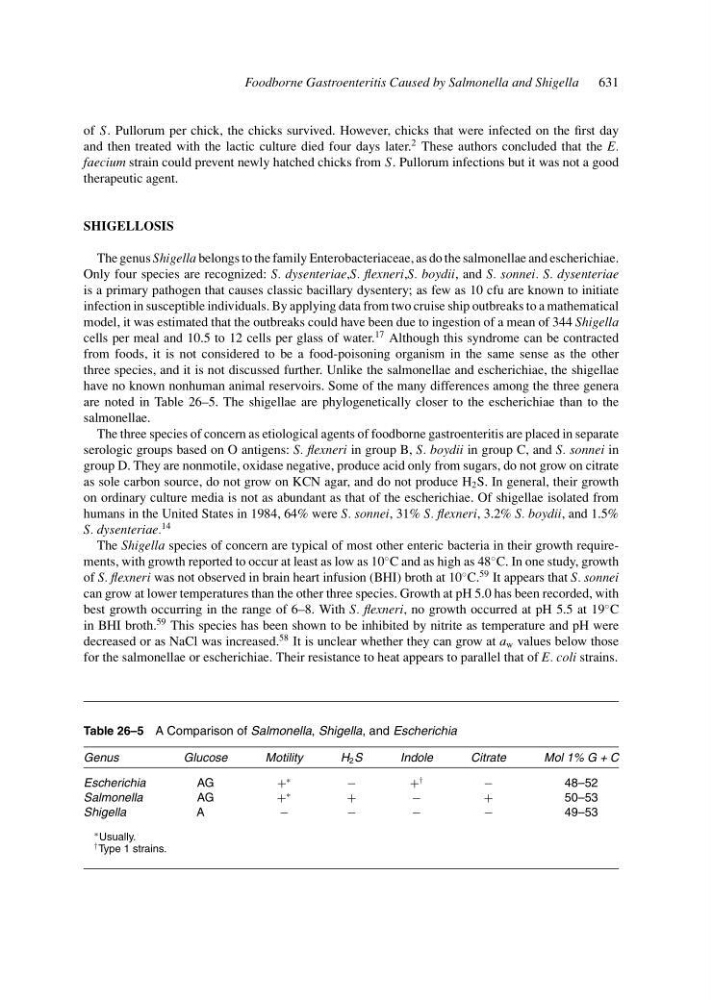
have no known nonhuman animal reservoirs. Some of the many differences among the three genera
are noted in Table 26–5. The shigellae are phylogenetically closer to the escherichiae than to the
salmonellae.
The three species of concern as etiological agents of foodborne gastroenteritis are placed in separate
serologic groups based on O antigens: S. flexneri in group B, S. boydii in group C, and S. sonnei in
group D. They are nonmotile, oxidase negative, produce acid only from sugars, do not grow on citrate
as sole carbon source, do not grow on KCN agar, and do not produce H 2 S. In general, their growth
on ordinary culture media is not as abundant as that of the escherichiae. Of shigellae isolated from
humans in the United States in 1984, 64% were S. sonnei, 31% S. flexneri, 3.2% S. boydii, and 1.5%
S. dysenteriae.
14
The Shigella species of concern are typical of most other enteric bacteria in their growth requirements, with growth reported to occur at least as low as 10
◦ C and as high as 48
◦ C. In one study, growth
of S. flexneri was not observed in brain heart infusion (BHI) broth at 10
◦ C.
59 It appears that S. sonnei
can grow at lower temperatures than the other three species. Growth at pH 5.0 has been recorded, with
best growth occurring in the range of 6–8. With S. flexneri, no growth occurred at pH 5.5 at 19
◦ C
in BHI broth.
59 This species has been shown to be inhibited by nitrite as temperature and pH were
decreased or as NaCl was increased.
58 It is unclear whether they can grow at a w values below those
for the salmonellae or escherichiae. Their resistance to heat appears to parallel that of E. coli strains.
Table 26–5 A Comparison of Salmonella, Shigella, and Escherichia
Genus
Glucose
Motility
H 2 S
Indole
Citrate
Mol 1% G + C
Escherichia
AG
+
∗
−
+
†
−
48–52
Salmonella
AG
+
∗
+
−
+
50–53
Shigella
A
−
−
−
−
49–53
∗ Usually.
† Type 1 strains.