

Intrinsic and Extrinsic Parameters of Foods That Affect Microbial Growth
47
(“dry-loving”) molds and osmophilic (preferring high osmotic pressures) yeasts have been reported
to grow at a w values of 0.65 and 0.61, respectively (Table 3–5). When salt is employed to control a w ,
an extremely high level is necessary to achieve a w values below 0.80 (see Table 3–4).
Certain relationships have been shown to exist among a w , temperature, and nutrition. First, at any
temperature, the ability of microorganisms to grow is reduced as the a w is lowered. Second, the range
of a w over which growth occurs is greatest at the optimum temperature for growth; and third, the
presence of nutrients increases the range of a w over which the organisms can survive.
32 The specific
values given in Table 3–5, then, should be taken only as reference points, as a change in temperature
or nutrient content might permit growth at lower values of a w .
Effects of Low a w
The general effect of lowering a w below optimum is to increase the length of the lag phase of growth
and to decrease the growth rate and size of final population. This effect may be expected to result
from adverse influences of lowered water on all metabolic activities because all chemical reactions
of cells require an aqueous environment. It must be kept in mind, however, that a w is influenced by
other environmental parameters such as pH, temperature of growth, and Eh. In their study of the
effect of a w on the growth of Enterobacter aerogenes in culture media, Wodzinski and Frazier
54
found that the lag phase and generation time were progressively lengthened until no growth occurred
with a lowering of a w . The minimum a w was raised, however, when the incubation temperature was
decreased. When both the pH and temperature of incubation were made unfavorable, the minimum
a w for growth was higher. The interaction of a w , pH, and temperature on the growth of molds on jam
was shown by Horner and Anagnostopoulos.
24 The interaction between a w and temperature was the
most significant.
In general, the strategy employed by microorganisms as protection against osmotic stress is the
intracellular accumulation of compatible solutes. Halophiles (e.g., Halobacterium spp.) maintain osmotic equilibrium by maintaining the concentration of KCl in their cytoplasm equal to that of the
suspending menstruum, and this is referred to as the “salt in cytoplasm” response. Nonhalophiles
accumulate compatible solutes (osmolytes) in a biphasic manner. The first response is to increase K
+
(and endogenously synthesized glutamate), and the second is to increase, either by de novo synthesis
or by uptake, compatible solutes. The latter are very soluble molecules that have no net charge at
physiological pH, and they do not adhere to or react with intracellular macromolecules (see reference
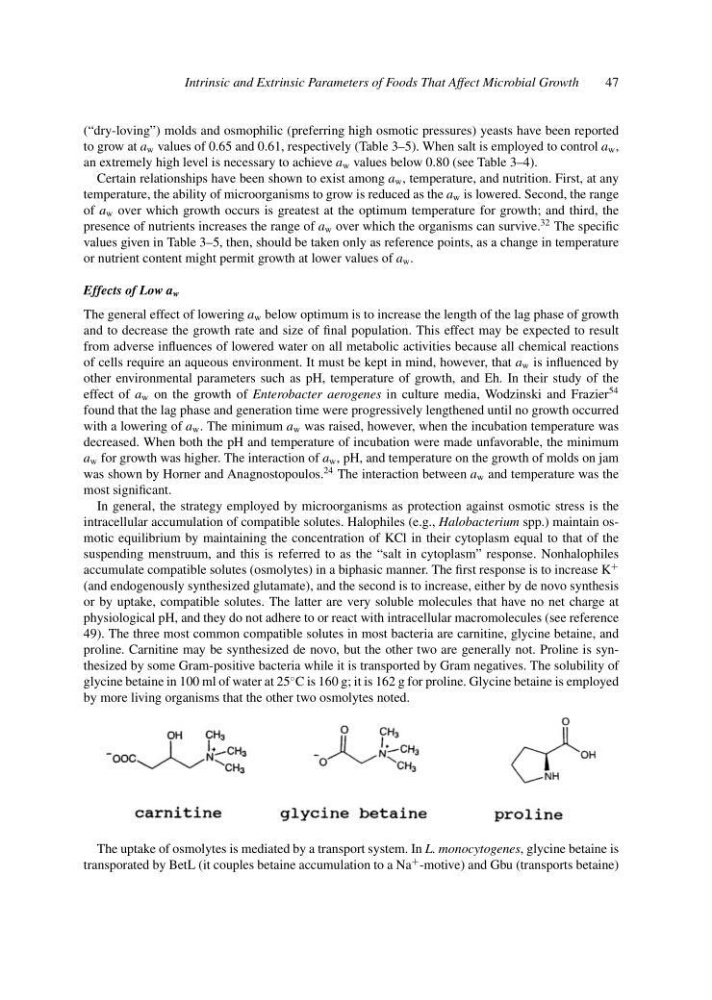
49). The three most common compatible solutes in most bacteria are carnitine, glycine betaine, and
proline. Carnitine may be synthesized de novo, but the other two are generally not. Proline is synthesized by some Gram-positive bacteria while it is transported by Gram negatives. The solubility of
glycine betaine in 100 ml of water at 25
◦ C is 160 g; it is 162 g for proline. Glycine betaine is employed
by more living organisms that the other two osmolytes noted.
The uptake of osmolytes is mediated by a transport system. In L. monocytogenes, glycine betaine is
transporated by BetL (it couples betaine accumulation to a Na
+ -motive) and Gbu (transports betaine)
47
(“dry-loving”) molds and osmophilic (preferring high osmotic pressures) yeasts have been reported
to grow at a w values of 0.65 and 0.61, respectively (Table 3–5). When salt is employed to control a w ,
an extremely high level is necessary to achieve a w values below 0.80 (see Table 3–4).
Certain relationships have been shown to exist among a w , temperature, and nutrition. First, at any
temperature, the ability of microorganisms to grow is reduced as the a w is lowered. Second, the range
of a w over which growth occurs is greatest at the optimum temperature for growth; and third, the
presence of nutrients increases the range of a w over which the organisms can survive.
32 The specific
values given in Table 3–5, then, should be taken only as reference points, as a change in temperature
or nutrient content might permit growth at lower values of a w .
Effects of Low a w
The general effect of lowering a w below optimum is to increase the length of the lag phase of growth
and to decrease the growth rate and size of final population. This effect may be expected to result
from adverse influences of lowered water on all metabolic activities because all chemical reactions
of cells require an aqueous environment. It must be kept in mind, however, that a w is influenced by
other environmental parameters such as pH, temperature of growth, and Eh. In their study of the
effect of a w on the growth of Enterobacter aerogenes in culture media, Wodzinski and Frazier
54
found that the lag phase and generation time were progressively lengthened until no growth occurred
with a lowering of a w . The minimum a w was raised, however, when the incubation temperature was
decreased. When both the pH and temperature of incubation were made unfavorable, the minimum
a w for growth was higher. The interaction of a w , pH, and temperature on the growth of molds on jam
was shown by Horner and Anagnostopoulos.
24 The interaction between a w and temperature was the
most significant.
In general, the strategy employed by microorganisms as protection against osmotic stress is the
intracellular accumulation of compatible solutes. Halophiles (e.g., Halobacterium spp.) maintain osmotic equilibrium by maintaining the concentration of KCl in their cytoplasm equal to that of the
suspending menstruum, and this is referred to as the “salt in cytoplasm” response. Nonhalophiles
accumulate compatible solutes (osmolytes) in a biphasic manner. The first response is to increase K
+
(and endogenously synthesized glutamate), and the second is to increase, either by de novo synthesis
or by uptake, compatible solutes. The latter are very soluble molecules that have no net charge at
physiological pH, and they do not adhere to or react with intracellular macromolecules (see reference
49). The three most common compatible solutes in most bacteria are carnitine, glycine betaine, and
proline. Carnitine may be synthesized de novo, but the other two are generally not. Proline is synthesized by some Gram-positive bacteria while it is transported by Gram negatives. The solubility of
glycine betaine in 100 ml of water at 25
◦ C is 160 g; it is 162 g for proline. Glycine betaine is employed
by more living organisms that the other two osmolytes noted.
The uptake of osmolytes is mediated by a transport system. In L. monocytogenes, glycine betaine is
transporated by BetL (it couples betaine accumulation to a Na
+ -motive) and Gbu (transports betaine)