

624 Modern Food Microbiology
sensitive in the log phase than in the stationary phase of growth. These investigators also found that
cells grown at 44
◦ C were more heat resistant than those grown at either 15
◦ C or 35
◦ C.
With respect to the destruction of Salmonella in baked foods, Beloian and Schlosser
5 found that
baked foods reaching a temperature of 160
◦ F or higher in the slowest heating region can be considered
Salmonella free. These authors employed S. Senftenberg 775W at a concentration of 7,000–10,000
cells/ml placed in reconstituted dried egg. With respect to the heat destruction of this strain in poultry,
it is recommended that internal temperatures of at least 160
◦ F be attained.
40 Although S. Senftenberg
775W has been reported to be 30 times more heat resistant than S. Typhimurium,
42 the latter organism
has been found to be more resistant to dry heat than the former.
21 These investigators tested dry heat
resistance in milk chocolate.
The destruction of S. Pullorum in turkeys was investigated by Rogers and Gunderson,
47 who found
that it required 4 hours and 55 minutes to destroy an initial inoculum of 115 million in 10- to 11lb turkeys with an internal temperature of 160
◦ F, and for 18-lb turkeys with an initial inoculum of
320 million organisms, 6 hours and 20 minutes were required for destruction. The salmonellae are
quite sensitive to ionizing radiation, with doses of 5–7.5 kGy being sufficient to eliminate them from
most foods and feed. The decimal reduction dose has been reported to range from 0.4 to 0.7 kGy for
Salmonella spp. in frozen eggs. The effect of various foods on the radiosensitivity of salmonellae is
shown in a study by Ley et al.
35 These investigators found that for frozen whole egg, 5 kGy gave a 10
7
reduction in the numbers of S. Typhimurium, whereas 6.5 kGy was required to give a 10
5 reduction
in frozen horsemeat, between 5 and 7.5 kGy for a 10
5 –10
8 reduction in bone meal, and only 4.5 kGy
to give a 10
3 reduction of S. Typhimurium in desiccated coconut. More extensive information on the
effect of irradiation on salmonellae is presented in Chapter 15.
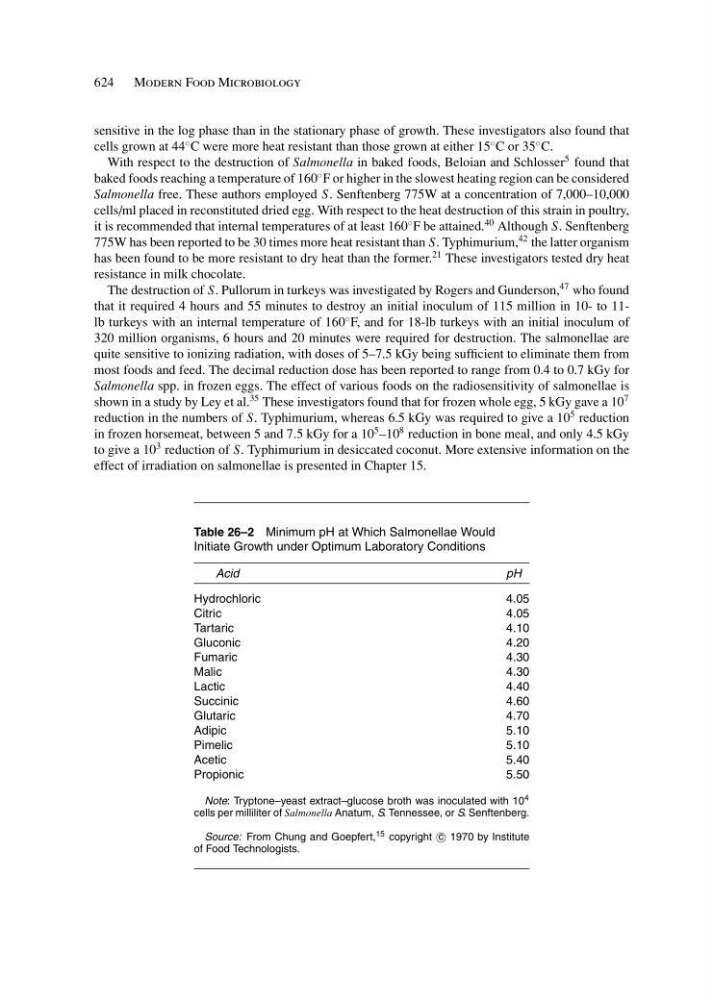
Table 26–2 Minimum pH at Which Salmonellae Would
Initiate Growth under Optimum Laboratory Conditions
Acid
pH
Hydrochloric
4.05
Citric
4.05
Tartaric
4.10
Gluconic
4.20
Fumaric
4.30
Malic
4.30
Lactic
4.40
Succinic
4.60
Glutaric
4.70
Adipic
5.10
Pimelic
5.10
Acetic
5.40
Propionic
5.50
Note: Tryptone–yeast extract–glucose broth was inoculated with 10 4
cells per milliliter of Salmonella Anatum, S. Tennessee, or S. Senftenberg.
Source: From Chung and Goepfert, 15 copyright c
1970 by Institute
of Food Technologists.