

Foodborne Listeriosis
597
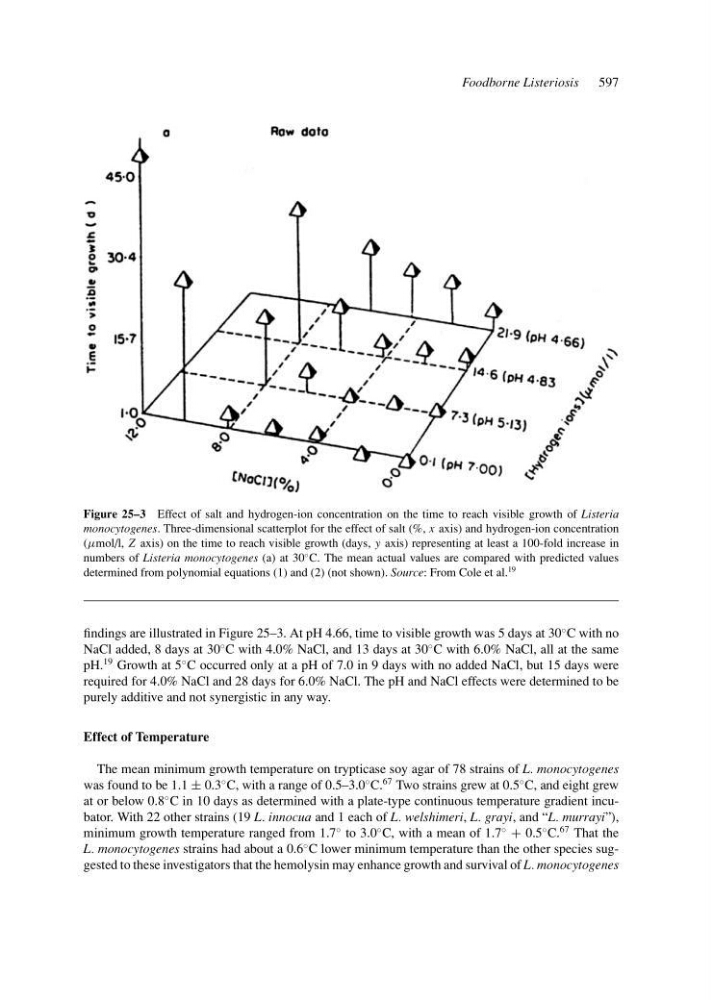
Figure 25–3 Effect of salt and hydrogen-ion concentration on the time to reach visible growth of Listeria
monocytogenes. Three-dimensional scatterplot for the effect of salt (%, x axis) and hydrogen-ion concentration
(µmol/l, Z axis) on the time to reach visible growth (days, y axis) representing at least a 100-fold increase in
numbers of Listeria monocytogenes (a) at 30
◦ C. The mean actual values are compared with predicted values
determined from polynomial equations (1) and (2) (not shown). Source: From Cole et al.
19
findings are illustrated in Figure 25–3. At pH 4.66, time to visible growth was 5 days at 30
◦ C with no
NaCl added, 8 days at 30
◦ C with 4.0% NaCl, and 13 days at 30
◦ C with 6.0% NaCl, all at the same
pH.
19 Growth at 5
◦ C occurred only at a pH of 7.0 in 9 days with no added NaCl, but 15 days were
required for 4.0% NaCl and 28 days for 6.0% NaCl. The pH and NaCl effects were determined to be
purely additive and not synergistic in any way.
Effect of Temperature
The mean minimum growth temperature on trypticase soy agar of 78 strains of L. monocytogenes
was found to be 1.1 ± 0.3
◦ C, with a range of 0.5–3.0
◦ C.
67 Two strains grew at 0.5
◦ C, and eight grew
at or below 0.8
◦ C in 10 days as determined with a plate-type continuous temperature gradient incubator. With 22 other strains (19 L. innocua and 1 each of L. welshimeri, L. grayi, and “L. murrayi”),
minimum growth temperature ranged from 1.7
◦ to 3.0
◦ C, with a mean of 1.7
◦
+ 0.5
◦ C.
67 That the
L. monocytogenes strains had about a 0.6
◦ C lower minimum temperature than the other species suggested to these investigators that the hemolysin may enhance growth and survival of L. monocytogenes