

584 Modern Food Microbiology
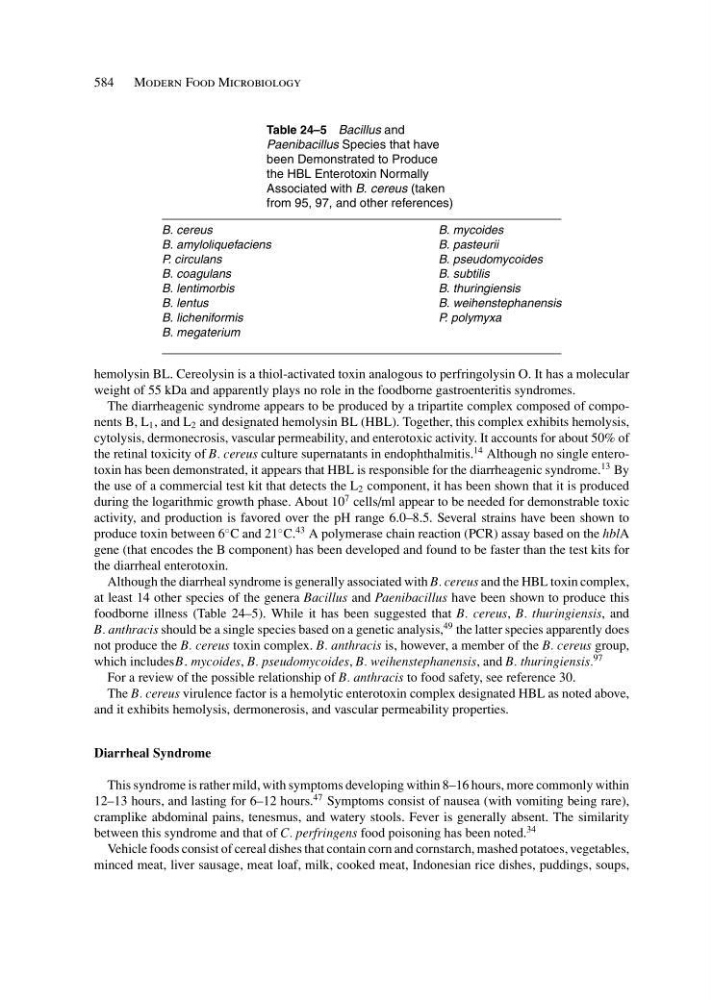
Table 24–5 Bacillus and
Paenibacillus Species that have
been Demonstrated to Produce
the HBL Enterotoxin Normally
Associated with B. cereus (taken
from 95, 97, and other references)
B. cereus
B. mycoides
B. amyloliquefaciens
B. pasteurii
P. circulans
B. pseudomycoides
B. coagulans
B. subtilis
B. lentimorbis
B. thuringiensis
B. lentus
B. weihenstephanensis
B. licheniformis
P. polymyxa
B. megaterium
hemolysin BL. Cereolysin is a thiol-activated toxin analogous to perfringolysin O. It has a molecular
weight of 55 kDa and apparently plays no role in the foodborne gastroenteritis syndromes.
The diarrheagenic syndrome appears to be produced by a tripartite complex composed of components B, L 1 , and L 2 and designated hemolysin BL (HBL). Together, this complex exhibits hemolysis,
cytolysis, dermonecrosis, vascular permeability, and enterotoxic activity. It accounts for about 50% of
the retinal toxicity of B. cereus culture supernatants in endophthalmitis.
14 Although no single enterotoxin has been demonstrated, it appears that HBL is responsible for the diarrheagenic syndrome.
13 By
the use of a commercial test kit that detects the L 2 component, it has been shown that it is produced
during the logarithmic growth phase. About 10
7 cells/ml appear to be needed for demonstrable toxic
activity, and production is favored over the pH range 6.0–8.5. Several strains have been shown to
produce toxin between 6
◦ C and 21
◦ C.
43 A polymerase chain reaction (PCR) assay based on the hblA
gene (that encodes the B component) has been developed and found to be faster than the test kits for
the diarrheal enterotoxin.
Although the diarrheal syndrome is generally associated with B. cereus and the HBL toxin complex,
at least 14 other species of the genera Bacillus and Paenibacillus have been shown to produce this
foodborne illness (Table 24–5). While it has been suggested that B. cereus, B. thuringiensis, and
B. anthracis should be a single species based on a genetic analysis,
49 the latter species apparently does
not produce the B. cereus toxin complex. B. anthracis is, however, a member of the B. cereus group,
which includesB. mycoides, B. pseudomycoides, B. weihenstephanensis, and B. thuringiensis.
97
For a review of the possible relationship of B. anthracis to food safety, see reference 30.
The B. cereus virulence factor is a hemolytic enterotoxin complex designated HBL as noted above,
and it exhibits hemolysis, dermonerosis, and vascular permeability properties.
Diarrheal Syndrome
This syndrome is rather mild, with symptoms developing within 8–16 hours, more commonly within
12–13 hours, and lasting for 6–12 hours.
47 Symptoms consist of nausea (with vomiting being rare),
cramplike abdominal pains, tenesmus, and watery stools. Fever is generally absent. The similarity
between this syndrome and that of C. perfringens food poisoning has been noted.
34
Vehicle foods consist of cereal dishes that contain corn and cornstarch, mashed potatoes, vegetables,
minced meat, liver sausage, meat loaf, milk, cooked meat, Indonesian rice dishes, puddings, soups,