

Food Poisoning Caused by Gram-Positive Sporeforming Bacteria
579
Concerns for Sous Vide and Related Food Products
Special concerns for the growth and toxin production by C. botulinum strains are presented by sous
vide processed foods. By this method, developed in France around 1980, raw food is placed in highbarrier bags and cooked under vacuum (sous vide, “under vacuum”). Most, if not all, vegetative cells
are destroyed, but bacterial spores survive. Thus, the sous vide product is one that contains bacterial
spores in an O 2 -depressed environment with no microbial competitors. In low-acid foods such as
meats, poultry, and seafoods, spores of C. botulinum can germinate, grow, and produce toxin. Holding
temperature and time are the two parameters that must be carefully monitored to avoid toxic products.
Whereas the proteolytic strains do not grow in the refrigerator temperature range, the nonproteolytic
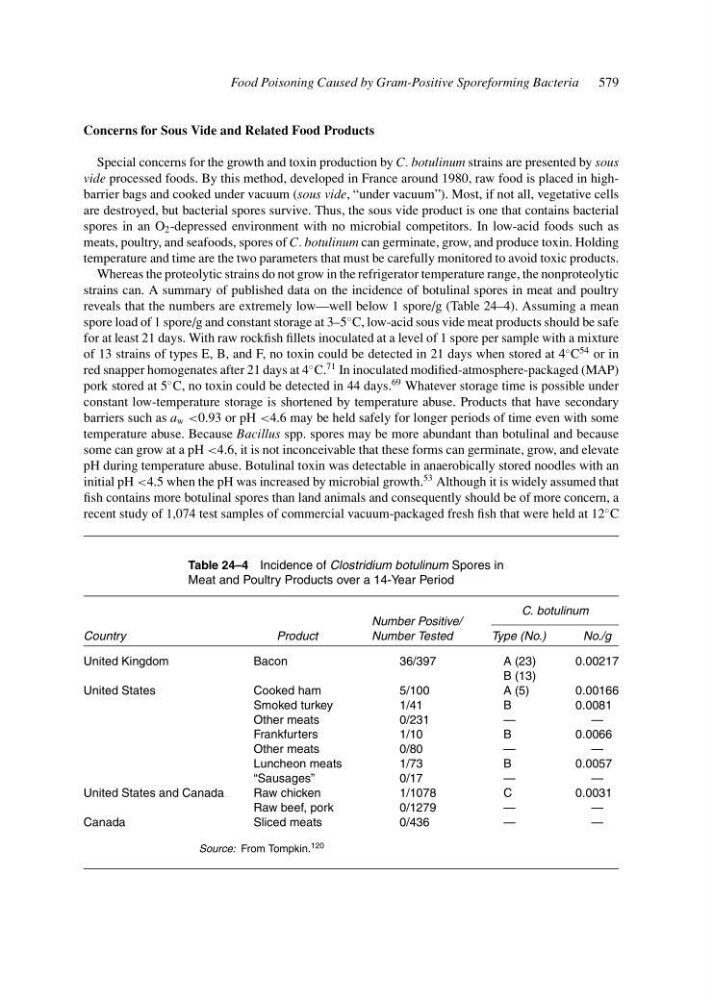
strains can. A summary of published data on the incidence of botulinal spores in meat and poultry
reveals that the numbers are extremely low—well below 1 spore/g (Table 24–4). Assuming a mean
spore load of 1 spore/g and constant storage at 3–5
◦ C, low-acid sous vide meat products should be safe
for at least 21 days. With raw rockfish fillets inoculated at a level of 1 spore per sample with a mixture
of 13 strains of types E, B, and F, no toxin could be detected in 21 days when stored at 4
◦ C
54 or in
red snapper homogenates after 21 days at 4
◦ C.
71 In inoculated modified-atmosphere-packaged (MAP)
pork stored at 5
◦ C, no toxin could be detected in 44 days.
69 Whatever storage time is possible under
constant low-temperature storage is shortened by temperature abuse. Products that have secondary
barriers such as a w <0.93 or pH <4.6 may be held safely for longer periods of time even with some
temperature abuse. Because Bacillus spp. spores may be more abundant than botulinal and because
some can grow at a pH <4.6, it is not inconceivable that these forms can germinate, grow, and elevate
pH during temperature abuse. Botulinal toxin was detectable in anaerobically stored noodles with an
initial pH <4.5 when the pH was increased by microbial growth.
53 Although it is widely assumed that
fish contains more botulinal spores than land animals and consequently should be of more concern, a
recent study of 1,074 test samples of commercial vacuum-packaged fresh fish that were held at 12
◦ C
Table 24–4 Incidence of Clostridium botulinum Spores in
Meat and Poultry Products over a 14-Year Period
C. botulinum
Number Positive/
Country
Product
Number Tested
Type (No.)
No./g
United Kingdom
Bacon
36/397
A (23)
0.00217
B (13)
United States
Cooked ham
5/100
A (5)
0.00166
Smoked turkey
1/41
B
0.0081
Other meats
0/231
—
—
Frankfurters
1/10
B
0.0066
Other meats
0/80
—
—
Luncheon meats
1/73
B
0.0057
“Sausages”
0/17
—
—
United States and Canada
Raw chicken
1/1078
C
0.0031
Raw beef, pork
0/1279
—
—
Canada
Sliced meats
0/436
—
—
Source: From Tompkin. 120