

Introduction to Foodborne Pathogens
531
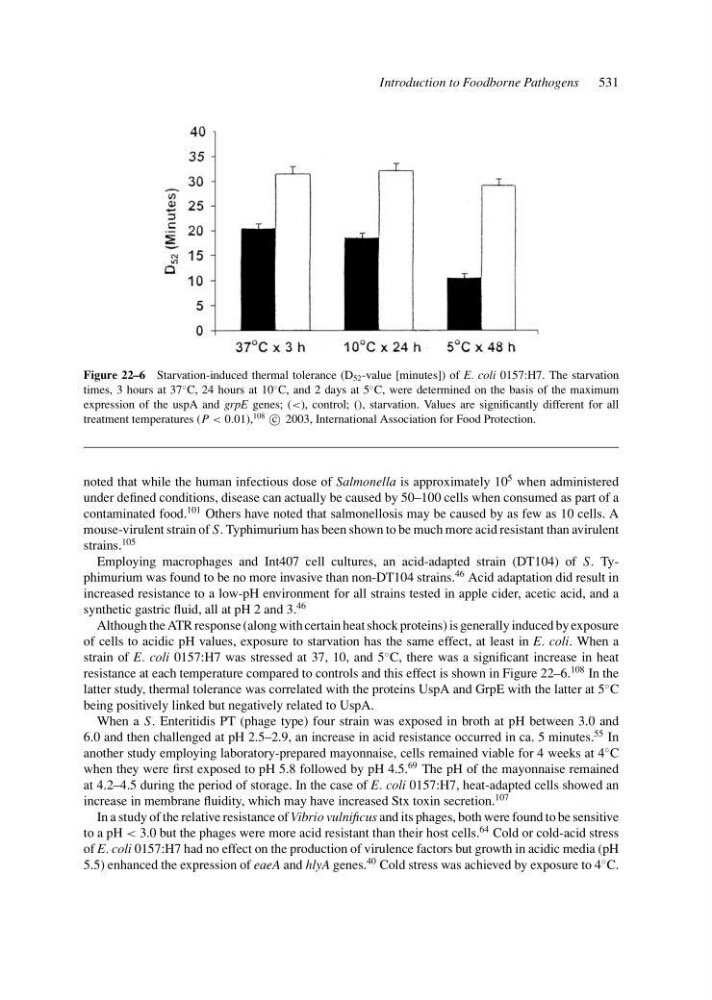
Figure 22–6 Starvation-induced thermal tolerance (D 52 -value [minutes]) of E. coli 0157:H7. The starvation
times, 3 hours at 37
◦ C, 24 hours at 10
◦ C, and 2 days at 5
◦ C, were determined on the basis of the maximum
expression of the uspA and grpE genes; (<), control; (), starvation. Values are significantly different for all
treatment temperatures (P < 0.01),
108 c
2003, International Association for Food Protection.
noted that while the human infectious dose of Salmonella is approximately 10
5 when administered
under defined conditions, disease can actually be caused by 50–100 cells when consumed as part of a
contaminated food.
101 Others have noted that salmonellosis may be caused by as few as 10 cells. A
mouse-virulent strain of S. Typhimurium has been shown to be much more acid resistant than avirulent
strains.
105
Employing macrophages and Int407 cell cultures, an acid-adapted strain (DT104) of S. Typhimurium was found to be no more invasive than non-DT104 strains.
46 Acid adaptation did result in
increased resistance to a low-pH environment for all strains tested in apple cider, acetic acid, and a
synthetic gastric fluid, all at pH 2 and 3.
46
Although the ATR response (along with certain heat shock proteins) is generally induced by exposure
of cells to acidic pH values, exposure to starvation has the same effect, at least in E. coli. When a
strain of E. coli 0157:H7 was stressed at 37, 10, and 5
◦ C, there was a significant increase in heat
resistance at each temperature compared to controls and this effect is shown in Figure 22–6.
108 In the
latter study, thermal tolerance was correlated with the proteins UspA and GrpE with the latter at 5
◦ C
being positively linked but negatively related to UspA.
When a S. Enteritidis PT (phage type) four strain was exposed in broth at pH between 3.0 and
6.0 and then challenged at pH 2.5–2.9, an increase in acid resistance occurred in ca. 5 minutes.
55 In
another study employing laboratory-prepared mayonnaise, cells remained viable for 4 weeks at 4
◦ C
when they were first exposed to pH 5.8 followed by pH 4.5.
69 The pH of the mayonnaise remained
at 4.2–4.5 during the period of storage. In the case of E. coli 0157:H7, heat-adapted cells showed an
increase in membrane fluidity, which may have increased Stx toxin secretion.
107
In a study of the relative resistance of Vibrio vulnificus and its phages, both were found to be sensitive
to a pH < 3.0 but the phages were more acid resistant than their host cells.
64 Cold or cold-acid stress
of E. coli 0157:H7 had no effect on the production of virulence factors but growth in acidic media (pH
5.5) enhanced the expression of eaeA and hlyA genes.
40 Cold stress was achieved by exposure to 4
◦ C.
531
Figure 22–6 Starvation-induced thermal tolerance (D 52 -value [minutes]) of E. coli 0157:H7. The starvation
times, 3 hours at 37
◦ C, 24 hours at 10
◦ C, and 2 days at 5
◦ C, were determined on the basis of the maximum
expression of the uspA and grpE genes; (<), control; (), starvation. Values are significantly different for all
treatment temperatures (P < 0.01),
108 c
2003, International Association for Food Protection.
noted that while the human infectious dose of Salmonella is approximately 10
5 when administered
under defined conditions, disease can actually be caused by 50–100 cells when consumed as part of a
contaminated food.
101 Others have noted that salmonellosis may be caused by as few as 10 cells. A
mouse-virulent strain of S. Typhimurium has been shown to be much more acid resistant than avirulent
strains.
105
Employing macrophages and Int407 cell cultures, an acid-adapted strain (DT104) of S. Typhimurium was found to be no more invasive than non-DT104 strains.
46 Acid adaptation did result in
increased resistance to a low-pH environment for all strains tested in apple cider, acetic acid, and a
synthetic gastric fluid, all at pH 2 and 3.
46
Although the ATR response (along with certain heat shock proteins) is generally induced by exposure
of cells to acidic pH values, exposure to starvation has the same effect, at least in E. coli. When a
strain of E. coli 0157:H7 was stressed at 37, 10, and 5
◦ C, there was a significant increase in heat
resistance at each temperature compared to controls and this effect is shown in Figure 22–6.
108 In the
latter study, thermal tolerance was correlated with the proteins UspA and GrpE with the latter at 5
◦ C
being positively linked but negatively related to UspA.
When a S. Enteritidis PT (phage type) four strain was exposed in broth at pH between 3.0 and
6.0 and then challenged at pH 2.5–2.9, an increase in acid resistance occurred in ca. 5 minutes.
55 In
another study employing laboratory-prepared mayonnaise, cells remained viable for 4 weeks at 4
◦ C
when they were first exposed to pH 5.8 followed by pH 4.5.
69 The pH of the mayonnaise remained
at 4.2–4.5 during the period of storage. In the case of E. coli 0157:H7, heat-adapted cells showed an
increase in membrane fluidity, which may have increased Stx toxin secretion.
107
In a study of the relative resistance of Vibrio vulnificus and its phages, both were found to be sensitive
to a pH < 3.0 but the phages were more acid resistant than their host cells.
64 Cold or cold-acid stress
of E. coli 0157:H7 had no effect on the production of virulence factors but growth in acidic media (pH
5.5) enhanced the expression of eaeA and hlyA genes.
40 Cold stress was achieved by exposure to 4
◦ C.