

The HACCP and FSO Systems for Food Safety 505
Principle 5—Corrective Actions
These refer to deviations from critical limits identified during monitoring of CCPs. Specific corrective
actions to be taken should be clearly spelled out. For example, if the target temperature in step 5 is
not reached, will the batch be discarded, reprocessed, or assigned to another use?
Principle 6—Verification
Overall, this is an assessment of how effective the HACCP system is performing. Typically, some
microbial analyses are in order—for example, were all relevant pathogens destroyed in step 5? Have
the products in retail stores been contaminated after being cooked?
Principle 7—Record-Keeping
This should be done by product lot number in such a way that records are available to verify the events
in steps 2 to 4. Where room temperatures are involved, chart recorder tracings should be kept.
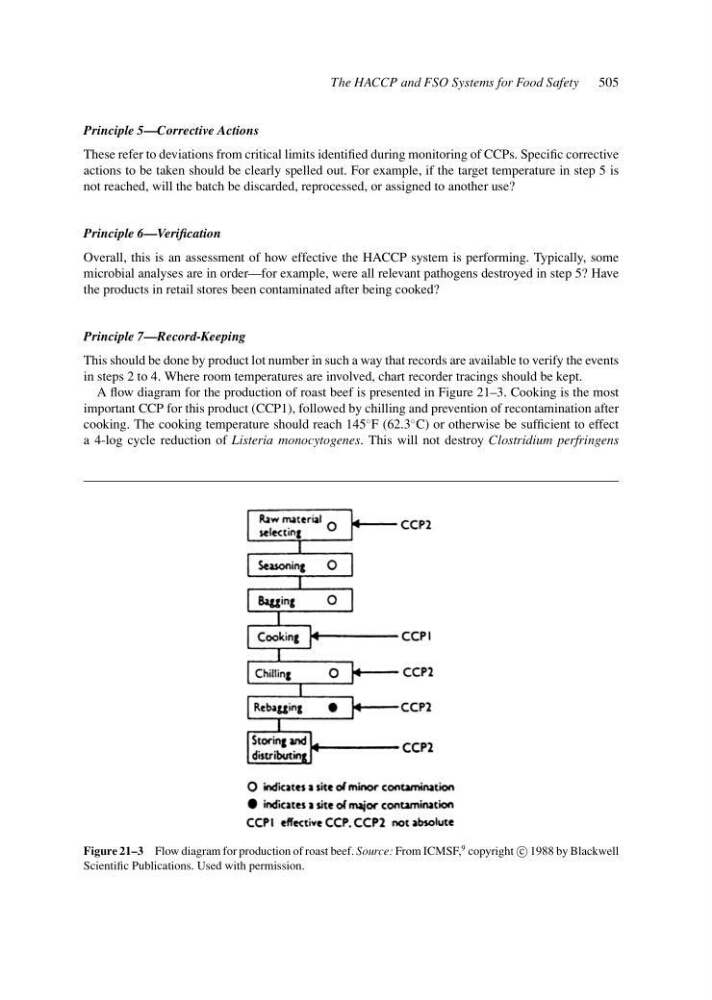
A flow diagram for the production of roast beef is presented in Figure 21–3. Cooking is the most
important CCP for this product (CCP1), followed by chilling and prevention of recontamination after
cooking. The cooking temperature should reach 145
◦ F (62.3
◦ C) or otherwise be sufficient to effect
a 4-log cycle reduction of Listeria monocytogenes. This will not destroy Clostridium perfringens
Figure 21–3 Flow diagram for production of roast beef. Source: From ICMSF,
9 copyright c
1988 by Blackwell
Scientific Publications. Used with permission.
Principle 5—Corrective Actions
These refer to deviations from critical limits identified during monitoring of CCPs. Specific corrective
actions to be taken should be clearly spelled out. For example, if the target temperature in step 5 is
not reached, will the batch be discarded, reprocessed, or assigned to another use?
Principle 6—Verification
Overall, this is an assessment of how effective the HACCP system is performing. Typically, some
microbial analyses are in order—for example, were all relevant pathogens destroyed in step 5? Have
the products in retail stores been contaminated after being cooked?
Principle 7—Record-Keeping
This should be done by product lot number in such a way that records are available to verify the events
in steps 2 to 4. Where room temperatures are involved, chart recorder tracings should be kept.
A flow diagram for the production of roast beef is presented in Figure 21–3. Cooking is the most
important CCP for this product (CCP1), followed by chilling and prevention of recontamination after
cooking. The cooking temperature should reach 145
◦ F (62.3
◦ C) or otherwise be sufficient to effect
a 4-log cycle reduction of Listeria monocytogenes. This will not destroy Clostridium perfringens
Figure 21–3 Flow diagram for production of roast beef. Source: From ICMSF,
9 copyright c
1988 by Blackwell
Scientific Publications. Used with permission.