

498 Modern Food Microbiology
Table 21–1 Leading Factors Contributing to Outbreaks of Foodborne Illness in the
United States
Factors
1961–1982
Improper cooling
44%
Lapse of 12 or more hours between preparation/eating
23%
Contaminated by handlers
18%
Raw ingredient added without subsequent heating/cooking
16%
Inadequate cooking/canning/heating
16%
Note: N = 1918.
Source: From Bryan. 1,2
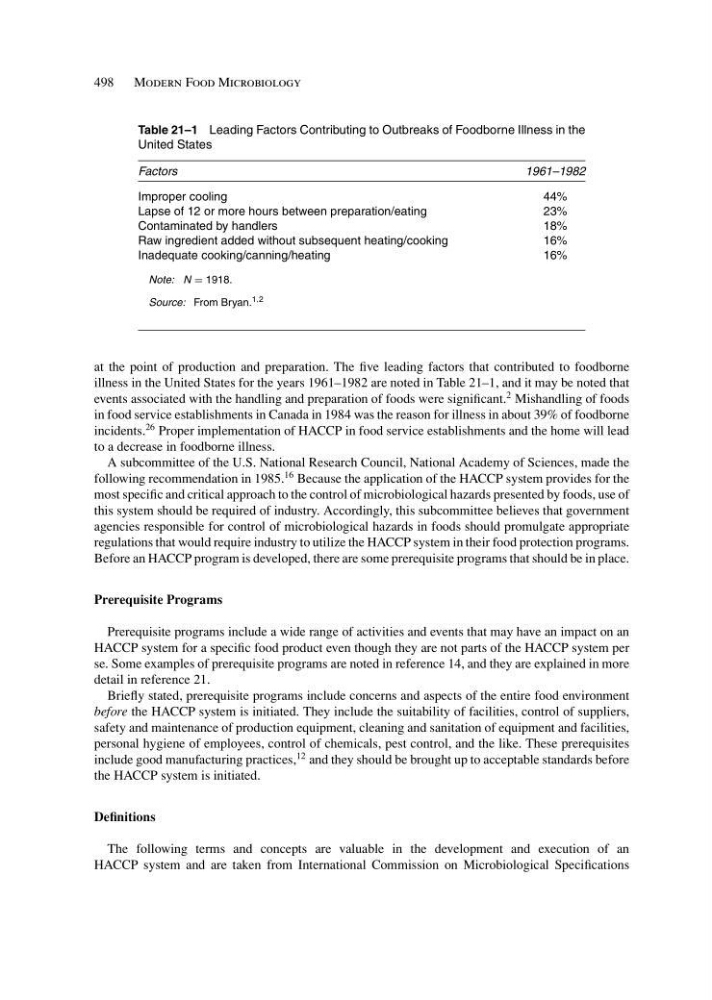
at the point of production and preparation. The five leading factors that contributed to foodborne
illness in the United States for the years 1961–1982 are noted in Table 21–1, and it may be noted that
events associated with the handling and preparation of foods were significant.
2 Mishandling of foods
in food service establishments in Canada in 1984 was the reason for illness in about 39% of foodborne
incidents.
26 Proper implementation of HACCP in food service establishments and the home will lead
to a decrease in foodborne illness.
A subcommittee of the U.S. National Research Council, National Academy of Sciences, made the
following recommendation in 1985.
16 Because the application of the HACCP system provides for the
most specific and critical approach to the control of microbiological hazards presented by foods, use of
this system should be required of industry. Accordingly, this subcommittee believes that government
agencies responsible for control of microbiological hazards in foods should promulgate appropriate
regulations that would require industry to utilize the HACCP system in their food protection programs.
Before an HACCP program is developed, there are some prerequisite programs that should be in place.
Prerequisite Programs
Prerequisite programs include a wide range of activities and events that may have an impact on an
HACCP system for a specific food product even though they are not parts of the HACCP system per
se. Some examples of prerequisite programs are noted in reference 14, and they are explained in more
detail in reference 21.
Briefly stated, prerequisite programs include concerns and aspects of the entire food environment
before the HACCP system is initiated. They include the suitability of facilities, control of suppliers,
safety and maintenance of production equipment, cleaning and sanitation of equipment and facilities,
personal hygiene of employees, control of chemicals, pest control, and the like. These prerequisites
include good manufacturing practices,
12 and they should be brought up to acceptable standards before
the HACCP system is initiated.
Definitions
The following terms and concepts are valuable in the development and execution of an
HACCP system and are taken from International Commission on Microbiological Specifications
Table 21–1 Leading Factors Contributing to Outbreaks of Foodborne Illness in the
United States
Factors
1961–1982
Improper cooling
44%
Lapse of 12 or more hours between preparation/eating
23%
Contaminated by handlers
18%
Raw ingredient added without subsequent heating/cooking
16%
Inadequate cooking/canning/heating
16%
Note: N = 1918.
Source: From Bryan. 1,2
at the point of production and preparation. The five leading factors that contributed to foodborne
illness in the United States for the years 1961–1982 are noted in Table 21–1, and it may be noted that
events associated with the handling and preparation of foods were significant.
2 Mishandling of foods
in food service establishments in Canada in 1984 was the reason for illness in about 39% of foodborne
incidents.
26 Proper implementation of HACCP in food service establishments and the home will lead
to a decrease in foodborne illness.
A subcommittee of the U.S. National Research Council, National Academy of Sciences, made the
following recommendation in 1985.
16 Because the application of the HACCP system provides for the
most specific and critical approach to the control of microbiological hazards presented by foods, use of
this system should be required of industry. Accordingly, this subcommittee believes that government
agencies responsible for control of microbiological hazards in foods should promulgate appropriate
regulations that would require industry to utilize the HACCP system in their food protection programs.
Before an HACCP program is developed, there are some prerequisite programs that should be in place.
Prerequisite Programs
Prerequisite programs include a wide range of activities and events that may have an impact on an
HACCP system for a specific food product even though they are not parts of the HACCP system per
se. Some examples of prerequisite programs are noted in reference 14, and they are explained in more
detail in reference 21.
Briefly stated, prerequisite programs include concerns and aspects of the entire food environment
before the HACCP system is initiated. They include the suitability of facilities, control of suppliers,
safety and maintenance of production equipment, cleaning and sanitation of equipment and facilities,
personal hygiene of employees, control of chemicals, pest control, and the like. These prerequisites
include good manufacturing practices,
12 and they should be brought up to acceptable standards before
the HACCP system is initiated.
Definitions
The following terms and concepts are valuable in the development and execution of an
HACCP system and are taken from International Commission on Microbiological Specifications