

Indicators of Food Microbial Quality and Safety
475
fish quality, including total volatile bases (TVB)—ammonia, dimethylamine, and TMA—and total
volatile nitrogen (TVN), which includes TVB and other nitrogen compounds that are released by
steam distillation of fish products. See Chapter 5.
Total viable count methods have been used to assess product quality. They are of greater value as
indicators of the existing state of given products than as predictors of shelf life because the portion of
the count represented by the ultimate spoilers is difficult to ascertain.
Overall, microbial quality indicator organisms can be used for food products that have a biota limited
by processing parameters and conditions where an undesirable state is associated consistently with a
given level of specified organisms. Where product quality is significantly affected by the presence and
quantity of certain metabolic products, they may be used as quality indicators. Total viable counts are
generally not reliable in this regard, but they are better than direct microscopic counts.
INDICATORS OF FOOD SAFETY
Microbial indicators are employed more often to assess food safety and sanitation than quality.
Ideally, a food safety indicator should meet certain important criteria. It should
1. be easily and rapidly detectable
2. be easily distinguishable from other members of the food biota
3. have a history of constant association with the pathogen whose presence it is to indicate
4. always be present when the pathogen of concern is present
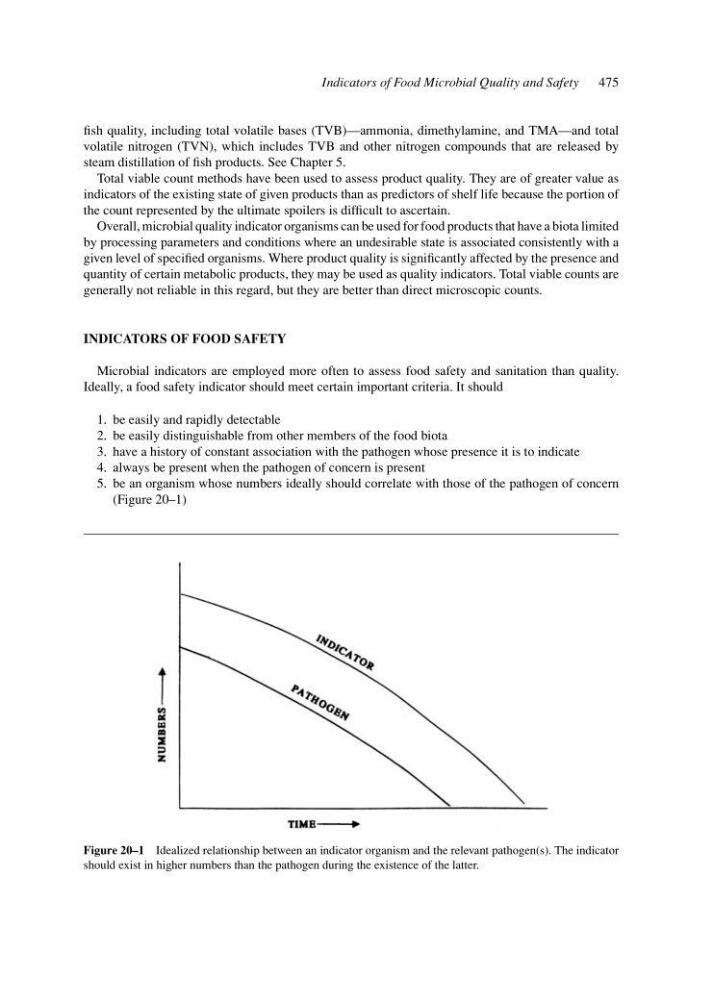
5. be an organism whose numbers ideally should correlate with those of the pathogen of concern
(Figure 20–1)
Figure 20–1 Idealized relationship between an indicator organism and the relevant pathogen(s). The indicator
should exist in higher numbers than the pathogen during the existence of the latter.
475
fish quality, including total volatile bases (TVB)—ammonia, dimethylamine, and TMA—and total
volatile nitrogen (TVN), which includes TVB and other nitrogen compounds that are released by
steam distillation of fish products. See Chapter 5.
Total viable count methods have been used to assess product quality. They are of greater value as
indicators of the existing state of given products than as predictors of shelf life because the portion of
the count represented by the ultimate spoilers is difficult to ascertain.
Overall, microbial quality indicator organisms can be used for food products that have a biota limited
by processing parameters and conditions where an undesirable state is associated consistently with a
given level of specified organisms. Where product quality is significantly affected by the presence and
quantity of certain metabolic products, they may be used as quality indicators. Total viable counts are
generally not reliable in this regard, but they are better than direct microscopic counts.
INDICATORS OF FOOD SAFETY
Microbial indicators are employed more often to assess food safety and sanitation than quality.
Ideally, a food safety indicator should meet certain important criteria. It should
1. be easily and rapidly detectable
2. be easily distinguishable from other members of the food biota
3. have a history of constant association with the pathogen whose presence it is to indicate
4. always be present when the pathogen of concern is present
5. be an organism whose numbers ideally should correlate with those of the pathogen of concern
(Figure 20–1)
Figure 20–1 Idealized relationship between an indicator organism and the relevant pathogen(s). The indicator
should exist in higher numbers than the pathogen during the existence of the latter.