

454 Modern Food Microbiology
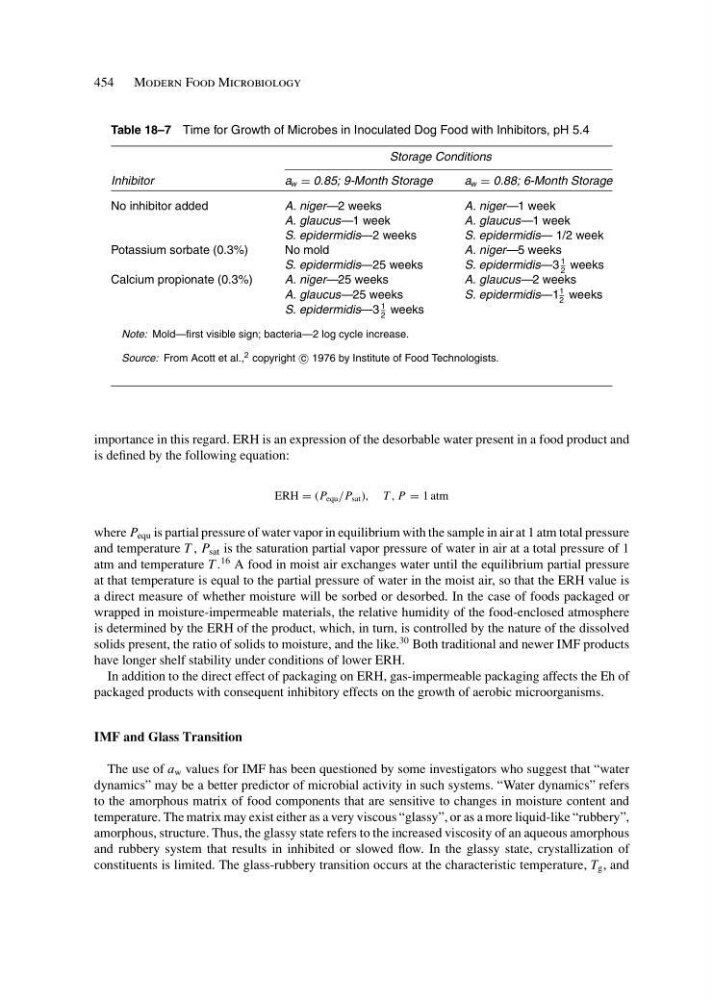
Table 18–7 Time for Growth of Microbes in Inoculated Dog Food with Inhibitors, pH 5.4
Storage Conditions
Inhibitor
a w = 0.85; 9-Month Storage
a w = 0.88; 6-Month Storage
No inhibitor added
A. niger—2 weeks
A. niger—1 week
A. glaucus—1 week
A. glaucus—1 week
S. epidermidis—2 weeks
S. epidermidis— 1/2 week
Potassium sorbate (0.3%)
No mold
A. niger—5 weeks
S. epidermidis—25 weeks
S. epidermidis—3
1
2
weeks
Calcium propionate (0.3%)
A. niger—25 weeks
A. glaucus—2 weeks
A. glaucus—25 weeks
S. epidermidis—1
1
2
weeks
S. epidermidis—3
1
2
weeks
Note: Mold—first visible sign; bacteria—2 log cycle increase.
Source: From Acott et al., 2 copyright c
1976 by Institute of Food Technologists.
importance in this regard. ERH is an expression of the desorbable water present in a food product and
is defined by the following equation:
ERH = (P equ /P sat ), T, P = 1 atm
where P equ is partial pressure of water vapor in equilibrium with the sample in air at 1 atm total pressure
and temperature T , P sat is the saturation partial vapor pressure of water in air at a total pressure of 1
atm and temperature T.
16 A food in moist air exchanges water until the equilibrium partial pressure
at that temperature is equal to the partial pressure of water in the moist air, so that the ERH value is
a direct measure of whether moisture will be sorbed or desorbed. In the case of foods packaged or
wrapped in moisture-impermeable materials, the relative humidity of the food-enclosed atmosphere
is determined by the ERH of the product, which, in turn, is controlled by the nature of the dissolved
solids present, the ratio of solids to moisture, and the like.
30 Both traditional and newer IMF products
have longer shelf stability under conditions of lower ERH.
In addition to the direct effect of packaging on ERH, gas-impermeable packaging affects the Eh of
packaged products with consequent inhibitory effects on the growth of aerobic microorganisms.
IMF and Glass Transition
The use of a w values for IMF has been questioned by some investigators who suggest that “water
dynamics” may be a better predictor of microbial activity in such systems. “Water dynamics” refers
to the amorphous matrix of food components that are sensitive to changes in moisture content and
temperature. The matrix may exist either as a very viscous “glassy”, or as a more liquid-like “rubbery”,
amorphous, structure. Thus, the glassy state refers to the increased viscosity of an aqueous amorphous
and rubbery system that results in inhibited or slowed flow. In the glassy state, crystallization of
constituents is limited. The glass-rubbery transition occurs at the characteristic temperature, T g , and
Table 18–7 Time for Growth of Microbes in Inoculated Dog Food with Inhibitors, pH 5.4
Storage Conditions
Inhibitor
a w = 0.85; 9-Month Storage
a w = 0.88; 6-Month Storage
No inhibitor added
A. niger—2 weeks
A. niger—1 week
A. glaucus—1 week
A. glaucus—1 week
S. epidermidis—2 weeks
S. epidermidis— 1/2 week
Potassium sorbate (0.3%)
No mold
A. niger—5 weeks
S. epidermidis—25 weeks
S. epidermidis—3
1
2
weeks
Calcium propionate (0.3%)
A. niger—25 weeks
A. glaucus—2 weeks
A. glaucus—25 weeks
S. epidermidis—1
1
2
weeks
S. epidermidis—3
1
2
weeks
Note: Mold—first visible sign; bacteria—2 log cycle increase.
Source: From Acott et al., 2 copyright c
1976 by Institute of Food Technologists.
importance in this regard. ERH is an expression of the desorbable water present in a food product and
is defined by the following equation:
ERH = (P equ /P sat ), T, P = 1 atm
where P equ is partial pressure of water vapor in equilibrium with the sample in air at 1 atm total pressure
and temperature T , P sat is the saturation partial vapor pressure of water in air at a total pressure of 1
atm and temperature T.
16 A food in moist air exchanges water until the equilibrium partial pressure
at that temperature is equal to the partial pressure of water in the moist air, so that the ERH value is
a direct measure of whether moisture will be sorbed or desorbed. In the case of foods packaged or
wrapped in moisture-impermeable materials, the relative humidity of the food-enclosed atmosphere
is determined by the ERH of the product, which, in turn, is controlled by the nature of the dissolved
solids present, the ratio of solids to moisture, and the like.
30 Both traditional and newer IMF products
have longer shelf stability under conditions of lower ERH.
In addition to the direct effect of packaging on ERH, gas-impermeable packaging affects the Eh of
packaged products with consequent inhibitory effects on the growth of aerobic microorganisms.
IMF and Glass Transition
The use of a w values for IMF has been questioned by some investigators who suggest that “water
dynamics” may be a better predictor of microbial activity in such systems. “Water dynamics” refers
to the amorphous matrix of food components that are sensitive to changes in moisture content and
temperature. The matrix may exist either as a very viscous “glassy”, or as a more liquid-like “rubbery”,
amorphous, structure. Thus, the glassy state refers to the increased viscosity of an aqueous amorphous
and rubbery system that results in inhibited or slowed flow. In the glassy state, crystallization of
constituents is limited. The glass-rubbery transition occurs at the characteristic temperature, T g , and