

448 Modern Food Microbiology
Table 18–3 Traditional Intermediate Moisture Foods
Food Products
a w Range
Dried fruits
0.60–0.75
Cake and pastry
0.60–0.90
Frozen foods
0.60–0.90
Sugars, syrups
0.60–0.75
Some candies
0.60–0.65
Commercial pastry fillings
0.65–0.71
Cereals (some)
0.65–0.75
Fruit cake
0.73–0.83
Honey
0.75
Fruit juice concentrates
0.79–0.84
Jams
0.80–0.91
Sweetened condensed milk
0.83
Fermented sausages (some)
0.83–0.87
Maple syrup
0.90
Ripened cheeses (some)
0.96
Liverwurst
0.96
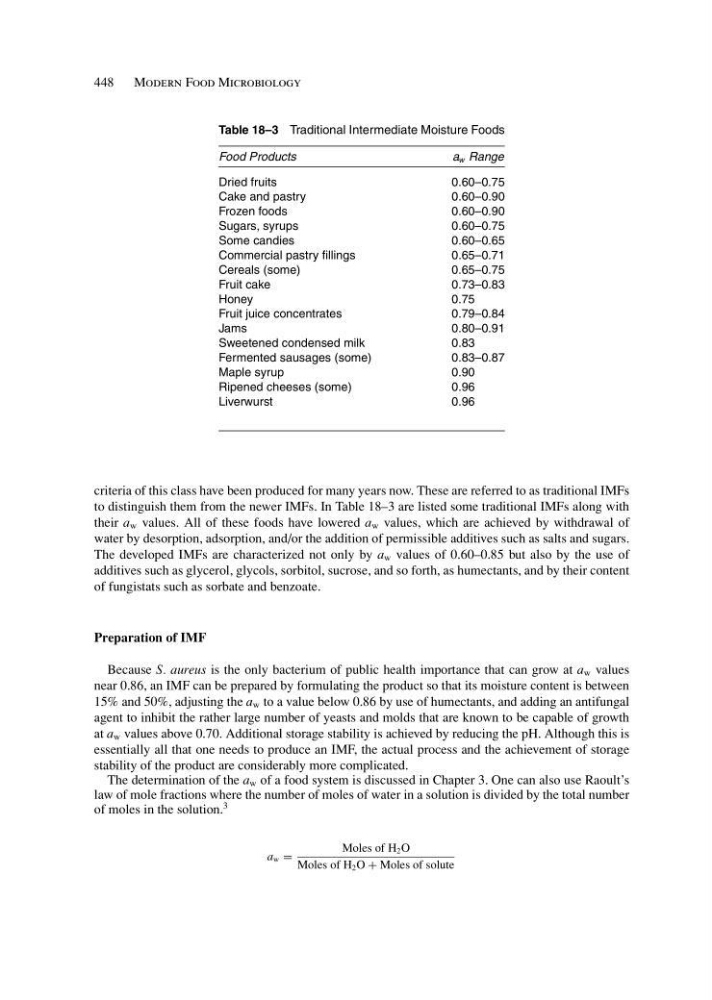
criteria of this class have been produced for many years now. These are referred to as traditional IMFs
to distinguish them from the newer IMFs. In Table 18–3 are listed some traditional IMFs along with
their a w values. All of these foods have lowered a w values, which are achieved by withdrawal of
water by desorption, adsorption, and/or the addition of permissible additives such as salts and sugars.
The developed IMFs are characterized not only by a w values of 0.60–0.85 but also by the use of
additives such as glycerol, glycols, sorbitol, sucrose, and so forth, as humectants, and by their content
of fungistats such as sorbate and benzoate.
Preparation of IMF
Because S. aureus is the only bacterium of public health importance that can grow at a w values
near 0.86, an IMF can be prepared by formulating the product so that its moisture content is between
15% and 50%, adjusting the a w to a value below 0.86 by use of humectants, and adding an antifungal
agent to inhibit the rather large number of yeasts and molds that are known to be capable of growth
at a w values above 0.70. Additional storage stability is achieved by reducing the pH. Although this is
essentially all that one needs to produce an IMF, the actual process and the achievement of storage
stability of the product are considerably more complicated.
The determination of the a w of a food system is discussed in Chapter 3. One can also use Raoult’s
law of mole fractions where the number of moles of water in a solution is divided by the total number
of moles in the solution.
3
a w =
Moles of H 2 O
Moles of H 2 O + Moles of solute
Table 18–3 Traditional Intermediate Moisture Foods
Food Products
a w Range
Dried fruits
0.60–0.75
Cake and pastry
0.60–0.90
Frozen foods
0.60–0.90
Sugars, syrups
0.60–0.75
Some candies
0.60–0.65
Commercial pastry fillings
0.65–0.71
Cereals (some)
0.65–0.75
Fruit cake
0.73–0.83
Honey
0.75
Fruit juice concentrates
0.79–0.84
Jams
0.80–0.91
Sweetened condensed milk
0.83
Fermented sausages (some)
0.83–0.87
Maple syrup
0.90
Ripened cheeses (some)
0.96
Liverwurst
0.96
criteria of this class have been produced for many years now. These are referred to as traditional IMFs
to distinguish them from the newer IMFs. In Table 18–3 are listed some traditional IMFs along with
their a w values. All of these foods have lowered a w values, which are achieved by withdrawal of
water by desorption, adsorption, and/or the addition of permissible additives such as salts and sugars.
The developed IMFs are characterized not only by a w values of 0.60–0.85 but also by the use of
additives such as glycerol, glycols, sorbitol, sucrose, and so forth, as humectants, and by their content
of fungistats such as sorbate and benzoate.
Preparation of IMF
Because S. aureus is the only bacterium of public health importance that can grow at a w values
near 0.86, an IMF can be prepared by formulating the product so that its moisture content is between
15% and 50%, adjusting the a w to a value below 0.86 by use of humectants, and adding an antifungal
agent to inhibit the rather large number of yeasts and molds that are known to be capable of growth
at a w values above 0.70. Additional storage stability is achieved by reducing the pH. Although this is
essentially all that one needs to produce an IMF, the actual process and the achievement of storage
stability of the product are considerably more complicated.
The determination of the a w of a food system is discussed in Chapter 3. One can also use Raoult’s
law of mole fractions where the number of moles of water in a solution is divided by the total number
of moles in the solution.
3
a w =
Moles of H 2 O
Moles of H 2 O + Moles of solute