

404 Modern Food Microbiology
have Q 10 values in excess of 4.0 at refrigerator temperatures. For example, P. fragi has been reported
to possess a Q 10 of 4.3 at 0
◦ C. Organisms of this type are capable of doubling their growth rate with
only a 4–5
◦ C rise in temperature. Whether frozen thawed foods do, in fact, spoil faster than fresh foods
would depend on a large number of factors, such as the type of freezing, the relative numbers and
types of organisms on the product prior to freezing, and the temperature at which the product is held to
thaw. Although there are no known toxic effects associated with the refreezing of frozen and thawed
foods, this act should be minimized in the interest of the overall nutritional quality of the products.
One effect of freezing and thawing animal tissues is the release of lysosomal enzymes consisting of
cathepsins, nucleases, phosphatases, glycosidases, and others. Once released, these enzymes may act
to degrade macromolecules and thus make available simpler compounds that are more readily utilized
by the spoilage biota.
SOME CHARACTERISTICS OF PSYCHROTROPHS AND PSYCHROPHILES
There is an increase in unsaturated fatty acid residues. The usual lipid content of most bacteria is
between 2% and 5%, most or all of which is in the cell membrane. Bacterial fats are glycerol esters
of two types: neutral lipids, in which all three or only one or two of the –OH groups of glycerol are
esterified with long-chain fatty acids; and phospholipids, in which one of the –OH groups is linked
through a phosphodiester bond to choline, ethanolamine, glycerol, inositol, or serine. The other two
–OH groups are esterified with long-chain fatty acids.
58
Many psychrotrophs synthesize neutral lipids and phospholipids containing an increased proportion
of unsaturated fatty acids when grown at low temperatures compared with growth at higher temperatures. As much as a 50% increase in the content of unsaturated bonds of fatty acids from mesophilic
and psychrotrophic Candida spp. was found in cells grown at 10
◦ C compared to 25
◦ C.
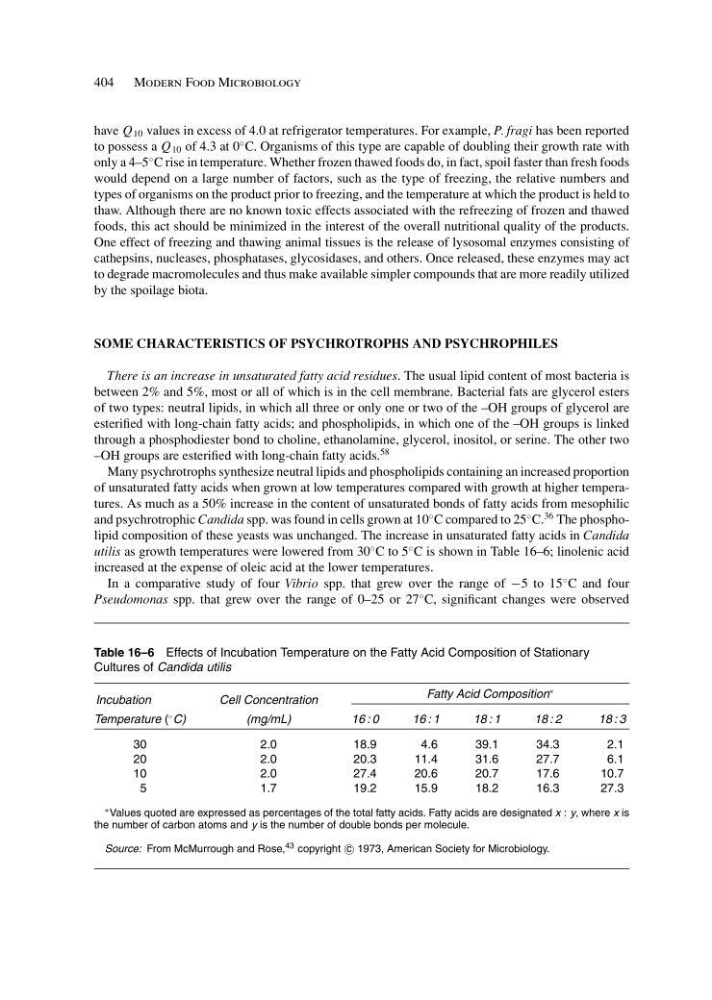
36 The phospholipid composition of these yeasts was unchanged. The increase in unsaturated fatty acids in Candida
utilis as growth temperatures were lowered from 30
◦ C to 5
◦ C is shown in Table 16–6; linolenic acid
increased at the expense of oleic acid at the lower temperatures.
In a comparative study of four Vibrio spp. that grew over the range of −5 to 15
◦ C and four
Pseudomonas spp. that grew over the range of 0–25 or 27
◦ C, significant changes were observed
Table 16–6 Effects of Incubation Temperature on the Fatty Acid Composition of Stationary
Cultures of Candida utilis
Incubation
Cell Concentration
Fatty Acid Composition
∗
Temperature (
◦ C)
(mg/mL)
16 : 0
16 : 1
18 : 1
18 : 2
18 : 3
30
2.0
18.9
4.6
39.1
34.3
2.1
20
2.0
20.3
11.4
31.6
27.7
6.1
10
2.0
27.4
20.6
20.7
17.6
10.7
5
1.7
19.2
15.9
18.2
16.3
27.3
∗ Values quoted are expressed as percentages of the total fatty acids. Fatty acids are designated x : y, where x is
the number of carbon atoms and y is the number of double bonds per molecule.
Source: From McMurrough and Rose, 43 copyright c
1973, American Society for Microbiology.
have Q 10 values in excess of 4.0 at refrigerator temperatures. For example, P. fragi has been reported
to possess a Q 10 of 4.3 at 0
◦ C. Organisms of this type are capable of doubling their growth rate with
only a 4–5
◦ C rise in temperature. Whether frozen thawed foods do, in fact, spoil faster than fresh foods
would depend on a large number of factors, such as the type of freezing, the relative numbers and
types of organisms on the product prior to freezing, and the temperature at which the product is held to
thaw. Although there are no known toxic effects associated with the refreezing of frozen and thawed
foods, this act should be minimized in the interest of the overall nutritional quality of the products.
One effect of freezing and thawing animal tissues is the release of lysosomal enzymes consisting of
cathepsins, nucleases, phosphatases, glycosidases, and others. Once released, these enzymes may act
to degrade macromolecules and thus make available simpler compounds that are more readily utilized
by the spoilage biota.
SOME CHARACTERISTICS OF PSYCHROTROPHS AND PSYCHROPHILES
There is an increase in unsaturated fatty acid residues. The usual lipid content of most bacteria is
between 2% and 5%, most or all of which is in the cell membrane. Bacterial fats are glycerol esters
of two types: neutral lipids, in which all three or only one or two of the –OH groups of glycerol are
esterified with long-chain fatty acids; and phospholipids, in which one of the –OH groups is linked
through a phosphodiester bond to choline, ethanolamine, glycerol, inositol, or serine. The other two
–OH groups are esterified with long-chain fatty acids.
58
Many psychrotrophs synthesize neutral lipids and phospholipids containing an increased proportion
of unsaturated fatty acids when grown at low temperatures compared with growth at higher temperatures. As much as a 50% increase in the content of unsaturated bonds of fatty acids from mesophilic
and psychrotrophic Candida spp. was found in cells grown at 10
◦ C compared to 25
◦ C.
36 The phospholipid composition of these yeasts was unchanged. The increase in unsaturated fatty acids in Candida
utilis as growth temperatures were lowered from 30
◦ C to 5
◦ C is shown in Table 16–6; linolenic acid
increased at the expense of oleic acid at the lower temperatures.
In a comparative study of four Vibrio spp. that grew over the range of −5 to 15
◦ C and four
Pseudomonas spp. that grew over the range of 0–25 or 27
◦ C, significant changes were observed
Table 16–6 Effects of Incubation Temperature on the Fatty Acid Composition of Stationary
Cultures of Candida utilis
Incubation
Cell Concentration
Fatty Acid Composition
∗
Temperature (
◦ C)
(mg/mL)
16 : 0
16 : 1
18 : 1
18 : 2
18 : 3
30
2.0
18.9
4.6
39.1
34.3
2.1
20
2.0
20.3
11.4
31.6
27.7
6.1
10
2.0
27.4
20.6
20.7
17.6
10.7
5
1.7
19.2
15.9
18.2
16.3
27.3
∗ Values quoted are expressed as percentages of the total fatty acids. Fatty acids are designated x : y, where x is
the number of carbon atoms and y is the number of double bonds per molecule.
Source: From McMurrough and Rose, 43 copyright c
1973, American Society for Microbiology.