

376 Modern Food Microbiology
APPLICATION OF RADIATION
The two most widely used techniques of irradiating foods are gamma radiation from either
60 Co or
137 Cs, and the use of electron beams from linear accelerators.
Gamma Radiation
The advantage of gamma radiation is that
60 Co and
137 Cs are relatively inexpensive byproducts of
atomic fission. In a common experimental radiation chamber employing these elements, the radioactive
material is placed on the top of an elevator that can be moved up for use and down under water when
not in use. Materials to be irradiated are placed around the radioactive material (the source) at a suitable
distance for the desired dosage. Once the chamber has been vacated by all personnel, the source is
raised into position, and the gamma rays irradiate the food. Irradiation at desired temperatures may
be achieved either by placing the samples in temperature-controlled containers or by controlling the
temperature of the entire concrete-leadwalled chamber. Among the drawbacks to the use of radioactive
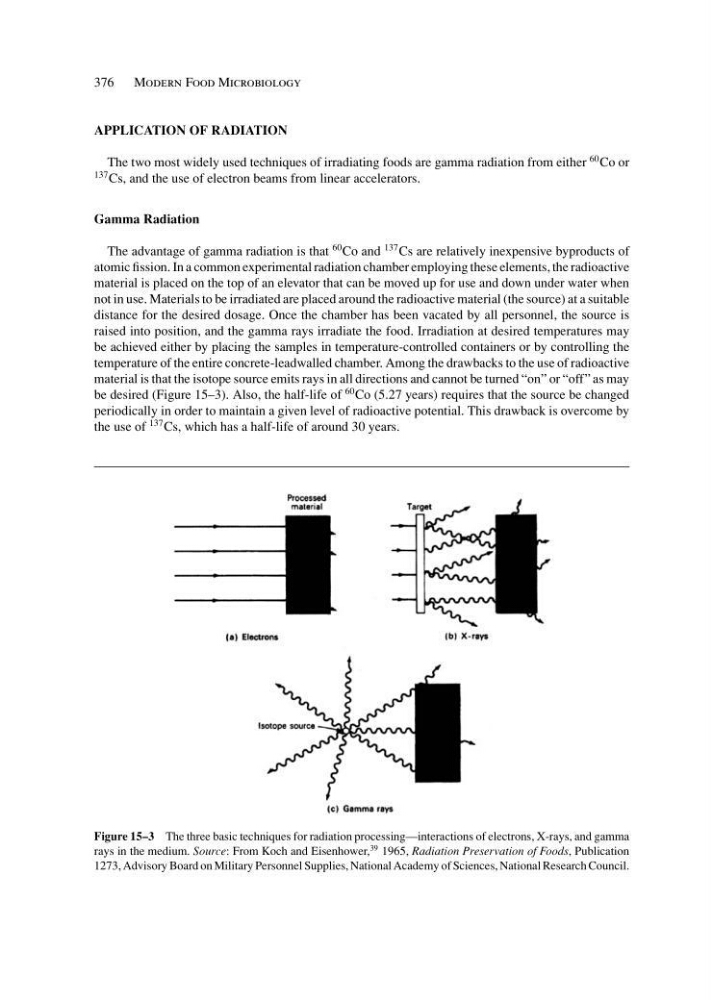
material is that the isotope source emits rays in all directions and cannot be turned “on” or “off” as may
be desired (Figure 15–3). Also, the half-life of
60 Co (5.27 years) requires that the source be changed
periodically in order to maintain a given level of radioactive potential. This drawback is overcome by
the use of
137 Cs, which has a half-life of around 30 years.
Figure 15–3 The three basic techniques for radiation processing—interactions of electrons, X-rays, and gamma
rays in the medium. Source: From Koch and Eisenhower,
39 1965, Radiation Preservation of Foods, Publication
1273, Advisory Board on Military Personnel Supplies, National Academy of Sciences, National Research Council.
APPLICATION OF RADIATION
The two most widely used techniques of irradiating foods are gamma radiation from either
60 Co or
137 Cs, and the use of electron beams from linear accelerators.
Gamma Radiation
The advantage of gamma radiation is that
60 Co and
137 Cs are relatively inexpensive byproducts of
atomic fission. In a common experimental radiation chamber employing these elements, the radioactive
material is placed on the top of an elevator that can be moved up for use and down under water when
not in use. Materials to be irradiated are placed around the radioactive material (the source) at a suitable
distance for the desired dosage. Once the chamber has been vacated by all personnel, the source is
raised into position, and the gamma rays irradiate the food. Irradiation at desired temperatures may
be achieved either by placing the samples in temperature-controlled containers or by controlling the
temperature of the entire concrete-leadwalled chamber. Among the drawbacks to the use of radioactive
material is that the isotope source emits rays in all directions and cannot be turned “on” or “off” as may
be desired (Figure 15–3). Also, the half-life of
60 Co (5.27 years) requires that the source be changed
periodically in order to maintain a given level of radioactive potential. This drawback is overcome by
the use of
137 Cs, which has a half-life of around 30 years.
Figure 15–3 The three basic techniques for radiation processing—interactions of electrons, X-rays, and gamma
rays in the medium. Source: From Koch and Eisenhower,
39 1965, Radiation Preservation of Foods, Publication
1273, Advisory Board on Military Personnel Supplies, National Academy of Sciences, National Research Council.