

372 Modern Food Microbiology
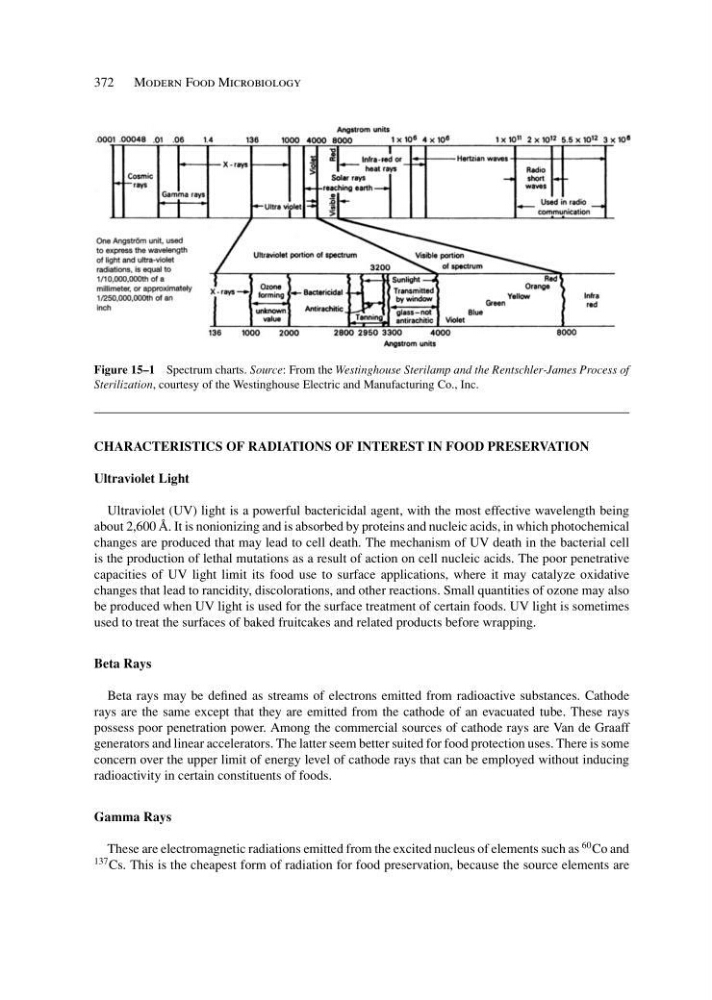
Figure 15–1 Spectrum charts. Source: From the Westinghouse Sterilamp and the Rentschler-James Process of
Sterilization, courtesy of the Westinghouse Electric and Manufacturing Co., Inc.
CHARACTERISTICS OF RADIATIONS OF INTEREST IN FOOD PRESERVATION
Ultraviolet Light
Ultraviolet (UV) light is a powerful bactericidal agent, with the most effective wavelength being
about 2,600 ˚
A. It is nonionizing and is absorbed by proteins and nucleic acids, in which photochemical
changes are produced that may lead to cell death. The mechanism of UV death in the bacterial cell
is the production of lethal mutations as a result of action on cell nucleic acids. The poor penetrative
capacities of UV light limit its food use to surface applications, where it may catalyze oxidative
changes that lead to rancidity, discolorations, and other reactions. Small quantities of ozone may also
be produced when UV light is used for the surface treatment of certain foods. UV light is sometimes
used to treat the surfaces of baked fruitcakes and related products before wrapping.
Beta Rays
Beta rays may be defined as streams of electrons emitted from radioactive substances. Cathode
rays are the same except that they are emitted from the cathode of an evacuated tube. These rays
possess poor penetration power. Among the commercial sources of cathode rays are Van de Graaff
generators and linear accelerators. The latter seem better suited for food protection uses. There is some
concern over the upper limit of energy level of cathode rays that can be employed without inducing
radioactivity in certain constituents of foods.
Gamma Rays
These are electromagnetic radiations emitted from the excited nucleus of elements such as
60 Co and
137 Cs. This is the cheapest form of radiation for food preservation, because the source elements are
Figure 15–1 Spectrum charts. Source: From the Westinghouse Sterilamp and the Rentschler-James Process of
Sterilization, courtesy of the Westinghouse Electric and Manufacturing Co., Inc.
CHARACTERISTICS OF RADIATIONS OF INTEREST IN FOOD PRESERVATION
Ultraviolet Light
Ultraviolet (UV) light is a powerful bactericidal agent, with the most effective wavelength being
about 2,600 ˚
A. It is nonionizing and is absorbed by proteins and nucleic acids, in which photochemical
changes are produced that may lead to cell death. The mechanism of UV death in the bacterial cell
is the production of lethal mutations as a result of action on cell nucleic acids. The poor penetrative
capacities of UV light limit its food use to surface applications, where it may catalyze oxidative
changes that lead to rancidity, discolorations, and other reactions. Small quantities of ozone may also
be produced when UV light is used for the surface treatment of certain foods. UV light is sometimes
used to treat the surfaces of baked fruitcakes and related products before wrapping.
Beta Rays
Beta rays may be defined as streams of electrons emitted from radioactive substances. Cathode
rays are the same except that they are emitted from the cathode of an evacuated tube. These rays
possess poor penetration power. Among the commercial sources of cathode rays are Van de Graaff
generators and linear accelerators. The latter seem better suited for food protection uses. There is some
concern over the upper limit of energy level of cathode rays that can be employed without inducing
radioactivity in certain constituents of foods.
Gamma Rays
These are electromagnetic radiations emitted from the excited nucleus of elements such as
60 Co and
137 Cs. This is the cheapest form of radiation for food preservation, because the source elements are