

362 Modern Food Microbiology
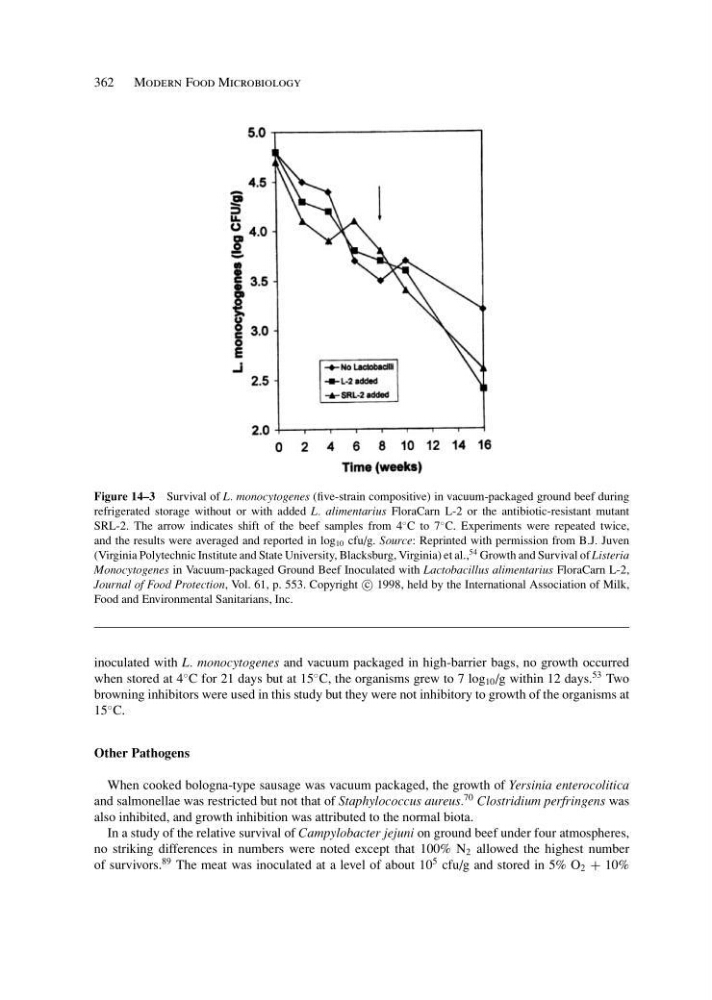
Figure 14–3 Survival of L. monocytogenes (five-strain compositive) in vacuum-packaged ground beef during
refrigerated storage without or with added L. alimentarius FloraCarn L-2 or the antibiotic-resistant mutant
SRL-2. The arrow indicates shift of the beef samples from 4
◦ C to 7
◦ C. Experiments were repeated twice,
and the results were averaged and reported in log 10 cfu/g. Source: Reprinted with permission from B.J. Juven
(Virginia Polytechnic Institute and State University, Blacksburg, Virginia) et al.,
54 Growth and Survival of Listeria
Monocytogenes in Vacuum-packaged Ground Beef Inoculated with Lactobacillus alimentarius FloraCarn L-2,
Journal of Food Protection, Vol. 61, p. 553. Copyright c
1998, held by the International Association of Milk,
Food and Environmental Sanitarians, Inc.
inoculated with L. monocytogenes and vacuum packaged in high-barrier bags, no growth occurred
when stored at 4
◦ C for 21 days but at 15
◦ C, the organisms grew to 7 log 10 /g within 12 days.
53 Two
browning inhibitors were used in this study but they were not inhibitory to growth of the organisms at
15
◦ C.
Other Pathogens
When cooked bologna-type sausage was vacuum packaged, the growth of Yersinia enterocolitica
and salmonellae was restricted but not that of Staphylococcus aureus.
70 Clostridium perfringens was
also inhibited, and growth inhibition was attributed to the normal biota.
In a study of the relative survival of Campylobacter jejuni on ground beef under four atmospheres,
no striking differences in numbers were noted except that 100% N 2 allowed the highest number
of survivors.
89 The meat was inoculated at a level of about 10
5 cfu/g and stored in 5% O 2 + 10%
Figure 14–3 Survival of L. monocytogenes (five-strain compositive) in vacuum-packaged ground beef during
refrigerated storage without or with added L. alimentarius FloraCarn L-2 or the antibiotic-resistant mutant
SRL-2. The arrow indicates shift of the beef samples from 4
◦ C to 7
◦ C. Experiments were repeated twice,
and the results were averaged and reported in log 10 cfu/g. Source: Reprinted with permission from B.J. Juven
(Virginia Polytechnic Institute and State University, Blacksburg, Virginia) et al.,
54 Growth and Survival of Listeria
Monocytogenes in Vacuum-packaged Ground Beef Inoculated with Lactobacillus alimentarius FloraCarn L-2,
Journal of Food Protection, Vol. 61, p. 553. Copyright c
1998, held by the International Association of Milk,
Food and Environmental Sanitarians, Inc.
inoculated with L. monocytogenes and vacuum packaged in high-barrier bags, no growth occurred
when stored at 4
◦ C for 21 days but at 15
◦ C, the organisms grew to 7 log 10 /g within 12 days.
53 Two
browning inhibitors were used in this study but they were not inhibitory to growth of the organisms at
15
◦ C.
Other Pathogens
When cooked bologna-type sausage was vacuum packaged, the growth of Yersinia enterocolitica
and salmonellae was restricted but not that of Staphylococcus aureus.
70 Clostridium perfringens was
also inhibited, and growth inhibition was attributed to the normal biota.
In a study of the relative survival of Campylobacter jejuni on ground beef under four atmospheres,
no striking differences in numbers were noted except that 100% N 2 allowed the highest number
of survivors.
89 The meat was inoculated at a level of about 10
5 cfu/g and stored in 5% O 2 + 10%