

Food Protection with Modified Atmospheres
359
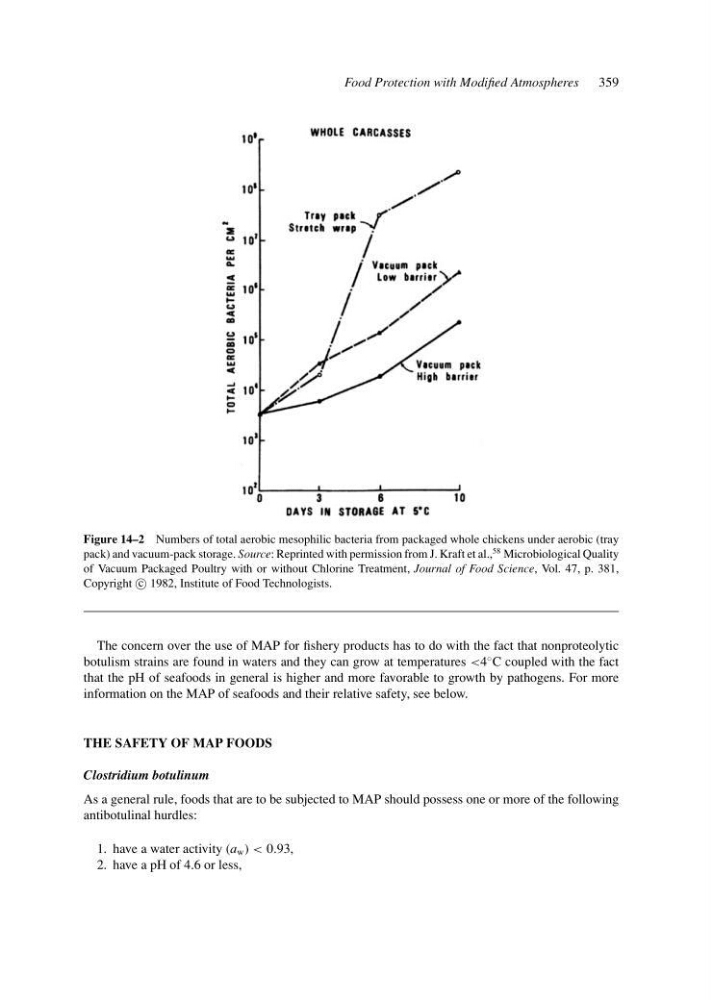
Figure 14–2 Numbers of total aerobic mesophilic bacteria from packaged whole chickens under aerobic (tray
pack) and vacuum-pack storage. Source: Reprinted with permission from J. Kraft et al.,
58 Microbiological Quality
of Vacuum Packaged Poultry with or without Chlorine Treatment, Journal of Food Science, Vol. 47, p. 381,
Copyright c
1982, Institute of Food Technologists.
The concern over the use of MAP for fishery products has to do with the fact that nonproteolytic
botulism strains are found in waters and they can grow at temperatures <4
◦ C coupled with the fact
that the pH of seafoods in general is higher and more favorable to growth by pathogens. For more
information on the MAP of seafoods and their relative safety, see below.
THE SAFETY OF MAP FOODS
Clostridium botulinum
As a general rule, foods that are to be subjected to MAP should possess one or more of the following
antibotulinal hurdles:
1. have a water activity (a w ) < 0.93,
2. have a pH of 4.6 or less,
359
Figure 14–2 Numbers of total aerobic mesophilic bacteria from packaged whole chickens under aerobic (tray
pack) and vacuum-pack storage. Source: Reprinted with permission from J. Kraft et al.,
58 Microbiological Quality
of Vacuum Packaged Poultry with or without Chlorine Treatment, Journal of Food Science, Vol. 47, p. 381,
Copyright c
1982, Institute of Food Technologists.
The concern over the use of MAP for fishery products has to do with the fact that nonproteolytic
botulism strains are found in waters and they can grow at temperatures <4
◦ C coupled with the fact
that the pH of seafoods in general is higher and more favorable to growth by pathogens. For more
information on the MAP of seafoods and their relative safety, see below.
THE SAFETY OF MAP FOODS
Clostridium botulinum
As a general rule, foods that are to be subjected to MAP should possess one or more of the following
antibotulinal hurdles:
1. have a water activity (a w ) < 0.93,
2. have a pH of 4.6 or less,