

Food Protection with Modified Atmospheres
357
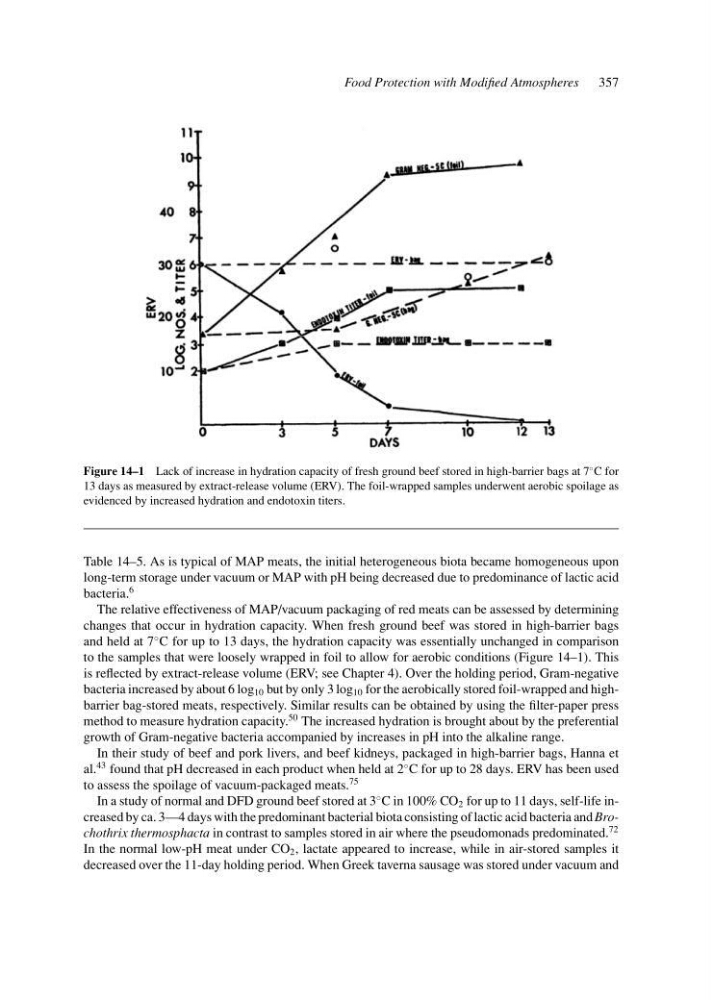
Figure 14–1 Lack of increase in hydration capacity of fresh ground beef stored in high-barrier bags at 7
◦ C for
13 days as measured by extract-release volume (ERV). The foil-wrapped samples underwent aerobic spoilage as
evidenced by increased hydration and endotoxin titers.
Table 14–5. As is typical of MAP meats, the initial heterogeneous biota became homogeneous upon
long-term storage under vacuum or MAP with pH being decreased due to predominance of lactic acid
bacteria.
6
The relative effectiveness of MAP/vacuum packaging of red meats can be assessed by determining
changes that occur in hydration capacity. When fresh ground beef was stored in high-barrier bags
and held at 7
◦ C for up to 13 days, the hydration capacity was essentially unchanged in comparison
to the samples that were loosely wrapped in foil to allow for aerobic conditions (Figure 14–1). This
is reflected by extract-release volume (ERV; see Chapter 4). Over the holding period, Gram-negative
bacteria increased by about 6 log 10 but by only 3 log 10 for the aerobically stored foil-wrapped and highbarrier bag-stored meats, respectively. Similar results can be obtained by using the filter-paper press
method to measure hydration capacity.
50 The increased hydration is brought about by the preferential
growth of Gram-negative bacteria accompanied by increases in pH into the alkaline range.
In their study of beef and pork livers, and beef kidneys, packaged in high-barrier bags, Hanna et
al.
43 found that pH decreased in each product when held at 2
◦ C for up to 28 days. ERV has been used
to assess the spoilage of vacuum-packaged meats.
75
In a study of normal and DFD ground beef stored at 3
◦ C in 100% CO 2 for up to 11 days, self-life increased by ca. 3—4 days with the predominant bacterial biota consisting of lactic acid bacteria and Brochothrix thermosphacta in contrast to samples stored in air where the pseudomonads predominated.
72
In the normal low-pH meat under CO 2 , lactate appeared to increase, while in air-stored samples it
decreased over the 11-day holding period. When Greek taverna sausage was stored under vacuum and
357
Figure 14–1 Lack of increase in hydration capacity of fresh ground beef stored in high-barrier bags at 7
◦ C for
13 days as measured by extract-release volume (ERV). The foil-wrapped samples underwent aerobic spoilage as
evidenced by increased hydration and endotoxin titers.
Table 14–5. As is typical of MAP meats, the initial heterogeneous biota became homogeneous upon
long-term storage under vacuum or MAP with pH being decreased due to predominance of lactic acid
bacteria.
6
The relative effectiveness of MAP/vacuum packaging of red meats can be assessed by determining
changes that occur in hydration capacity. When fresh ground beef was stored in high-barrier bags
and held at 7
◦ C for up to 13 days, the hydration capacity was essentially unchanged in comparison
to the samples that were loosely wrapped in foil to allow for aerobic conditions (Figure 14–1). This
is reflected by extract-release volume (ERV; see Chapter 4). Over the holding period, Gram-negative
bacteria increased by about 6 log 10 but by only 3 log 10 for the aerobically stored foil-wrapped and highbarrier bag-stored meats, respectively. Similar results can be obtained by using the filter-paper press
method to measure hydration capacity.
50 The increased hydration is brought about by the preferential
growth of Gram-negative bacteria accompanied by increases in pH into the alkaline range.
In their study of beef and pork livers, and beef kidneys, packaged in high-barrier bags, Hanna et
al.
43 found that pH decreased in each product when held at 2
◦ C for up to 28 days. ERV has been used
to assess the spoilage of vacuum-packaged meats.
75
In a study of normal and DFD ground beef stored at 3
◦ C in 100% CO 2 for up to 11 days, self-life increased by ca. 3—4 days with the predominant bacterial biota consisting of lactic acid bacteria and Brochothrix thermosphacta in contrast to samples stored in air where the pseudomonads predominated.
72
In the normal low-pH meat under CO 2 , lactate appeared to increase, while in air-stored samples it
decreased over the 11-day holding period. When Greek taverna sausage was stored under vacuum and