

338 Modern Food Microbiology
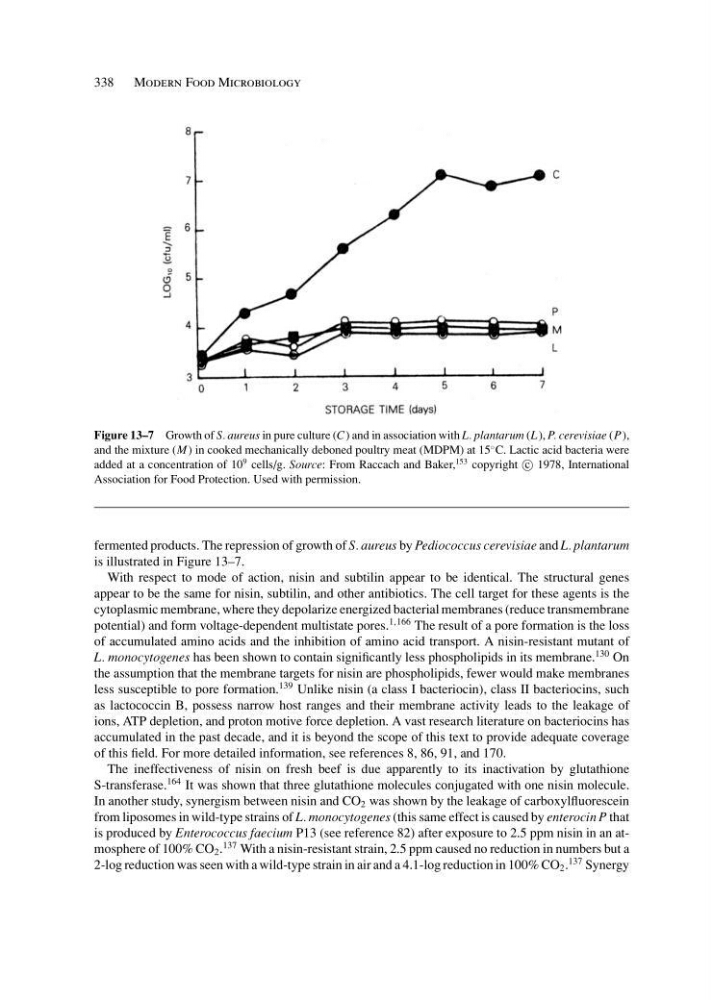
Figure 13–7 Growth of S. aureus in pure culture (C) and in association with L. plantarum (L), P. cerevisiae (P),
and the mixture (M) in cooked mechanically deboned poultry meat (MDPM) at 15
◦ C. Lactic acid bacteria were
added at a concentration of 10
9 cells/g. Source: From Raccach and Baker,
153 copyright c
1978, International
Association for Food Protection. Used with permission.
fermented products. The repression of growth of S. aureus by Pediococcus cerevisiae and L. plantarum
is illustrated in Figure 13–7.
With respect to mode of action, nisin and subtilin appear to be identical. The structural genes
appear to be the same for nisin, subtilin, and other antibiotics. The cell target for these agents is the
cytoplasmic membrane, where they depolarize energized bacterial membranes (reduce transmembrane
potential) and form voltage-dependent multistate pores.
1,166 The result of a pore formation is the loss
of accumulated amino acids and the inhibition of amino acid transport. A nisin-resistant mutant of
L. monocytogenes has been shown to contain significantly less phospholipids in its membrane.
130 On
the assumption that the membrane targets for nisin are phospholipids, fewer would make membranes
less susceptible to pore formation.
139 Unlike nisin (a class I bacteriocin), class II bacteriocins, such
as lactococcin B, possess narrow host ranges and their membrane activity leads to the leakage of
ions, ATP depletion, and proton motive force depletion. A vast research literature on bacteriocins has
accumulated in the past decade, and it is beyond the scope of this text to provide adequate coverage
of this field. For more detailed information, see references 8, 86, 91, and 170.
The ineffectiveness of nisin on fresh beef is due apparently to its inactivation by glutathione
S-transferase.
164 It was shown that three glutathione molecules conjugated with one nisin molecule.
In another study, synergism between nisin and CO 2 was shown by the leakage of carboxylfluorescein
from liposomes in wild-type strains of L. monocytogenes (this same effect is caused by enterocin P that
is produced by Enterococcus faecium P13 (see reference 82) after exposure to 2.5 ppm nisin in an atmosphere of 100% CO 2 .
137 With a nisin-resistant strain, 2.5 ppm caused no reduction in numbers but a
2-log reduction was seen with a wild-type strain in air and a 4.1-log reduction in 100% CO 2 .
137 Synergy
Figure 13–7 Growth of S. aureus in pure culture (C) and in association with L. plantarum (L), P. cerevisiae (P),
and the mixture (M) in cooked mechanically deboned poultry meat (MDPM) at 15
◦ C. Lactic acid bacteria were
added at a concentration of 10
9 cells/g. Source: From Raccach and Baker,
153 copyright c
1978, International
Association for Food Protection. Used with permission.
fermented products. The repression of growth of S. aureus by Pediococcus cerevisiae and L. plantarum
is illustrated in Figure 13–7.
With respect to mode of action, nisin and subtilin appear to be identical. The structural genes
appear to be the same for nisin, subtilin, and other antibiotics. The cell target for these agents is the
cytoplasmic membrane, where they depolarize energized bacterial membranes (reduce transmembrane
potential) and form voltage-dependent multistate pores.
1,166 The result of a pore formation is the loss
of accumulated amino acids and the inhibition of amino acid transport. A nisin-resistant mutant of
L. monocytogenes has been shown to contain significantly less phospholipids in its membrane.
130 On
the assumption that the membrane targets for nisin are phospholipids, fewer would make membranes
less susceptible to pore formation.
139 Unlike nisin (a class I bacteriocin), class II bacteriocins, such
as lactococcin B, possess narrow host ranges and their membrane activity leads to the leakage of
ions, ATP depletion, and proton motive force depletion. A vast research literature on bacteriocins has
accumulated in the past decade, and it is beyond the scope of this text to provide adequate coverage
of this field. For more detailed information, see references 8, 86, 91, and 170.
The ineffectiveness of nisin on fresh beef is due apparently to its inactivation by glutathione
S-transferase.
164 It was shown that three glutathione molecules conjugated with one nisin molecule.
In another study, synergism between nisin and CO 2 was shown by the leakage of carboxylfluorescein
from liposomes in wild-type strains of L. monocytogenes (this same effect is caused by enterocin P that
is produced by Enterococcus faecium P13 (see reference 82) after exposure to 2.5 ppm nisin in an atmosphere of 100% CO 2 .
137 With a nisin-resistant strain, 2.5 ppm caused no reduction in numbers but a
2-log reduction was seen with a wild-type strain in air and a 4.1-log reduction in 100% CO 2 .
137 Synergy