

Food Protection with Chemicals, and by Biocontrol 321
Sugars, such as sucrose, exert their preserving effect in essentially the same manner as salt. One of
the main differences lies in relative concentrations. It generally requires about six times more sucrose
than NaCl to effect the same degree of inhibition. The most common uses of sugars as preserving agents
are in the making of fruit preserves, candies, condensed milk, and the like. The shelf stability of certain
pies, cakes, and other such products is due in large part to the preserving effect of high concentrations
of sugar, which, like salt, makes water unavailable to microorganisms. Bacterial pathogens inoculated
into liquid sweeteners (such as high-fructose corn syrup) at levels of about 10
5 /g could not be detected
after 3 days at normal storage temperatures
139 and these investigators suggested that the incidental
contamination of such products by pathogens should be of no public health concern.
Microorganisms differ in their response to hypertonic concentrations of sugars, with yeasts and
molds being less susceptible than bacteria. Some yeasts and molds can grow in the presence of as
much as 60% sucrose, whereas most bacteria are inhibited by much lower levels. Organisms that are
able to grow in high concentrations of sugars are designated osmophiles; osmoduric microorganisms
are those that are unable to grow but are able to withstand high levels of sugars. Some osmophilic yeasts
such as Zygosaccharomyces rouxii can grow in the presence of extremely high concentrations of sugars.
INDIRECT ANTIMICROBIALS
The compounds and products in this section are added to foods primarily for effects other than
antimicrobial and are thus multifunctional food additives.
Antioxidants
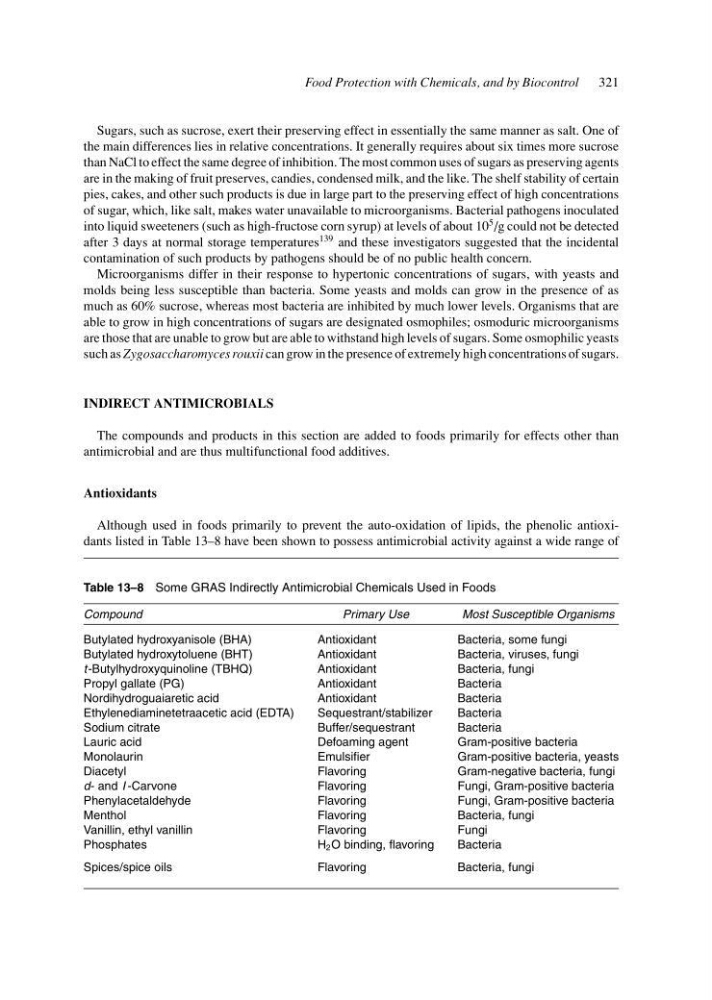
Although used in foods primarily to prevent the auto-oxidation of lipids, the phenolic antioxidants listed in Table 13–8 have been shown to possess antimicrobial activity against a wide range of
Table 13–8 Some GRAS Indirectly Antimicrobial Chemicals Used in Foods
Compound
Primary Use
Most Susceptible Organisms
Butylated hydroxyanisole (BHA)
Antioxidant
Bacteria, some fungi
Butylated hydroxytoluene (BHT)
Antioxidant
Bacteria, viruses, fungi
t-Butylhydroxyquinoline (TBHQ)
Antioxidant
Bacteria, fungi
Propyl gallate (PG)
Antioxidant
Bacteria
Nordihydroguaiaretic acid
Antioxidant
Bacteria
Ethylenediaminetetraacetic acid (EDTA)
Sequestrant/stabilizer
Bacteria
Sodium citrate
Buffer/sequestrant
Bacteria
Lauric acid
Defoaming agent
Gram-positive bacteria
Monolaurin
Emulsifier
Gram-positive bacteria, yeasts
Diacetyl
Flavoring
Gram-negative bacteria, fungi
d- and I -Carvone
Flavoring
Fungi, Gram-positive bacteria
Phenylacetaldehyde
Flavoring
Fungi, Gram-positive bacteria
Menthol
Flavoring
Bacteria, fungi
Vanillin, ethyl vanillin
Flavoring
Fungi
Phosphates
H 2 O binding, flavoring
Bacteria
Spices/spice oils
Flavoring
Bacteria, fungi
Sugars, such as sucrose, exert their preserving effect in essentially the same manner as salt. One of
the main differences lies in relative concentrations. It generally requires about six times more sucrose
than NaCl to effect the same degree of inhibition. The most common uses of sugars as preserving agents
are in the making of fruit preserves, candies, condensed milk, and the like. The shelf stability of certain
pies, cakes, and other such products is due in large part to the preserving effect of high concentrations
of sugar, which, like salt, makes water unavailable to microorganisms. Bacterial pathogens inoculated
into liquid sweeteners (such as high-fructose corn syrup) at levels of about 10
5 /g could not be detected
after 3 days at normal storage temperatures
139 and these investigators suggested that the incidental
contamination of such products by pathogens should be of no public health concern.
Microorganisms differ in their response to hypertonic concentrations of sugars, with yeasts and
molds being less susceptible than bacteria. Some yeasts and molds can grow in the presence of as
much as 60% sucrose, whereas most bacteria are inhibited by much lower levels. Organisms that are
able to grow in high concentrations of sugars are designated osmophiles; osmoduric microorganisms
are those that are unable to grow but are able to withstand high levels of sugars. Some osmophilic yeasts
such as Zygosaccharomyces rouxii can grow in the presence of extremely high concentrations of sugars.
INDIRECT ANTIMICROBIALS
The compounds and products in this section are added to foods primarily for effects other than
antimicrobial and are thus multifunctional food additives.
Antioxidants
Although used in foods primarily to prevent the auto-oxidation of lipids, the phenolic antioxidants listed in Table 13–8 have been shown to possess antimicrobial activity against a wide range of
Table 13–8 Some GRAS Indirectly Antimicrobial Chemicals Used in Foods
Compound
Primary Use
Most Susceptible Organisms
Butylated hydroxyanisole (BHA)
Antioxidant
Bacteria, some fungi
Butylated hydroxytoluene (BHT)
Antioxidant
Bacteria, viruses, fungi
t-Butylhydroxyquinoline (TBHQ)
Antioxidant
Bacteria, fungi
Propyl gallate (PG)
Antioxidant
Bacteria
Nordihydroguaiaretic acid
Antioxidant
Bacteria
Ethylenediaminetetraacetic acid (EDTA)
Sequestrant/stabilizer
Bacteria
Sodium citrate
Buffer/sequestrant
Bacteria
Lauric acid
Defoaming agent
Gram-positive bacteria
Monolaurin
Emulsifier
Gram-positive bacteria, yeasts
Diacetyl
Flavoring
Gram-negative bacteria, fungi
d- and I -Carvone
Flavoring
Fungi, Gram-positive bacteria
Phenylacetaldehyde
Flavoring
Fungi, Gram-positive bacteria
Menthol
Flavoring
Bacteria, fungi
Vanillin, ethyl vanillin
Flavoring
Fungi
Phosphates
H 2 O binding, flavoring
Bacteria
Spices/spice oils
Flavoring
Bacteria, fungi