

Food Protection with Chemicals, and by Biocontrol 307
utilizing nitrate as an electron acceptor and in the process effect its reduction to nitrite. The nitrite ion
is by far the more important of the two in preserved meats. This ion is highly reactive and is capable
of serving as a reducing and an oxidizing agent. In an acid environment, it ionizes to yield nitrous
acid (3HONO), which further decomposes to yield nitric oxide (NO), the important product from the
standpoint of color fixation in cured meats. Ascorbate or erythrobate acts also to reduce NO 2 to NO.
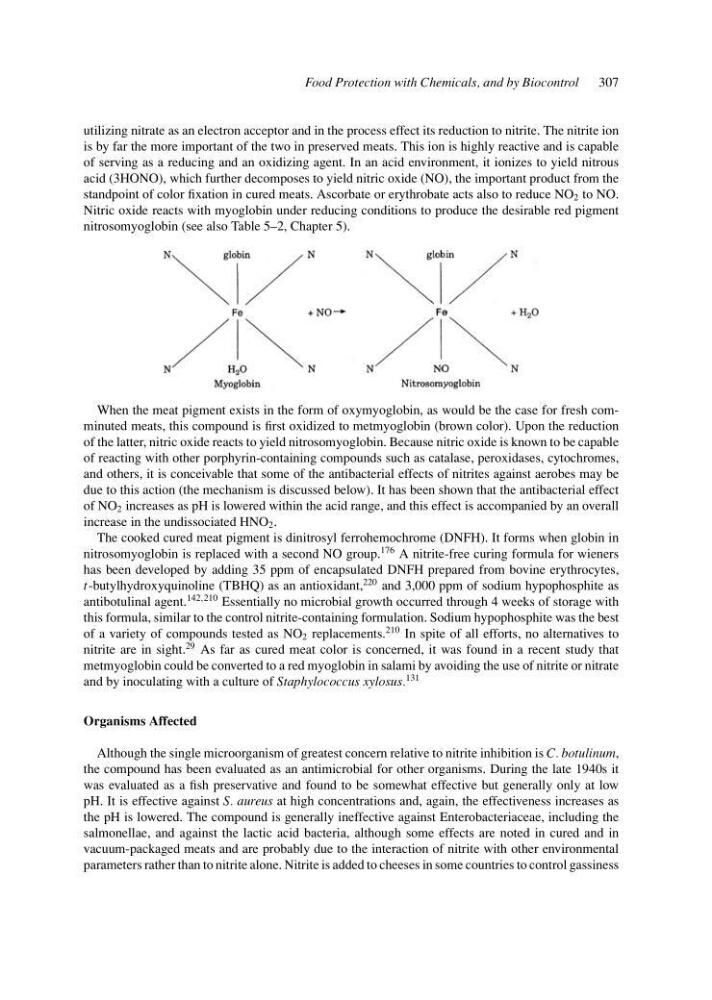
Nitric oxide reacts with myoglobin under reducing conditions to produce the desirable red pigment
nitrosomyoglobin (see also Table 5–2, Chapter 5).
When the meat pigment exists in the form of oxymyoglobin, as would be the case for fresh comminuted meats, this compound is first oxidized to metmyoglobin (brown color). Upon the reduction
of the latter, nitric oxide reacts to yield nitrosomyoglobin. Because nitric oxide is known to be capable
of reacting with other porphyrin-containing compounds such as catalase, peroxidases, cytochromes,
and others, it is conceivable that some of the antibacterial effects of nitrites against aerobes may be
due to this action (the mechanism is discussed below). It has been shown that the antibacterial effect
of NO 2 increases as pH is lowered within the acid range, and this effect is accompanied by an overall
increase in the undissociated HNO 2 .
The cooked cured meat pigment is dinitrosyl ferrohemochrome (DNFH). It forms when globin in
nitrosomyoglobin is replaced with a second NO group.
176 A nitrite-free curing formula for wieners
has been developed by adding 35 ppm of encapsulated DNFH prepared from bovine erythrocytes,
t-butylhydroxyquinoline (TBHQ) as an antioxidant,
220 and 3,000 ppm of sodium hypophosphite as
antibotulinal agent.
142,210 Essentially no microbial growth occurred through 4 weeks of storage with
this formula, similar to the control nitrite-containing formulation. Sodium hypophosphite was the best
of a variety of compounds tested as NO 2 replacements.
210 In spite of all efforts, no alternatives to
nitrite are in sight.
29 As far as cured meat color is concerned, it was found in a recent study that
metmyoglobin could be converted to a red myoglobin in salami by avoiding the use of nitrite or nitrate
and by inoculating with a culture of Staphylococcus xylosus.
131
Organisms Affected
Although the single microorganism of greatest concern relative to nitrite inhibition is C. botulinum,
the compound has been evaluated as an antimicrobial for other organisms. During the late 1940s it
was evaluated as a fish preservative and found to be somewhat effective but generally only at low
pH. It is effective against S. aureus at high concentrations and, again, the effectiveness increases as
the pH is lowered. The compound is generally ineffective against Enterobacteriaceae, including the
salmonellae, and against the lactic acid bacteria, although some effects are noted in cured and in
vacuum-packaged meats and are probably due to the interaction of nitrite with other environmental
parameters rather than to nitrite alone. Nitrite is added to cheeses in some countries to control gassiness
utilizing nitrate as an electron acceptor and in the process effect its reduction to nitrite. The nitrite ion
is by far the more important of the two in preserved meats. This ion is highly reactive and is capable
of serving as a reducing and an oxidizing agent. In an acid environment, it ionizes to yield nitrous
acid (3HONO), which further decomposes to yield nitric oxide (NO), the important product from the
standpoint of color fixation in cured meats. Ascorbate or erythrobate acts also to reduce NO 2 to NO.
Nitric oxide reacts with myoglobin under reducing conditions to produce the desirable red pigment
nitrosomyoglobin (see also Table 5–2, Chapter 5).
When the meat pigment exists in the form of oxymyoglobin, as would be the case for fresh comminuted meats, this compound is first oxidized to metmyoglobin (brown color). Upon the reduction
of the latter, nitric oxide reacts to yield nitrosomyoglobin. Because nitric oxide is known to be capable
of reacting with other porphyrin-containing compounds such as catalase, peroxidases, cytochromes,
and others, it is conceivable that some of the antibacterial effects of nitrites against aerobes may be
due to this action (the mechanism is discussed below). It has been shown that the antibacterial effect
of NO 2 increases as pH is lowered within the acid range, and this effect is accompanied by an overall
increase in the undissociated HNO 2 .
The cooked cured meat pigment is dinitrosyl ferrohemochrome (DNFH). It forms when globin in
nitrosomyoglobin is replaced with a second NO group.
176 A nitrite-free curing formula for wieners
has been developed by adding 35 ppm of encapsulated DNFH prepared from bovine erythrocytes,
t-butylhydroxyquinoline (TBHQ) as an antioxidant,
220 and 3,000 ppm of sodium hypophosphite as
antibotulinal agent.
142,210 Essentially no microbial growth occurred through 4 weeks of storage with
this formula, similar to the control nitrite-containing formulation. Sodium hypophosphite was the best
of a variety of compounds tested as NO 2 replacements.
210 In spite of all efforts, no alternatives to
nitrite are in sight.
29 As far as cured meat color is concerned, it was found in a recent study that
metmyoglobin could be converted to a red myoglobin in salami by avoiding the use of nitrite or nitrate
and by inoculating with a culture of Staphylococcus xylosus.
131
Organisms Affected
Although the single microorganism of greatest concern relative to nitrite inhibition is C. botulinum,
the compound has been evaluated as an antimicrobial for other organisms. During the late 1940s it
was evaluated as a fish preservative and found to be somewhat effective but generally only at low
pH. It is effective against S. aureus at high concentrations and, again, the effectiveness increases as
the pH is lowered. The compound is generally ineffective against Enterobacteriaceae, including the
salmonellae, and against the lactic acid bacteria, although some effects are noted in cured and in
vacuum-packaged meats and are probably due to the interaction of nitrite with other environmental
parameters rather than to nitrite alone. Nitrite is added to cheeses in some countries to control gassiness