

14
Modern Food Microbiology
BACTERIAL TAXONOMY
Many changes have taken place in the classification or taxonomy of bacteria in the past two decades.
Many of the new taxa have been created as a result of the employment of molecular genetic methods,
alone or in combination with some of the more traditional methods:
1. DNA homology and mol% G + C content of DNA
2. 23S, 16S, and 5S rRNA sequence similarities
3. Oligonucleotide cataloging
4. Numerical taxonomic analysis of total soluble proteins or of a battery of morphological and
biochemical characteristics
5. Cell wall analysis
6. Serological profiles
7. Cellular fatty acid profiles
Although some of these have been employed for many years (e.g., cell wall analysis and serological
profiles) others (e.g., ribosomal RNA [rRNA] sequence similarity) came into wide use only during the
1980s. The methods that are the most powerful as bacterial taxonomic tools are outlined and briefly
discussed below.
rRNA Analyses
Taxonomic information can be obtained from RNA in the production of nucleotide catalogs and the
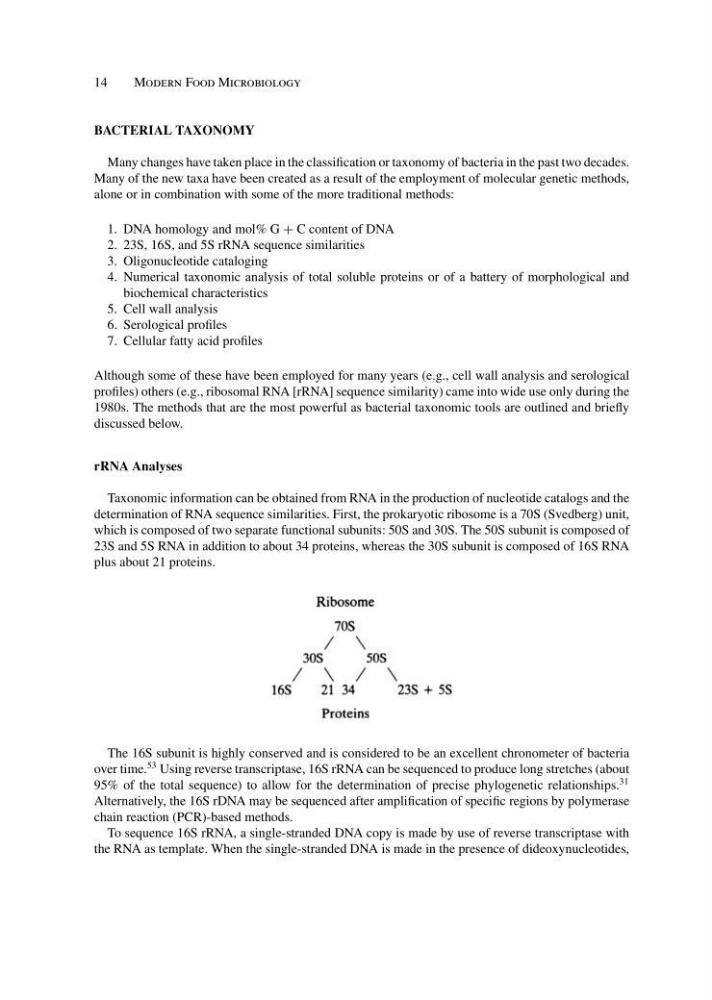
determination of RNA sequence similarities. First, the prokaryotic ribosome is a 70S (Svedberg) unit,
which is composed of two separate functional subunits: 50S and 30S. The 50S subunit is composed of
23S and 5S RNA in addition to about 34 proteins, whereas the 30S subunit is composed of 16S RNA
plus about 21 proteins.
The 16S subunit is highly conserved and is considered to be an excellent chronometer of bacteria
over time.
53 Using reverse transcriptase, 16S rRNA can be sequenced to produce long stretches (about
95% of the total sequence) to allow for the determination of precise phylogenetic relationships.
31
Alternatively, the 16S rDNA may be sequenced after amplification of specific regions by polymerase
chain reaction (PCR)-based methods.
To sequence 16S rRNA, a single-stranded DNA copy is made by use of reverse transcriptase with
the RNA as template. When the single-stranded DNA is made in the presence of dideoxynucleotides,
Modern Food Microbiology
BACTERIAL TAXONOMY
Many changes have taken place in the classification or taxonomy of bacteria in the past two decades.
Many of the new taxa have been created as a result of the employment of molecular genetic methods,
alone or in combination with some of the more traditional methods:
1. DNA homology and mol% G + C content of DNA
2. 23S, 16S, and 5S rRNA sequence similarities
3. Oligonucleotide cataloging
4. Numerical taxonomic analysis of total soluble proteins or of a battery of morphological and
biochemical characteristics
5. Cell wall analysis
6. Serological profiles
7. Cellular fatty acid profiles
Although some of these have been employed for many years (e.g., cell wall analysis and serological
profiles) others (e.g., ribosomal RNA [rRNA] sequence similarity) came into wide use only during the
1980s. The methods that are the most powerful as bacterial taxonomic tools are outlined and briefly
discussed below.
rRNA Analyses
Taxonomic information can be obtained from RNA in the production of nucleotide catalogs and the
determination of RNA sequence similarities. First, the prokaryotic ribosome is a 70S (Svedberg) unit,
which is composed of two separate functional subunits: 50S and 30S. The 50S subunit is composed of
23S and 5S RNA in addition to about 34 proteins, whereas the 30S subunit is composed of 16S RNA
plus about 21 proteins.
The 16S subunit is highly conserved and is considered to be an excellent chronometer of bacteria
over time.
53 Using reverse transcriptase, 16S rRNA can be sequenced to produce long stretches (about
95% of the total sequence) to allow for the determination of precise phylogenetic relationships.
31
Alternatively, the 16S rDNA may be sequenced after amplification of specific regions by polymerase
chain reaction (PCR)-based methods.
To sequence 16S rRNA, a single-stranded DNA copy is made by use of reverse transcriptase with
the RNA as template. When the single-stranded DNA is made in the presence of dideoxynucleotides,