

Chemical, Biological, and Physical Methods
273
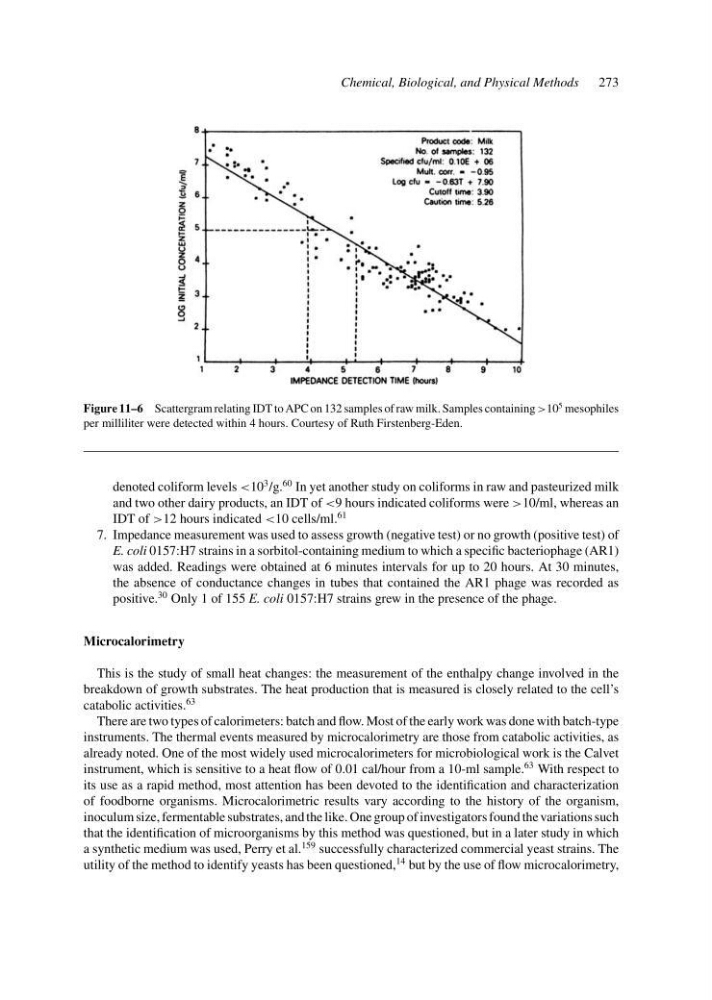
Figure 11–6 Scattergram relating IDT to APC on 132 samples of raw milk. Samples containing >10
5 mesophiles
per milliliter were detected within 4 hours. Courtesy of Ruth Firstenberg-Eden.
denoted coliform levels <10
3 /g.
60 In yet another study on coliforms in raw and pasteurized milk
and two other dairy products, an IDT of <9 hours indicated coliforms were >10/ml, whereas an
IDT of >12 hours indicated <10 cells/ml.
61
7. Impedance measurement was used to assess growth (negative test) or no growth (positive test) of
E. coli 0157:H7 strains in a sorbitol-containing medium to which a specific bacteriophage (AR1)
was added. Readings were obtained at 6 minutes intervals for up to 20 hours. At 30 minutes,
the absence of conductance changes in tubes that contained the AR1 phage was recorded as
positive.
30 Only 1 of 155 E. coli 0157:H7 strains grew in the presence of the phage.
Microcalorimetry
This is the study of small heat changes: the measurement of the enthalpy change involved in the
breakdown of growth substrates. The heat production that is measured is closely related to the cell’s
catabolic activities.
63
There are two types of calorimeters: batch and flow. Most of the early work was done with batch-type
instruments. The thermal events measured by microcalorimetry are those from catabolic activities, as
already noted. One of the most widely used microcalorimeters for microbiological work is the Calvet
instrument, which is sensitive to a heat flow of 0.01 cal/hour from a 10-ml sample.
63 With respect to
its use as a rapid method, most attention has been devoted to the identification and characterization
of foodborne organisms. Microcalorimetric results vary according to the history of the organism,
inoculum size, fermentable substrates, and the like. One group of investigators found the variations such
that the identification of microorganisms by this method was questioned, but in a later study in which
a synthetic medium was used, Perry et al.
159 successfully characterized commercial yeast strains. The
utility of the method to identify yeasts has been questioned,
14 but by the use of flow microcalorimetry,
273
Figure 11–6 Scattergram relating IDT to APC on 132 samples of raw milk. Samples containing >10
5 mesophiles
per milliliter were detected within 4 hours. Courtesy of Ruth Firstenberg-Eden.
denoted coliform levels <10
3 /g.
60 In yet another study on coliforms in raw and pasteurized milk
and two other dairy products, an IDT of <9 hours indicated coliforms were >10/ml, whereas an
IDT of >12 hours indicated <10 cells/ml.
61
7. Impedance measurement was used to assess growth (negative test) or no growth (positive test) of
E. coli 0157:H7 strains in a sorbitol-containing medium to which a specific bacteriophage (AR1)
was added. Readings were obtained at 6 minutes intervals for up to 20 hours. At 30 minutes,
the absence of conductance changes in tubes that contained the AR1 phage was recorded as
positive.
30 Only 1 of 155 E. coli 0157:H7 strains grew in the presence of the phage.
Microcalorimetry
This is the study of small heat changes: the measurement of the enthalpy change involved in the
breakdown of growth substrates. The heat production that is measured is closely related to the cell’s
catabolic activities.
63
There are two types of calorimeters: batch and flow. Most of the early work was done with batch-type
instruments. The thermal events measured by microcalorimetry are those from catabolic activities, as
already noted. One of the most widely used microcalorimeters for microbiological work is the Calvet
instrument, which is sensitive to a heat flow of 0.01 cal/hour from a 10-ml sample.
63 With respect to
its use as a rapid method, most attention has been devoted to the identification and characterization
of foodborne organisms. Microcalorimetric results vary according to the history of the organism,
inoculum size, fermentable substrates, and the like. One group of investigators found the variations such
that the identification of microorganisms by this method was questioned, but in a later study in which
a synthetic medium was used, Perry et al.
159 successfully characterized commercial yeast strains. The
utility of the method to identify yeasts has been questioned,
14 but by the use of flow microcalorimetry,