

268 Modern Food Microbiology
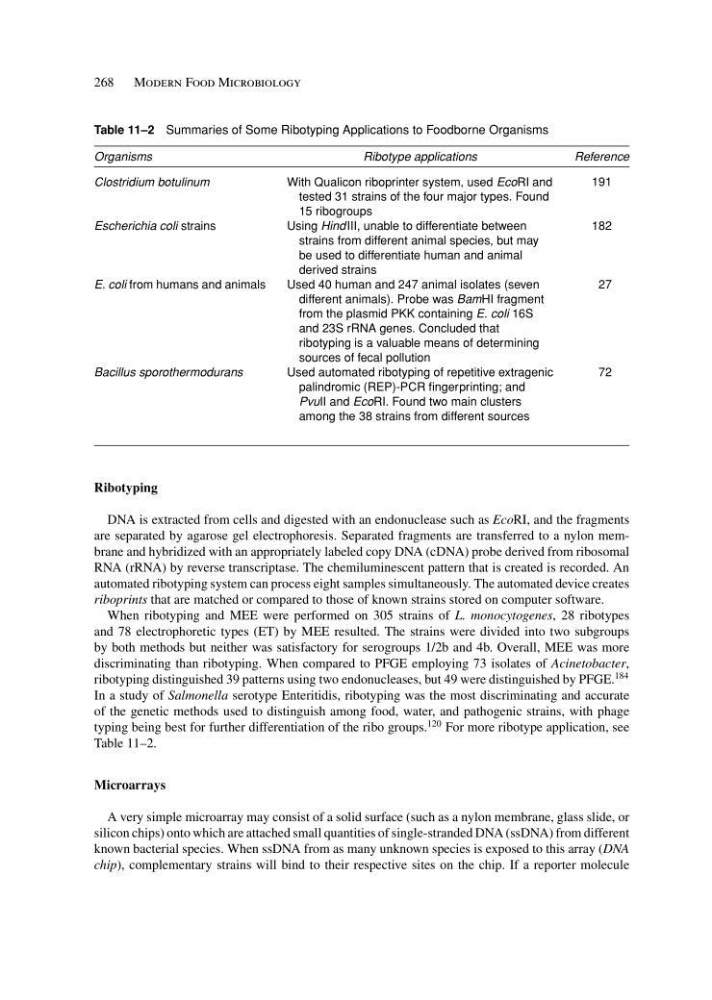
Table 11–2 Summaries of Some Ribotyping Applications to Foodborne Organisms
Organisms
Ribotype applications
Reference
Clostridium botulinum
With Qualicon riboprinter system, used EcoRI and
tested 31 strains of the four major types. Found
15 ribogroups
191
Escherichia coli strains
Using Hind III, unable to differentiate between
strains from different animal species, but may
be used to differentiate human and animal
derived strains
182
E. coli from humans and animals
Used 40 human and 247 animal isolates (seven
different animals). Probe was BamHI fragment
from the plasmid PKK containing E. coli 16S
and 23S rRNA genes. Concluded that
ribotyping is a valuable means of determining
sources of fecal pollution
27
Bacillus sporothermodurans
Used automated ribotyping of repetitive extragenic
palindromic (REP)-PCR fingerprinting; and
PvuII and EcoRI. Found two main clusters
among the 38 strains from different sources
72
Ribotyping
DNA is extracted from cells and digested with an endonuclease such as EcoRI, and the fragments
are separated by agarose gel electrophoresis. Separated fragments are transferred to a nylon membrane and hybridized with an appropriately labeled copy DNA (cDNA) probe derived from ribosomal
RNA (rRNA) by reverse transcriptase. The chemiluminescent pattern that is created is recorded. An
automated ribotyping system can process eight samples simultaneously. The automated device creates
riboprints that are matched or compared to those of known strains stored on computer software.
When ribotyping and MEE were performed on 305 strains of L. monocytogenes, 28 ribotypes
and 78 electrophoretic types (ET) by MEE resulted. The strains were divided into two subgroups
by both methods but neither was satisfactory for serogroups 1/2b and 4b. Overall, MEE was more
discriminating than ribotyping. When compared to PFGE employing 73 isolates of Acinetobacter,
ribotyping distinguished 39 patterns using two endonucleases, but 49 were distinguished by PFGE.
184
In a study of Salmonella serotype Enteritidis, ribotyping was the most discriminating and accurate
of the genetic methods used to distinguish among food, water, and pathogenic strains, with phage
typing being best for further differentiation of the ribo groups.
120 For more ribotype application, see
Table 11–2.
Microarrays
A very simple microarray may consist of a solid surface (such as a nylon membrane, glass slide, or
silicon chips) onto which are attached small quantities of single-stranded DNA (ssDNA) from different
known bacterial species. When ssDNA from as many unknown species is exposed to this array (DNA
chip), complementary strains will bind to their respective sites on the chip. If a reporter molecule
Table 11–2 Summaries of Some Ribotyping Applications to Foodborne Organisms
Organisms
Ribotype applications
Reference
Clostridium botulinum
With Qualicon riboprinter system, used EcoRI and
tested 31 strains of the four major types. Found
15 ribogroups
191
Escherichia coli strains
Using Hind III, unable to differentiate between
strains from different animal species, but may
be used to differentiate human and animal
derived strains
182
E. coli from humans and animals
Used 40 human and 247 animal isolates (seven
different animals). Probe was BamHI fragment
from the plasmid PKK containing E. coli 16S
and 23S rRNA genes. Concluded that
ribotyping is a valuable means of determining
sources of fecal pollution
27
Bacillus sporothermodurans
Used automated ribotyping of repetitive extragenic
palindromic (REP)-PCR fingerprinting; and
PvuII and EcoRI. Found two main clusters
among the 38 strains from different sources
72
Ribotyping
DNA is extracted from cells and digested with an endonuclease such as EcoRI, and the fragments
are separated by agarose gel electrophoresis. Separated fragments are transferred to a nylon membrane and hybridized with an appropriately labeled copy DNA (cDNA) probe derived from ribosomal
RNA (rRNA) by reverse transcriptase. The chemiluminescent pattern that is created is recorded. An
automated ribotyping system can process eight samples simultaneously. The automated device creates
riboprints that are matched or compared to those of known strains stored on computer software.
When ribotyping and MEE were performed on 305 strains of L. monocytogenes, 28 ribotypes
and 78 electrophoretic types (ET) by MEE resulted. The strains were divided into two subgroups
by both methods but neither was satisfactory for serogroups 1/2b and 4b. Overall, MEE was more
discriminating than ribotyping. When compared to PFGE employing 73 isolates of Acinetobacter,
ribotyping distinguished 39 patterns using two endonucleases, but 49 were distinguished by PFGE.
184
In a study of Salmonella serotype Enteritidis, ribotyping was the most discriminating and accurate
of the genetic methods used to distinguish among food, water, and pathogenic strains, with phage
typing being best for further differentiation of the ribo groups.
120 For more ribotype application, see
Table 11–2.
Microarrays
A very simple microarray may consist of a solid surface (such as a nylon membrane, glass slide, or
silicon chips) onto which are attached small quantities of single-stranded DNA (ssDNA) from different
known bacterial species. When ssDNA from as many unknown species is exposed to this array (DNA
chip), complementary strains will bind to their respective sites on the chip. If a reporter molecule