

230 Modern Food Microbiology
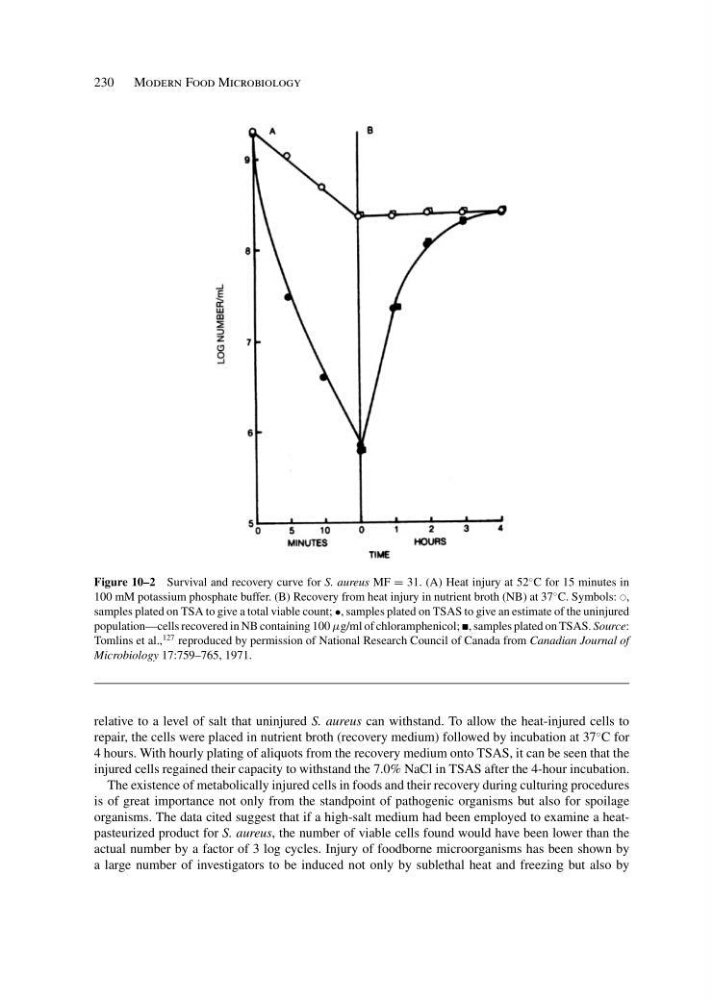
Figure 10–2 Survival and recovery curve for S. aureus MF = 31. (A) Heat injury at 52
◦ C for 15 minutes in
100 mM potassium phosphate buffer. (B) Recovery from heat injury in nutrient broth (NB) at 37
◦ C. Symbols: ᭺,
samples plated on TSA to give a total viable count; •, samples plated on TSAS to give an estimate of the uninjured
population—cells recovered in NB containing 100 µg/ml of chloramphenicol; , samples plated on TSAS. Source:
Tomlins et al.,
127 reproduced by permission of National Research Council of Canada from Canadian Journal of
Microbiology 17:759–765, 1971.
relative to a level of salt that uninjured S. aureus can withstand. To allow the heat-injured cells to
repair, the cells were placed in nutrient broth (recovery medium) followed by incubation at 37
◦ C for
4 hours. With hourly plating of aliquots from the recovery medium onto TSAS, it can be seen that the
injured cells regained their capacity to withstand the 7.0% NaCl in TSAS after the 4-hour incubation.
The existence of metabolically injured cells in foods and their recovery during culturing procedures
is of great importance not only from the standpoint of pathogenic organisms but also for spoilage
organisms. The data cited suggest that if a high-salt medium had been employed to examine a heatpasteurized product for S. aureus, the number of viable cells found would have been lower than the
actual number by a factor of 3 log cycles. Injury of foodborne microorganisms has been shown by
a large number of investigators to be induced not only by sublethal heat and freezing but also by
Figure 10–2 Survival and recovery curve for S. aureus MF = 31. (A) Heat injury at 52
◦ C for 15 minutes in
100 mM potassium phosphate buffer. (B) Recovery from heat injury in nutrient broth (NB) at 37
◦ C. Symbols: ᭺,
samples plated on TSA to give a total viable count; •, samples plated on TSAS to give an estimate of the uninjured
population—cells recovered in NB containing 100 µg/ml of chloramphenicol; , samples plated on TSAS. Source:
Tomlins et al.,
127 reproduced by permission of National Research Council of Canada from Canadian Journal of
Microbiology 17:759–765, 1971.
relative to a level of salt that uninjured S. aureus can withstand. To allow the heat-injured cells to
repair, the cells were placed in nutrient broth (recovery medium) followed by incubation at 37
◦ C for
4 hours. With hourly plating of aliquots from the recovery medium onto TSAS, it can be seen that the
injured cells regained their capacity to withstand the 7.0% NaCl in TSAS after the 4-hour incubation.
The existence of metabolically injured cells in foods and their recovery during culturing procedures
is of great importance not only from the standpoint of pathogenic organisms but also for spoilage
organisms. The data cited suggest that if a high-salt medium had been employed to examine a heatpasteurized product for S. aureus, the number of viable cells found would have been lower than the
actual number by a factor of 3 log cycles. Injury of foodborne microorganisms has been shown by
a large number of investigators to be induced not only by sublethal heat and freezing but also by