

208 Modern Food Microbiology
Of these groups, yeasts have received, by far, the most attention.
The choice of a given organism is dictated in large part by the type of substrate or waste material
in question. The cyanobacterium Spirulina maxima grows in shallow waters high in bicarbonate at a
temperature of 30
◦ C and a pH of 8.5–11.0. It can be harvested from pond waters and dried for food
use. This cell has been eaten by the people of the Chad Republic for many years.
54 Other cyanobacteria
require sunlight, CO 2 , minerals, water, and proper growth temperatures. However, the large-scale use
of such cells as SCP sources is said to be practical only in areas below 35
◦ latitude, where sunlight is
available most of the year.
37
Bacteria, yeasts, and molds can be grown on a wide variety of materials, including food-processing
wastes (such as cheese whey and brewery, potato processing, cannery, and coffee wastes), industrial
wastes (such as sulfite liquor in the paper industry and combustion gases), and cellulosic wastes
(including bagasse, newsprint mill, and barley straw). In the case of cellulosic wastes, it is necessary
to use organisms that can utilize cellulose, such as a Cellulomonas sp. or Trichoderma viride. A mixed
culture of Cellulomonas and Alcaligenes has been employed. For starchy materials, a combination
of Saccharomycopsis fibuligera and a Candida sp. such as C. utilis has been employed, in which the
former effects hydrolysis of starches and the latter subsists on the hydrolyzed products to produce
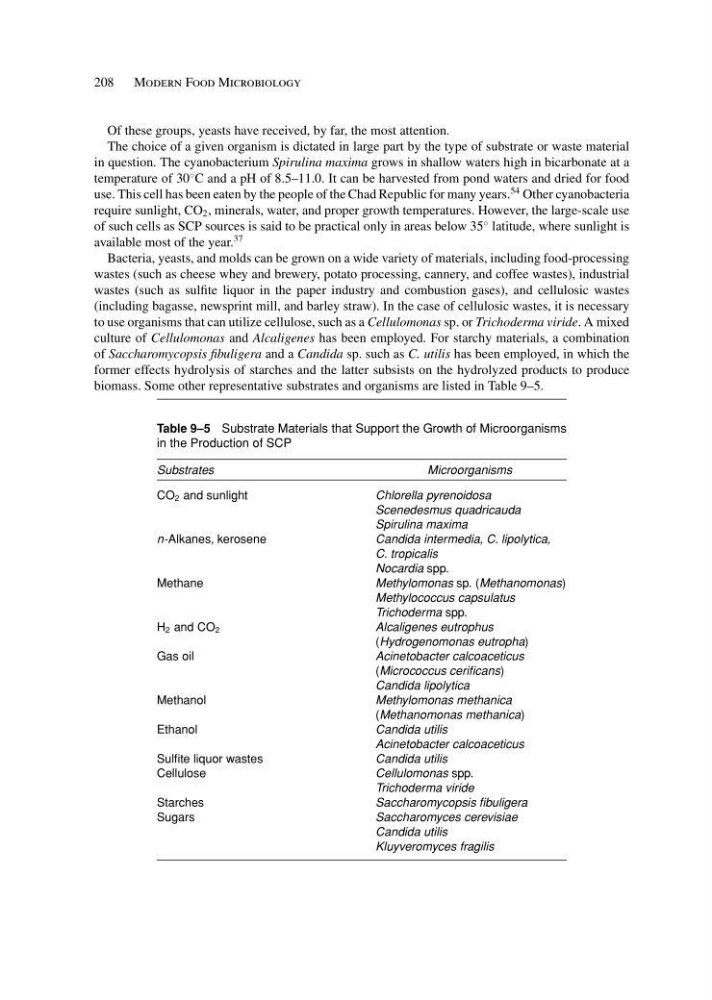
biomass. Some other representative substrates and organisms are listed in Table 9–5.
Table 9–5 Substrate Materials that Support the Growth of Microorganisms
in the Production of SCP
Substrates
Microorganisms
CO 2 and sunlight
Chlorella pyrenoidosa
Scenedesmus quadricauda
Spirulina maxima
n-Alkanes, kerosene
Candida intermedia, C. lipolytica,
C. tropicalis
Nocardia spp.
Methane
Methylomonas sp. (Methanomonas)
Methylococcus capsulatus
Trichoderma spp.
H 2 and CO 2
Alcaligenes eutrophus
(Hydrogenomonas eutropha)
Gas oil
Acinetobacter calcoaceticus
(Micrococcus cerificans)
Candida lipolytica
Methanol
Methylomonas methanica
(Methanomonas methanica)
Ethanol
Candida utilis
Acinetobacter calcoaceticus
Sulfite liquor wastes
Candida utilis
Cellulose
Cellulomonas spp.
Trichoderma viride
Starches
Saccharomycopsis fibuligera
Sugars
Saccharomyces cerevisiae
Candida utilis
Kluyveromyces fragilis
Of these groups, yeasts have received, by far, the most attention.
The choice of a given organism is dictated in large part by the type of substrate or waste material
in question. The cyanobacterium Spirulina maxima grows in shallow waters high in bicarbonate at a
temperature of 30
◦ C and a pH of 8.5–11.0. It can be harvested from pond waters and dried for food
use. This cell has been eaten by the people of the Chad Republic for many years.
54 Other cyanobacteria
require sunlight, CO 2 , minerals, water, and proper growth temperatures. However, the large-scale use
of such cells as SCP sources is said to be practical only in areas below 35
◦ latitude, where sunlight is
available most of the year.
37
Bacteria, yeasts, and molds can be grown on a wide variety of materials, including food-processing
wastes (such as cheese whey and brewery, potato processing, cannery, and coffee wastes), industrial
wastes (such as sulfite liquor in the paper industry and combustion gases), and cellulosic wastes
(including bagasse, newsprint mill, and barley straw). In the case of cellulosic wastes, it is necessary
to use organisms that can utilize cellulose, such as a Cellulomonas sp. or Trichoderma viride. A mixed
culture of Cellulomonas and Alcaligenes has been employed. For starchy materials, a combination
of Saccharomycopsis fibuligera and a Candida sp. such as C. utilis has been employed, in which the
former effects hydrolysis of starches and the latter subsists on the hydrolyzed products to produce
biomass. Some other representative substrates and organisms are listed in Table 9–5.
Table 9–5 Substrate Materials that Support the Growth of Microorganisms
in the Production of SCP
Substrates
Microorganisms
CO 2 and sunlight
Chlorella pyrenoidosa
Scenedesmus quadricauda
Spirulina maxima
n-Alkanes, kerosene
Candida intermedia, C. lipolytica,
C. tropicalis
Nocardia spp.
Methane
Methylomonas sp. (Methanomonas)
Methylococcus capsulatus
Trichoderma spp.
H 2 and CO 2
Alcaligenes eutrophus
(Hydrogenomonas eutropha)
Gas oil
Acinetobacter calcoaceticus
(Micrococcus cerificans)
Candida lipolytica
Methanol
Methylomonas methanica
(Methanomonas methanica)
Ethanol
Candida utilis
Acinetobacter calcoaceticus
Sulfite liquor wastes
Candida utilis
Cellulose
Cellulomonas spp.
Trichoderma viride
Starches
Saccharomycopsis fibuligera
Sugars
Saccharomyces cerevisiae
Candida utilis
Kluyveromyces fragilis