

Miscellaneous Food Products 201
Table 9–3 Summary of Aeromonas spp. in Ready-to-Eat Foods in Naples, Italy
62
Percent
A. hydrophila
A. caviae
A. sobria
Products
Number
Positive
Isolates
Isolates
Isolates
Vegetables
a
100
25
11
15
0
Cheeses
a
100
10
6
5
1
Meat products
a
100
11
10
3
0
Ice cream
20
0
0
0
0
a Five different products included.
P. fluorescens; colorless rots by Pseudomonas, Acinetobacter, and other species; black rots by Proteus,
Pseudomonas, and Aeromonas; pink rots by Pseudomonas; red rots by Serratia spp., and “custard”
rots by Proteus vulgaris and P. intermedium. Mold spoilage of eggs is generally referred to as pinspots,
from the appearance of mycelial growth on the inside upon candling. Penicillium andCladosporium
spp. are among the most common causes of pinspots and fungal rotting in eggs. Bacteria also cause a
condition in eggs known as mustiness. Pseudomonas graveolens and Proteus spp. have been implicated
in this condition, with P. graveolens producing the most characteristic spoilage pattern.
The entry of microorganisms into whole eggs is favored by high humidity. Under such conditions,
growth of microorganisms on the surface of eggs is favored, followed by penetration through the shell
and inner membrane. The latter structure is the most important barrier to the penetration of bacteria
into eggs, followed by the shell and the outer membrane.
36 More bacteria are found in egg yolk than
in egg white, and the reason for a general lack of microorganisms in egg white is quite possibly its
content of antimicrobial substances. In addition, upon storage, the thick white loses water to the yolk,
resulting in a thinning of yolk and a shrinking of the thick white. This phenomenon makes it possible
for the yolk to come into direct contact with the inner membrane, where it may be infected directly by
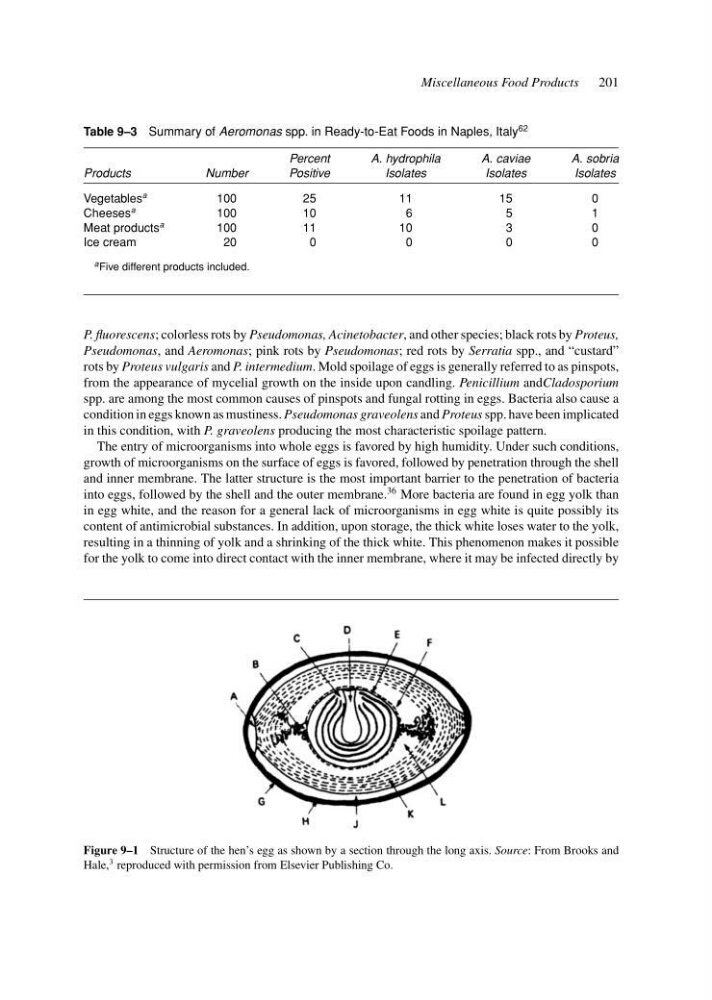
Figure 9–1 Structure of the hen’s egg as shown by a section through the long axis. Source: From Brooks and
Hale,
3 reproduced with permission from Elsevier Publishing Co.
Table 9–3 Summary of Aeromonas spp. in Ready-to-Eat Foods in Naples, Italy
62
Percent
A. hydrophila
A. caviae
A. sobria
Products
Number
Positive
Isolates
Isolates
Isolates
Vegetables
a
100
25
11
15
0
Cheeses
a
100
10
6
5
1
Meat products
a
100
11
10
3
0
Ice cream
20
0
0
0
0
a Five different products included.
P. fluorescens; colorless rots by Pseudomonas, Acinetobacter, and other species; black rots by Proteus,
Pseudomonas, and Aeromonas; pink rots by Pseudomonas; red rots by Serratia spp., and “custard”
rots by Proteus vulgaris and P. intermedium. Mold spoilage of eggs is generally referred to as pinspots,
from the appearance of mycelial growth on the inside upon candling. Penicillium andCladosporium
spp. are among the most common causes of pinspots and fungal rotting in eggs. Bacteria also cause a
condition in eggs known as mustiness. Pseudomonas graveolens and Proteus spp. have been implicated
in this condition, with P. graveolens producing the most characteristic spoilage pattern.
The entry of microorganisms into whole eggs is favored by high humidity. Under such conditions,
growth of microorganisms on the surface of eggs is favored, followed by penetration through the shell
and inner membrane. The latter structure is the most important barrier to the penetration of bacteria
into eggs, followed by the shell and the outer membrane.
36 More bacteria are found in egg yolk than
in egg white, and the reason for a general lack of microorganisms in egg white is quite possibly its
content of antimicrobial substances. In addition, upon storage, the thick white loses water to the yolk,
resulting in a thinning of yolk and a shrinking of the thick white. This phenomenon makes it possible
for the yolk to come into direct contact with the inner membrane, where it may be infected directly by
Figure 9–1 Structure of the hen’s egg as shown by a section through the long axis. Source: From Brooks and
Hale,
3 reproduced with permission from Elsevier Publishing Co.