

Nondairy Fermented Foods and Products 191
Gari is a staple food of West Africa prepared from the root of the cassava plant. Cassava roots
contain cyanogenic glucosides, linamarin and lotaustralin, which make them poisonous if eaten fresh
or raw. The roots can be detoxified by the addition of linamarase, which acts on both.
13 In practice
the roots are rendered safe by a fermentation during which the toxic glucoside decomposes with the
liberation of gaseous hydrocyanic acid. In the home preparation of gari, the outer peel and the thick
cortex of the cassava roots are removed, followed by grinding or grating the remainder. The pulp
is pressed to remove the remaining juice and placed in bags for 3 or 4 days to allow fermentation
to occur.
17 The organisms most responsible for the product include L. plantarum, E. faecium, and
Leuconostoc mesenteroides.
13 The fermented product is cooked by frying.
Bongkrek is an example of a fermented food product that in the past has led to a large number of
deaths. Bongkrek or semaji is a coconut presscake product of central Indonesia, and it is the homemade
product that may become toxic. The safe products fermented by R. oligosporus are finished cakes
covered with and penetrated by the white fungus. In order to obtain the desirable fungal growth, it
appears to be essential that conditions permit good growth within the first 1 or 2 days of incubation. If,
however, bacterial growth is favored during this time and if the bacterium Burkholderia cocovenenans
is present, it grows and produces two toxic substances–toxoflavin and bongkrekic acid.
84,85,86,94 Both
of these compounds show antifungal and antibacterial activity, are toxic for humans and animals, and
are heat stable. Production of both is favored by growth of the organisms on coconut (toxoflavin can
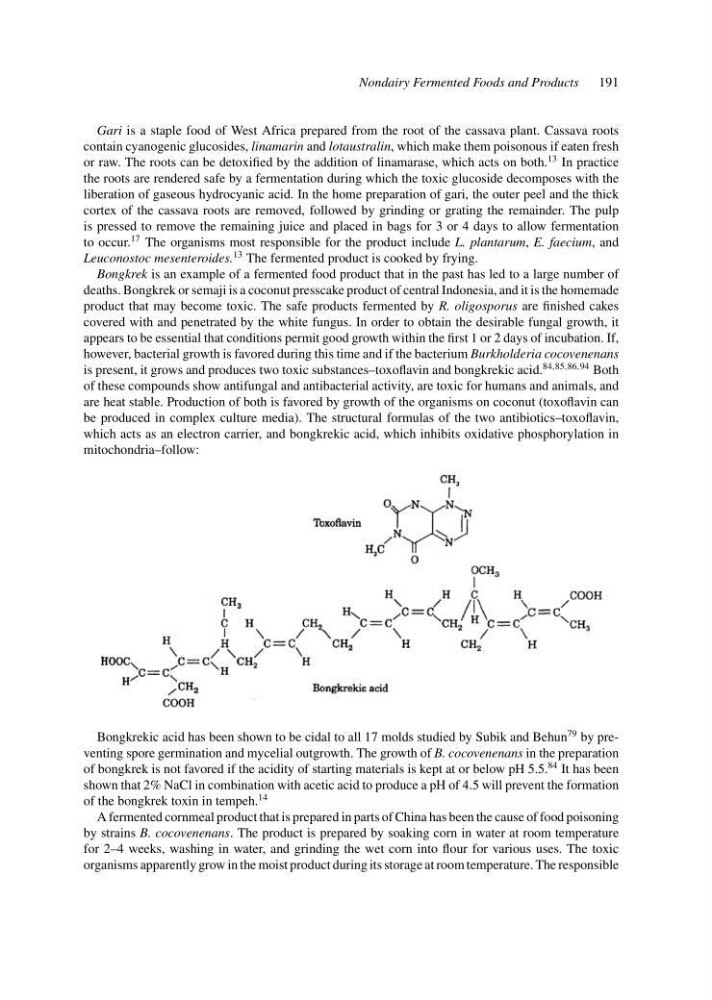
be produced in complex culture media). The structural formulas of the two antibiotics–toxoflavin,
which acts as an electron carrier, and bongkrekic acid, which inhibits oxidative phosphorylation in
mitochondria–follow:
Bongkrekic acid has been shown to be cidal to all 17 molds studied by Subik and Behun
79 by preventing spore germination and mycelial outgrowth. The growth of B. cocovenenans in the preparation
of bongkrek is not favored if the acidity of starting materials is kept at or below pH 5.5.
84 It has been
shown that 2% NaCl in combination with acetic acid to produce a pH of 4.5 will prevent the formation
of the bongkrek toxin in tempeh.
14
A fermented cornmeal product that is prepared in parts of China has been the cause of food poisoning
by strains B. cocovenenans. The product is prepared by soaking corn in water at room temperature
for 2–4 weeks, washing in water, and grinding the wet corn into flour for various uses. The toxic
organisms apparently grow in the moist product during its storage at room temperature. The responsible
Gari is a staple food of West Africa prepared from the root of the cassava plant. Cassava roots
contain cyanogenic glucosides, linamarin and lotaustralin, which make them poisonous if eaten fresh
or raw. The roots can be detoxified by the addition of linamarase, which acts on both.
13 In practice
the roots are rendered safe by a fermentation during which the toxic glucoside decomposes with the
liberation of gaseous hydrocyanic acid. In the home preparation of gari, the outer peel and the thick
cortex of the cassava roots are removed, followed by grinding or grating the remainder. The pulp
is pressed to remove the remaining juice and placed in bags for 3 or 4 days to allow fermentation
to occur.
17 The organisms most responsible for the product include L. plantarum, E. faecium, and
Leuconostoc mesenteroides.
13 The fermented product is cooked by frying.
Bongkrek is an example of a fermented food product that in the past has led to a large number of
deaths. Bongkrek or semaji is a coconut presscake product of central Indonesia, and it is the homemade
product that may become toxic. The safe products fermented by R. oligosporus are finished cakes
covered with and penetrated by the white fungus. In order to obtain the desirable fungal growth, it
appears to be essential that conditions permit good growth within the first 1 or 2 days of incubation. If,
however, bacterial growth is favored during this time and if the bacterium Burkholderia cocovenenans
is present, it grows and produces two toxic substances–toxoflavin and bongkrekic acid.
84,85,86,94 Both
of these compounds show antifungal and antibacterial activity, are toxic for humans and animals, and
are heat stable. Production of both is favored by growth of the organisms on coconut (toxoflavin can
be produced in complex culture media). The structural formulas of the two antibiotics–toxoflavin,
which acts as an electron carrier, and bongkrekic acid, which inhibits oxidative phosphorylation in
mitochondria–follow:
Bongkrekic acid has been shown to be cidal to all 17 molds studied by Subik and Behun
79 by preventing spore germination and mycelial outgrowth. The growth of B. cocovenenans in the preparation
of bongkrek is not favored if the acidity of starting materials is kept at or below pH 5.5.
84 It has been
shown that 2% NaCl in combination with acetic acid to produce a pH of 4.5 will prevent the formation
of the bongkrek toxin in tempeh.
14
A fermented cornmeal product that is prepared in parts of China has been the cause of food poisoning
by strains B. cocovenenans. The product is prepared by soaking corn in water at room temperature
for 2–4 weeks, washing in water, and grinding the wet corn into flour for various uses. The toxic
organisms apparently grow in the moist product during its storage at room temperature. The responsible