

Nondairy Fermented Foods and Products 177
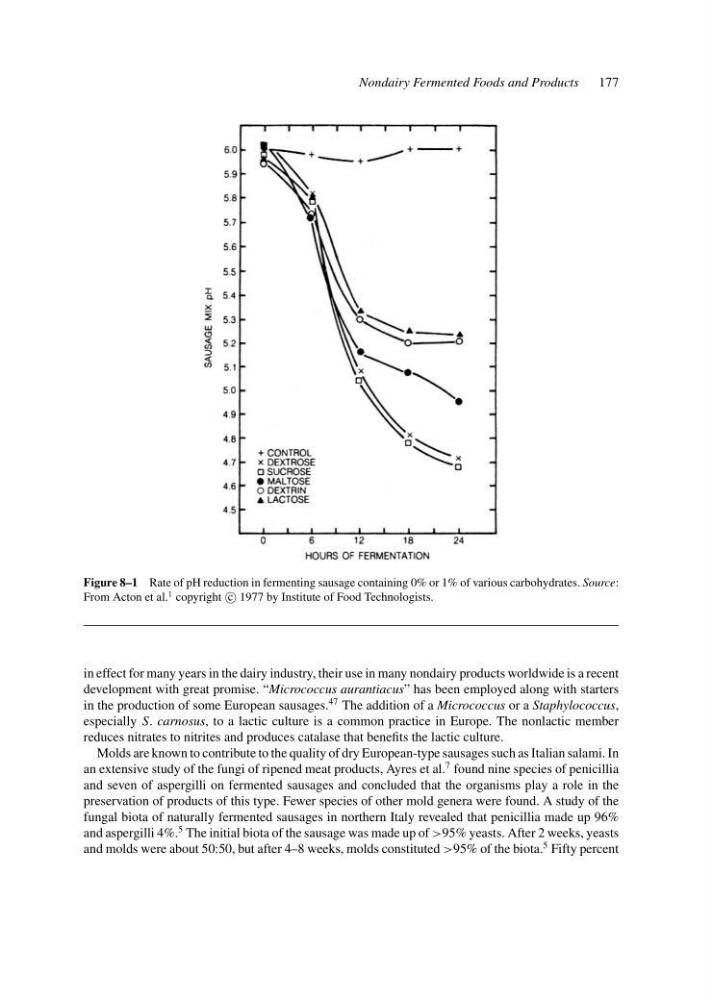
Figure 8–1 Rate of pH reduction in fermenting sausage containing 0% or 1% of various carbohydrates. Source:
From Acton et al.
1 copyright c
1977 by Institute of Food Technologists.
in effect for many years in the dairy industry, their use in many nondairy products worldwide is a recent
development with great promise. “Micrococcus aurantiacus” has been employed along with starters
in the production of some European sausages.
47 The addition of a Micrococcus or a Staphylococcus,
especially S. carnosus, to a lactic culture is a common practice in Europe. The nonlactic member
reduces nitrates to nitrites and produces catalase that benefits the lactic culture.
Molds are known to contribute to the quality of dry European-type sausages such as Italian salami. In
an extensive study of the fungi of ripened meat products, Ayres et al.
7 found nine species of penicillia
and seven of aspergilli on fermented sausages and concluded that the organisms play a role in the
preservation of products of this type. Fewer species of other mold genera were found. A study of the
fungal biota of naturally fermented sausages in northern Italy revealed that penicillia made up 96%
and aspergilli 4%.
5 The initial biota of the sausage was made up of >95% yeasts. After 2 weeks, yeasts
and molds were about 50:50, but after 4–8 weeks, molds constituted >95% of the biota.
5 Fifty percent
Figure 8–1 Rate of pH reduction in fermenting sausage containing 0% or 1% of various carbohydrates. Source:
From Acton et al.
1 copyright c
1977 by Institute of Food Technologists.
in effect for many years in the dairy industry, their use in many nondairy products worldwide is a recent
development with great promise. “Micrococcus aurantiacus” has been employed along with starters
in the production of some European sausages.
47 The addition of a Micrococcus or a Staphylococcus,
especially S. carnosus, to a lactic culture is a common practice in Europe. The nonlactic member
reduces nitrates to nitrites and produces catalase that benefits the lactic culture.
Molds are known to contribute to the quality of dry European-type sausages such as Italian salami. In
an extensive study of the fungi of ripened meat products, Ayres et al.
7 found nine species of penicillia
and seven of aspergilli on fermented sausages and concluded that the organisms play a role in the
preservation of products of this type. Fewer species of other mold genera were found. A study of the
fungal biota of naturally fermented sausages in northern Italy revealed that penicillia made up 96%
and aspergilli 4%.
5 The initial biota of the sausage was made up of >95% yeasts. After 2 weeks, yeasts
and molds were about 50:50, but after 4–8 weeks, molds constituted >95% of the biota.
5 Fifty percent