

Milk, Fermentation, and Fermented and Nonfermented Dairy Products 169
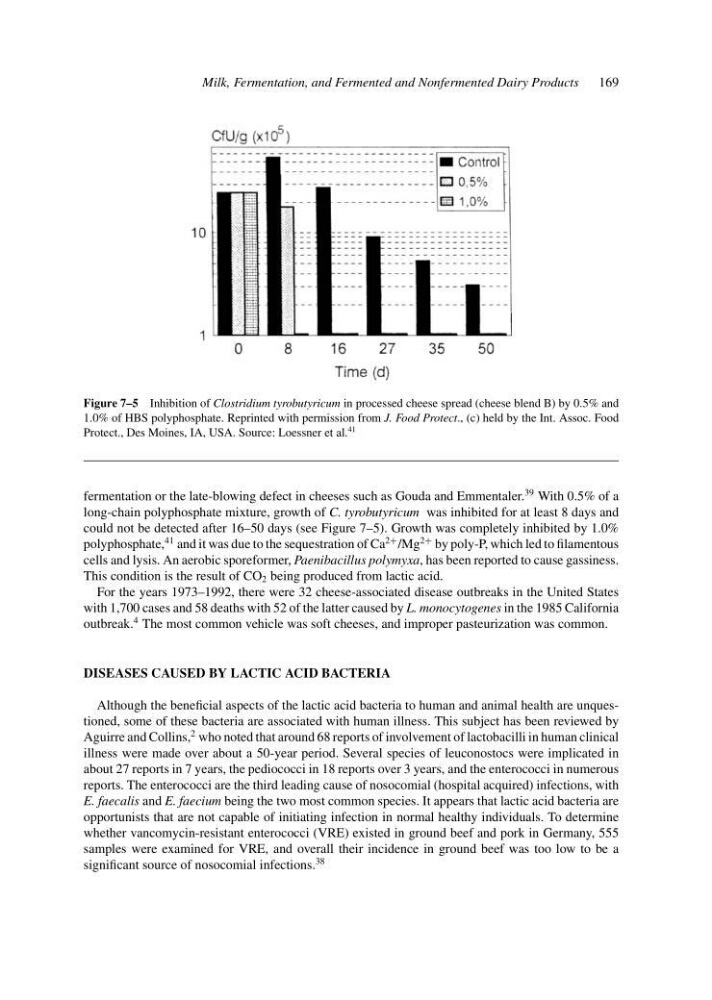
Figure 7–5 Inhibition of Clostridium tyrobutyricum in processed cheese spread (cheese blend B) by 0.5% and
1.0% of HBS polyphosphate. Reprinted with permission from J. Food Protect., (c) held by the Int. Assoc. Food
Protect., Des Moines, IA, USA. Source: Loessner et al.
41
fermentation or the late-blowing defect in cheeses such as Gouda and Emmentaler.
39 With 0.5% of a
long-chain polyphosphate mixture, growth of C. tyrobutyricum was inhibited for at least 8 days and
could not be detected after 16–50 days (see Figure 7–5). Growth was completely inhibited by 1.0%
polyphosphate,
41 and it was due to the sequestration of Ca
2+ /Mg
2+ by poly-P, which led to filamentous
cells and lysis. An aerobic sporeformer, Paenibacillus polymyxa, has been reported to cause gassiness.
This condition is the result of CO 2 being produced from lactic acid.
For the years 1973–1992, there were 32 cheese-associated disease outbreaks in the United States
with 1,700 cases and 58 deaths with 52 of the latter caused by L. monocytogenes in the 1985 California
outbreak.
4 The most common vehicle was soft cheeses, and improper pasteurization was common.
DISEASES CAUSED BY LACTIC ACID BACTERIA
Although the beneficial aspects of the lactic acid bacteria to human and animal health are unquestioned, some of these bacteria are associated with human illness. This subject has been reviewed by
Aguirre and Collins,
2 who noted that around 68 reports of involvement of lactobacilli in human clinical
illness were made over about a 50-year period. Several species of leuconostocs were implicated in
about 27 reports in 7 years, the pediococci in 18 reports over 3 years, and the enterococci in numerous
reports. The enterococci are the third leading cause of nosocomial (hospital acquired) infections, with
E. faecalis and E. faecium being the two most common species. It appears that lactic acid bacteria are
opportunists that are not capable of initiating infection in normal healthy individuals. To determine
whether vancomycin-resistant enterococci (VRE) existed in ground beef and pork in Germany, 555
samples were examined for VRE, and overall their incidence in ground beef was too low to be a
significant source of nosocomial infections.
38
Figure 7–5 Inhibition of Clostridium tyrobutyricum in processed cheese spread (cheese blend B) by 0.5% and
1.0% of HBS polyphosphate. Reprinted with permission from J. Food Protect., (c) held by the Int. Assoc. Food
Protect., Des Moines, IA, USA. Source: Loessner et al.
41
fermentation or the late-blowing defect in cheeses such as Gouda and Emmentaler.
39 With 0.5% of a
long-chain polyphosphate mixture, growth of C. tyrobutyricum was inhibited for at least 8 days and
could not be detected after 16–50 days (see Figure 7–5). Growth was completely inhibited by 1.0%
polyphosphate,
41 and it was due to the sequestration of Ca
2+ /Mg
2+ by poly-P, which led to filamentous
cells and lysis. An aerobic sporeformer, Paenibacillus polymyxa, has been reported to cause gassiness.
This condition is the result of CO 2 being produced from lactic acid.
For the years 1973–1992, there were 32 cheese-associated disease outbreaks in the United States
with 1,700 cases and 58 deaths with 52 of the latter caused by L. monocytogenes in the 1985 California
outbreak.
4 The most common vehicle was soft cheeses, and improper pasteurization was common.
DISEASES CAUSED BY LACTIC ACID BACTERIA
Although the beneficial aspects of the lactic acid bacteria to human and animal health are unquestioned, some of these bacteria are associated with human illness. This subject has been reviewed by
Aguirre and Collins,
2 who noted that around 68 reports of involvement of lactobacilli in human clinical
illness were made over about a 50-year period. Several species of leuconostocs were implicated in
about 27 reports in 7 years, the pediococci in 18 reports over 3 years, and the enterococci in numerous
reports. The enterococci are the third leading cause of nosocomial (hospital acquired) infections, with
E. faecalis and E. faecium being the two most common species. It appears that lactic acid bacteria are
opportunists that are not capable of initiating infection in normal healthy individuals. To determine
whether vancomycin-resistant enterococci (VRE) existed in ground beef and pork in Germany, 555
samples were examined for VRE, and overall their incidence in ground beef was too low to be a
significant source of nosocomial infections.
38