

Milk, Fermentation, and Fermented and Nonfermented Dairy Products 167
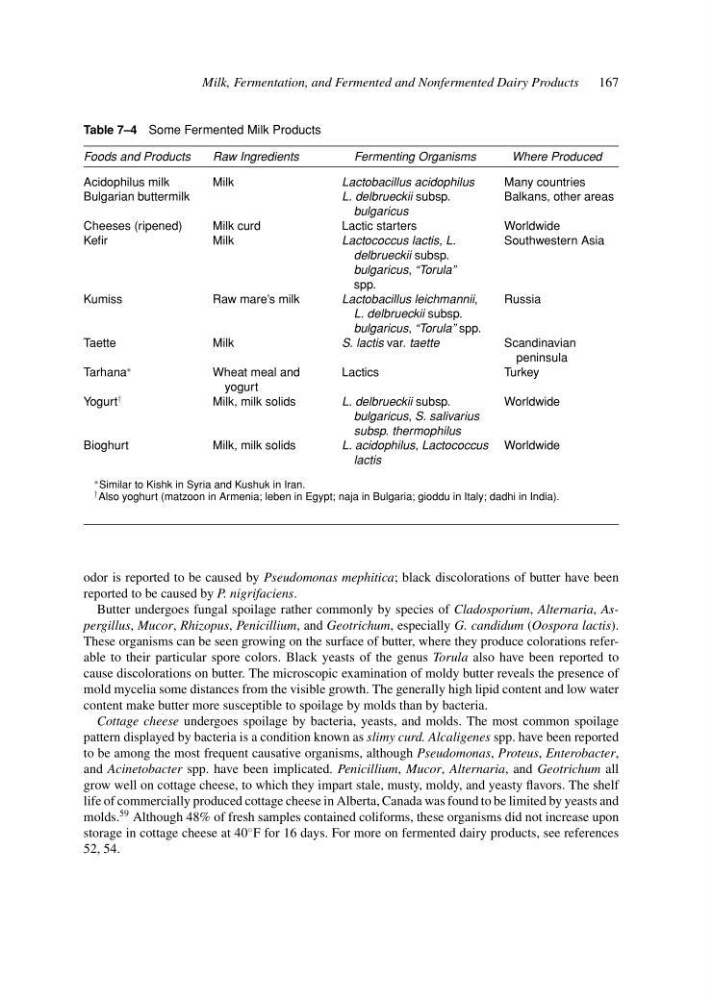
Table 7–4 Some Fermented Milk Products
Foods and Products
Raw Ingredients
Fermenting Organisms
Where Produced
Acidophilus milk
Milk
Lactobacillus acidophilus
Many countries
Bulgarian buttermilk
L. delbrueckii subsp.
bulgaricus
Balkans, other areas
Cheeses (ripened)
Milk curd
Lactic starters
Worldwide
Kefir
Milk
Lactococcus lactis, L.
delbrueckii subsp.
bulgaricus, “Torula”
spp.
Southwestern Asia
Kumiss
Raw mare’s milk
Lactobacillus leichmannii,
L. delbrueckii subsp.
bulgaricus, “Torula” spp.
Russia
Taette
Milk
S. lactis var. taette
Scandinavian
peninsula
Tarhana
∗
Wheat meal and
yogurt
Lactics
Turkey
Yogurt
†
Milk, milk solids
L. delbrueckii subsp.
bulgaricus, S. salivarius
subsp. thermophilus
Worldwide
Bioghurt
Milk, milk solids
L. acidophilus, Lactococcus
lactis
Worldwide
∗ Similar to Kishk in Syria and Kushuk in Iran.
† Also yoghurt (matzoon in Armenia; leben in Egypt; naja in Bulgaria; gioddu in Italy; dadhi in India).
odor is reported to be caused by Pseudomonas mephitica; black discolorations of butter have been
reported to be caused by P. nigrifaciens.
Butter undergoes fungal spoilage rather commonly by species of Cladosporium, Alternaria, Aspergillus, Mucor, Rhizopus, Penicillium, and Geotrichum, especially G. candidum (Oospora lactis).
These organisms can be seen growing on the surface of butter, where they produce colorations referable to their particular spore colors. Black yeasts of the genus Torula also have been reported to
cause discolorations on butter. The microscopic examination of moldy butter reveals the presence of
mold mycelia some distances from the visible growth. The generally high lipid content and low water
content make butter more susceptible to spoilage by molds than by bacteria.
Cottage cheese undergoes spoilage by bacteria, yeasts, and molds. The most common spoilage
pattern displayed by bacteria is a condition known as slimy curd. Alcaligenes spp. have been reported
to be among the most frequent causative organisms, although Pseudomonas, Proteus, Enterobacter,
and Acinetobacter spp. have been implicated. Penicillium, Mucor, Alternaria, and Geotrichum all
grow well on cottage cheese, to which they impart stale, musty, moldy, and yeasty flavors. The shelf
life of commercially produced cottage cheese in Alberta, Canada was found to be limited by yeasts and
molds.
59 Although 48% of fresh samples contained coliforms, these organisms did not increase upon
storage in cottage cheese at 40
◦ F for 16 days. For more on fermented dairy products, see references
52, 54.
Table 7–4 Some Fermented Milk Products
Foods and Products
Raw Ingredients
Fermenting Organisms
Where Produced
Acidophilus milk
Milk
Lactobacillus acidophilus
Many countries
Bulgarian buttermilk
L. delbrueckii subsp.
bulgaricus
Balkans, other areas
Cheeses (ripened)
Milk curd
Lactic starters
Worldwide
Kefir
Milk
Lactococcus lactis, L.
delbrueckii subsp.
bulgaricus, “Torula”
spp.
Southwestern Asia
Kumiss
Raw mare’s milk
Lactobacillus leichmannii,
L. delbrueckii subsp.
bulgaricus, “Torula” spp.
Russia
Taette
Milk
S. lactis var. taette
Scandinavian
peninsula
Tarhana
∗
Wheat meal and
yogurt
Lactics
Turkey
Yogurt
†
Milk, milk solids
L. delbrueckii subsp.
bulgaricus, S. salivarius
subsp. thermophilus
Worldwide
Bioghurt
Milk, milk solids
L. acidophilus, Lactococcus
lactis
Worldwide
∗ Similar to Kishk in Syria and Kushuk in Iran.
† Also yoghurt (matzoon in Armenia; leben in Egypt; naja in Bulgaria; gioddu in Italy; dadhi in India).
odor is reported to be caused by Pseudomonas mephitica; black discolorations of butter have been
reported to be caused by P. nigrifaciens.
Butter undergoes fungal spoilage rather commonly by species of Cladosporium, Alternaria, Aspergillus, Mucor, Rhizopus, Penicillium, and Geotrichum, especially G. candidum (Oospora lactis).
These organisms can be seen growing on the surface of butter, where they produce colorations referable to their particular spore colors. Black yeasts of the genus Torula also have been reported to
cause discolorations on butter. The microscopic examination of moldy butter reveals the presence of
mold mycelia some distances from the visible growth. The generally high lipid content and low water
content make butter more susceptible to spoilage by molds than by bacteria.
Cottage cheese undergoes spoilage by bacteria, yeasts, and molds. The most common spoilage
pattern displayed by bacteria is a condition known as slimy curd. Alcaligenes spp. have been reported
to be among the most frequent causative organisms, although Pseudomonas, Proteus, Enterobacter,
and Acinetobacter spp. have been implicated. Penicillium, Mucor, Alternaria, and Geotrichum all
grow well on cottage cheese, to which they impart stale, musty, moldy, and yeasty flavors. The shelf
life of commercially produced cottage cheese in Alberta, Canada was found to be limited by yeasts and
molds.
59 Although 48% of fresh samples contained coliforms, these organisms did not increase upon
storage in cottage cheese at 40
◦ F for 16 days. For more on fermented dairy products, see references
52, 54.