

158 Modern Food Microbiology
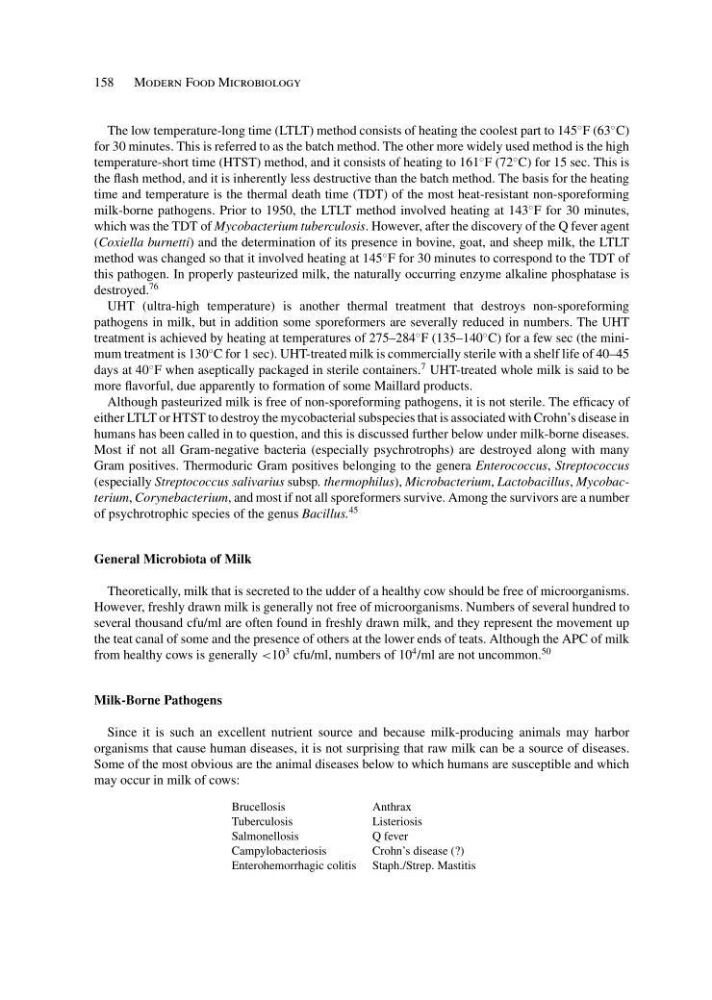
The low temperature-long time (LTLT) method consists of heating the coolest part to 145
◦ F (63
◦ C)
for 30 minutes. This is referred to as the batch method. The other more widely used method is the high
temperature-short time (HTST) method, and it consists of heating to 161
◦ F (72
◦ C) for 15 sec. This is
the flash method, and it is inherently less destructive than the batch method. The basis for the heating
time and temperature is the thermal death time (TDT) of the most heat-resistant non-sporeforming
milk-borne pathogens. Prior to 1950, the LTLT method involved heating at 143
◦ F for 30 minutes,
which was the TDT of Mycobacterium tuberculosis. However, after the discovery of the Q fever agent
(Coxiella burnetti) and the determination of its presence in bovine, goat, and sheep milk, the LTLT
method was changed so that it involved heating at 145
◦ F for 30 minutes to correspond to the TDT of
this pathogen. In properly pasteurized milk, the naturally occurring enzyme alkaline phosphatase is
destroyed.
76
UHT (ultra-high temperature) is another thermal treatment that destroys non-sporeforming
pathogens in milk, but in addition some sporeformers are severally reduced in numbers. The UHT
treatment is achieved by heating at temperatures of 275–284
◦ F (135–140
◦ C) for a few sec (the minimum treatment is 130
◦ C for 1 sec). UHT-treated milk is commercially sterile with a shelf life of 40–45
days at 40
◦ F when aseptically packaged in sterile containers.
7 UHT-treated whole milk is said to be
more flavorful, due apparently to formation of some Maillard products.
Although pasteurized milk is free of non-sporeforming pathogens, it is not sterile. The efficacy of
either LTLT or HTST to destroy the mycobacterial subspecies that is associated with Crohn’s disease in
humans has been called in to question, and this is discussed further below under milk-borne diseases.
Most if not all Gram-negative bacteria (especially psychrotrophs) are destroyed along with many
Gram positives. Thermoduric Gram positives belonging to the genera Enterococcus, Streptococcus
(especially Streptococcus salivarius subsp. thermophilus), Microbacterium, Lactobacillus, Mycobacterium, Corynebacterium, and most if not all sporeformers survive. Among the survivors are a number
of psychrotrophic species of the genus Bacillus.
45
General Microbiota of Milk
Theoretically, milk that is secreted to the udder of a healthy cow should be free of microorganisms.
However, freshly drawn milk is generally not free of microorganisms. Numbers of several hundred to
several thousand cfu/ml are often found in freshly drawn milk, and they represent the movement up
the teat canal of some and the presence of others at the lower ends of teats. Although the APC of milk
from healthy cows is generally <10
3 cfu/ml, numbers of 10
4 /ml are not uncommon.
50
Milk-Borne Pathogens
Since it is such an excellent nutrient source and because milk-producing animals may harbor
organisms that cause human diseases, it is not surprising that raw milk can be a source of diseases.
Some of the most obvious are the animal diseases below to which humans are susceptible and which
may occur in milk of cows:
Brucellosis
Anthrax
Tuberculosis
Listeriosis
Salmonellosis
Q fever
Campylobacteriosis
Crohn’s disease (?)
Enterohemorrhagic colitis Staph./Strep. Mastitis
The low temperature-long time (LTLT) method consists of heating the coolest part to 145
◦ F (63
◦ C)
for 30 minutes. This is referred to as the batch method. The other more widely used method is the high
temperature-short time (HTST) method, and it consists of heating to 161
◦ F (72
◦ C) for 15 sec. This is
the flash method, and it is inherently less destructive than the batch method. The basis for the heating
time and temperature is the thermal death time (TDT) of the most heat-resistant non-sporeforming
milk-borne pathogens. Prior to 1950, the LTLT method involved heating at 143
◦ F for 30 minutes,
which was the TDT of Mycobacterium tuberculosis. However, after the discovery of the Q fever agent
(Coxiella burnetti) and the determination of its presence in bovine, goat, and sheep milk, the LTLT
method was changed so that it involved heating at 145
◦ F for 30 minutes to correspond to the TDT of
this pathogen. In properly pasteurized milk, the naturally occurring enzyme alkaline phosphatase is
destroyed.
76
UHT (ultra-high temperature) is another thermal treatment that destroys non-sporeforming
pathogens in milk, but in addition some sporeformers are severally reduced in numbers. The UHT
treatment is achieved by heating at temperatures of 275–284
◦ F (135–140
◦ C) for a few sec (the minimum treatment is 130
◦ C for 1 sec). UHT-treated milk is commercially sterile with a shelf life of 40–45
days at 40
◦ F when aseptically packaged in sterile containers.
7 UHT-treated whole milk is said to be
more flavorful, due apparently to formation of some Maillard products.
Although pasteurized milk is free of non-sporeforming pathogens, it is not sterile. The efficacy of
either LTLT or HTST to destroy the mycobacterial subspecies that is associated with Crohn’s disease in
humans has been called in to question, and this is discussed further below under milk-borne diseases.
Most if not all Gram-negative bacteria (especially psychrotrophs) are destroyed along with many
Gram positives. Thermoduric Gram positives belonging to the genera Enterococcus, Streptococcus
(especially Streptococcus salivarius subsp. thermophilus), Microbacterium, Lactobacillus, Mycobacterium, Corynebacterium, and most if not all sporeformers survive. Among the survivors are a number
of psychrotrophic species of the genus Bacillus.
45
General Microbiota of Milk
Theoretically, milk that is secreted to the udder of a healthy cow should be free of microorganisms.
However, freshly drawn milk is generally not free of microorganisms. Numbers of several hundred to
several thousand cfu/ml are often found in freshly drawn milk, and they represent the movement up
the teat canal of some and the presence of others at the lower ends of teats. Although the APC of milk
from healthy cows is generally <10
3 cfu/ml, numbers of 10
4 /ml are not uncommon.
50
Milk-Borne Pathogens
Since it is such an excellent nutrient source and because milk-producing animals may harbor
organisms that cause human diseases, it is not surprising that raw milk can be a source of diseases.
Some of the most obvious are the animal diseases below to which humans are susceptible and which
may occur in milk of cows:
Brucellosis
Anthrax
Tuberculosis
Listeriosis
Salmonellosis
Q fever
Campylobacteriosis
Crohn’s disease (?)
Enterohemorrhagic colitis Staph./Strep. Mastitis