

Processed Meats and Seafoods
107
Table 5–3 Effect of Meat pH and Glucose on Hydrogen Sulfide
Production by a Pure Culture of Lactobacillus sakei L13 Growing
under Anaerobic Conditions at 5
◦ C on Beef
Hydrogen Sulfide Production
pH 6.4–6.6 with 250 µg
Days
pH 5.6–5.7
pH 6.4–6.6
Glucose per Gram of Meat
8
−
∗
−
−
9
−
+
‡
−
11
−
+
−
15
−
+
−
18
+
†
+
+
‡
21
+
+
+
∗ Each treatment done in triplicate. − = All three tubes negative; + = all
three positive.
† One tube out of three positive.
‡ Two tubes out of three positive.
Source: Egan et al. 26
it was fluorescent under long-wave ultraviolet light.
10 Between 3 and 4 weeks were required for
the condition to develop, and the responsible organism survived 71.1
◦ C for 20 minutes but not 30
minutes. In addition to 4.4
◦ C, it occurred also at 10
◦ C but not at 20
◦ C or above. Although tentatively
identified as E. casseliflavus, the causative organism did not react with Group D antisera. The other
yellow-pigmented enterococcal species is E. mundtii; and both are discussed further in Chapter 20.
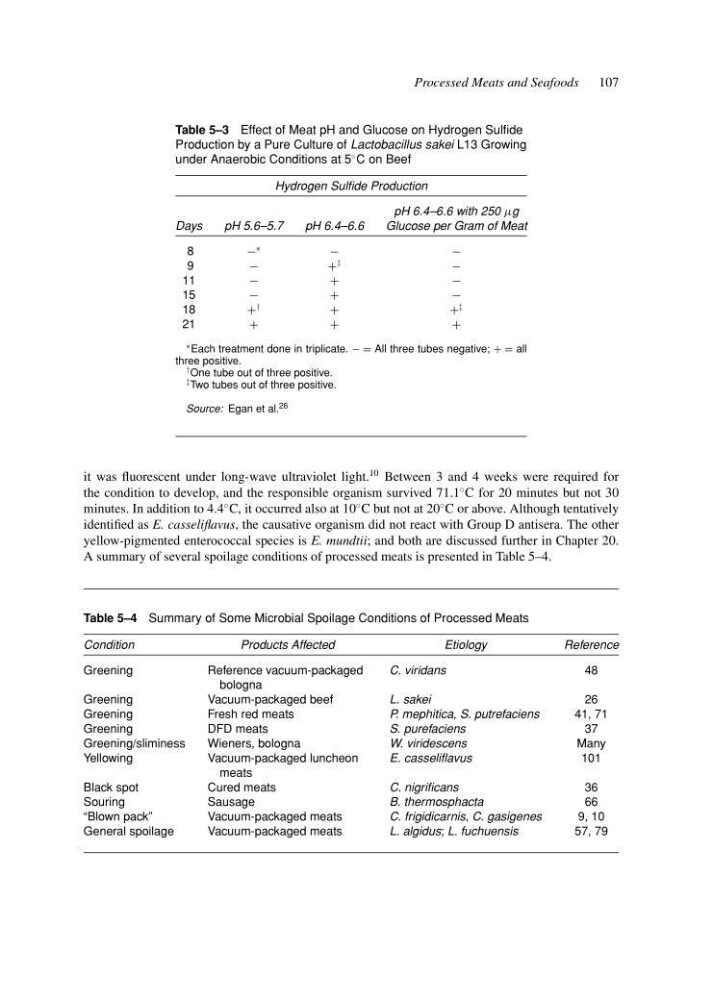
A summary of several spoilage conditions of processed meats is presented in Table 5–4.
Table 5–4 Summary of Some Microbial Spoilage Conditions of Processed Meats
Condition
Products Affected
Etiology
Reference
Greening
Reference vacuum-packaged
bologna
C. viridans
48
Greening
Vacuum-packaged beef
L. sakei
26
Greening
Fresh red meats
P. mephitica, S. putrefaciens
41, 71
Greening
DFD meats
S. purefaciens
37
Greening/sliminess
Wieners, bologna
W. viridescens
Many
Yellowing
Vacuum-packaged luncheon
meats
E. casseliflavus
101
Black spot
Cured meats
C. nigrificans
36
Souring
Sausage
B. thermosphacta
66
“Blown pack”
Vacuum-packaged meats
C. frigidicarnis, C. gasigenes
9, 10
General spoilage
Vacuum-packaged meats
L. algidus; L. fuchuensis
57, 79
107
Table 5–3 Effect of Meat pH and Glucose on Hydrogen Sulfide
Production by a Pure Culture of Lactobacillus sakei L13 Growing
under Anaerobic Conditions at 5
◦ C on Beef
Hydrogen Sulfide Production
pH 6.4–6.6 with 250 µg
Days
pH 5.6–5.7
pH 6.4–6.6
Glucose per Gram of Meat
8
−
∗
−
−
9
−
+
‡
−
11
−
+
−
15
−
+
−
18
+
†
+
+
‡
21
+
+
+
∗ Each treatment done in triplicate. − = All three tubes negative; + = all
three positive.
† One tube out of three positive.
‡ Two tubes out of three positive.
Source: Egan et al. 26
it was fluorescent under long-wave ultraviolet light.
10 Between 3 and 4 weeks were required for
the condition to develop, and the responsible organism survived 71.1
◦ C for 20 minutes but not 30
minutes. In addition to 4.4
◦ C, it occurred also at 10
◦ C but not at 20
◦ C or above. Although tentatively
identified as E. casseliflavus, the causative organism did not react with Group D antisera. The other
yellow-pigmented enterococcal species is E. mundtii; and both are discussed further in Chapter 20.
A summary of several spoilage conditions of processed meats is presented in Table 5–4.
Table 5–4 Summary of Some Microbial Spoilage Conditions of Processed Meats
Condition
Products Affected
Etiology
Reference
Greening
Reference vacuum-packaged
bologna
C. viridans
48
Greening
Vacuum-packaged beef
L. sakei
26
Greening
Fresh red meats
P. mephitica, S. putrefaciens
41, 71
Greening
DFD meats
S. purefaciens
37
Greening/sliminess
Wieners, bologna
W. viridescens
Many
Yellowing
Vacuum-packaged luncheon
meats
E. casseliflavus
101
Black spot
Cured meats
C. nigrificans
36
Souring
Sausage
B. thermosphacta
66
“Blown pack”
Vacuum-packaged meats
C. frigidicarnis, C. gasigenes
9, 10
General spoilage
Vacuum-packaged meats
L. algidus; L. fuchuensis
57, 79