

Application of Sustainable and Low-Cost Sludge-Based Adsorbents …
65
Fig. 24, can be explained from the fact that the anions are favourably adsorbed by
the adsorbent at lower pH due to the presence of H
+ ions. The removal of dyes at
lower pH (2.0–7.0) decreased from 92.05% to 85.40% for RR31 on CAC; 90.70%
to 74.20% for RR2 on CAC; 75.44% to 69.28% for RR31 on SC600; 81.06% to
77.07% for RR2 on SC600; 66.22% to 61.87% for RR31 on SC300; and 61.58% to
49.70% for RR2 on SC300.
The percentage removal of the reactive dyes at lower pH increased in the order
of CAC > SC600 > SC300. Similar results were reported by Santhy and Selvapathy
[103] in the removal of Reactive Red dye. Moreover, lower sorption of the anionic
dye at alkaline pH can be attributed to the abundance of OH
− ions, which will
compete with the dye anions for the sorption sites [28, 95] (Khaled et al. 2009).
Similar observations have been reported by previous work for sorption of reactive
dyes on activated carbon prepared from sugarcane bagasse pith, coir pith and orange
peel (Khaled et al. 2009) [7, 103]. A useful index that shows whether the surface is
likely to become negatively or positively charged as a function of pH is pH value
at which the net electric charge of the surface is zero. This value is called the zero
point charge (pH zpc ) or the pH value of isoelectric point of zeta potential (Z IEP ).
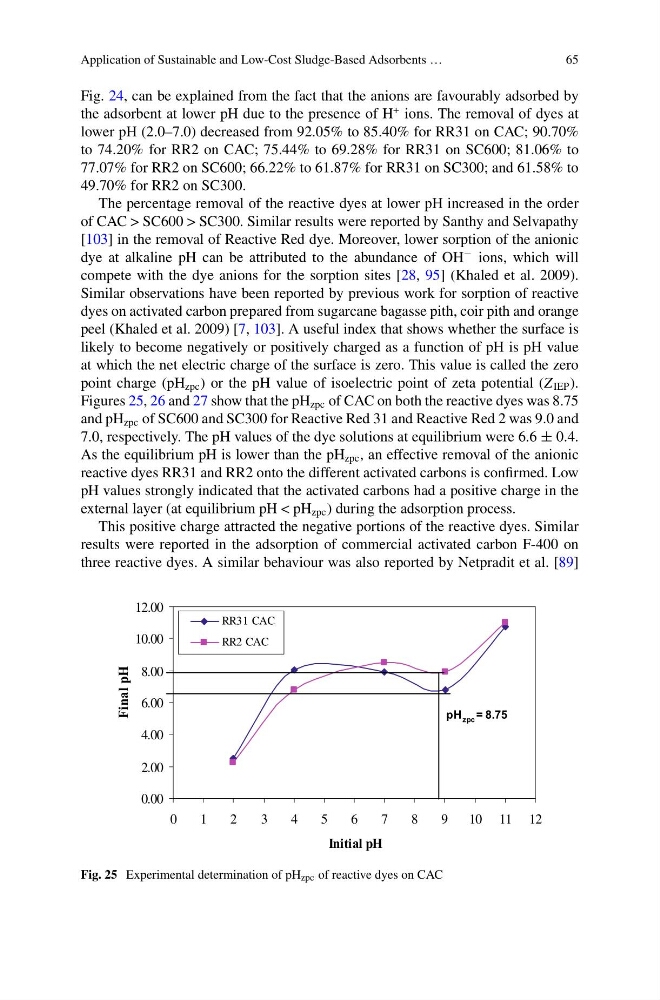
Figures 25, 26 and 27 show that the pH zpc of CAC on both the reactive dyes was 8.75
and pH zpc of SC600 and SC300 for Reactive Red 31 and Reactive Red 2 was 9.0 and
7.0, respectively. The pH values of the dye solutions at equilibrium were 6.6 ± 0.4.
As the equilibrium pH is lower than the pH zpc , an effective removal of the anionic
reactive dyes RR31 and RR2 onto the different activated carbons is confirmed. Low
pH values strongly indicated that the activated carbons had a positive charge in the
external layer (at equilibrium pH < pH zpc ) during the adsorption process.
This positive charge attracted the negative portions of the reactive dyes. Similar
results were reported in the adsorption of commercial activated carbon F-400 on
three reactive dyes. A similar behaviour was also reported by Netpradit et al. [89]
0.00
2.00
4.00
6.00
8.00
10.00
12.00
0
1
2
3
4
5
6
7
8
9
10 11 12
Initial pH
H
RR31 CAC
RR2 CAC
pH zpc = 8.75
Final p
Fig. 25 Experimental determination of pH zpc of reactive dyes on CAC
65
Fig. 24, can be explained from the fact that the anions are favourably adsorbed by
the adsorbent at lower pH due to the presence of H
+ ions. The removal of dyes at
lower pH (2.0–7.0) decreased from 92.05% to 85.40% for RR31 on CAC; 90.70%
to 74.20% for RR2 on CAC; 75.44% to 69.28% for RR31 on SC600; 81.06% to
77.07% for RR2 on SC600; 66.22% to 61.87% for RR31 on SC300; and 61.58% to
49.70% for RR2 on SC300.
The percentage removal of the reactive dyes at lower pH increased in the order
of CAC > SC600 > SC300. Similar results were reported by Santhy and Selvapathy
[103] in the removal of Reactive Red dye. Moreover, lower sorption of the anionic
dye at alkaline pH can be attributed to the abundance of OH
− ions, which will
compete with the dye anions for the sorption sites [28, 95] (Khaled et al. 2009).
Similar observations have been reported by previous work for sorption of reactive
dyes on activated carbon prepared from sugarcane bagasse pith, coir pith and orange
peel (Khaled et al. 2009) [7, 103]. A useful index that shows whether the surface is
likely to become negatively or positively charged as a function of pH is pH value
at which the net electric charge of the surface is zero. This value is called the zero
point charge (pH zpc ) or the pH value of isoelectric point of zeta potential (Z IEP ).
Figures 25, 26 and 27 show that the pH zpc of CAC on both the reactive dyes was 8.75
and pH zpc of SC600 and SC300 for Reactive Red 31 and Reactive Red 2 was 9.0 and
7.0, respectively. The pH values of the dye solutions at equilibrium were 6.6 ± 0.4.
As the equilibrium pH is lower than the pH zpc , an effective removal of the anionic
reactive dyes RR31 and RR2 onto the different activated carbons is confirmed. Low
pH values strongly indicated that the activated carbons had a positive charge in the
external layer (at equilibrium pH < pH zpc ) during the adsorption process.
This positive charge attracted the negative portions of the reactive dyes. Similar
results were reported in the adsorption of commercial activated carbon F-400 on
three reactive dyes. A similar behaviour was also reported by Netpradit et al. [89]
0.00
2.00
4.00
6.00
8.00
10.00
12.00
0
1
2
3
4
5
6
7
8
9
10 11 12
Initial pH
H
RR31 CAC
RR2 CAC
pH zpc = 8.75
Final p
Fig. 25 Experimental determination of pH zpc of reactive dyes on CAC