

Application of Sustainable and Low-Cost Sludge-Based Adsorbents …
61
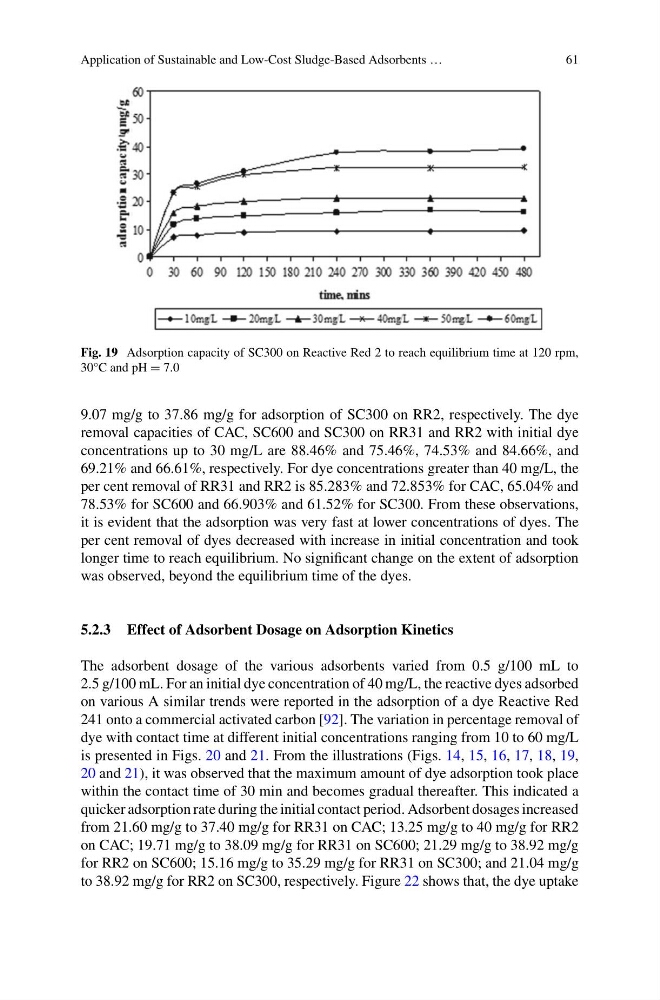
Fig. 19 Adsorption capacity of SC300 on Reactive Red 2 to reach equilibrium time at 120 rpm,
30°C and pH = 7.0
9.07 mg/g to 37.86 mg/g for adsorption of SC300 on RR2, respectively. The dye
removal capacities of CAC, SC600 and SC300 on RR31 and RR2 with initial dye
concentrations up to 30 mg/L are 88.46% and 75.46%, 74.53% and 84.66%, and
69.21% and 66.61%, respectively. For dye concentrations greater than 40 mg/L, the
per cent removal of RR31 and RR2 is 85.283% and 72.853% for CAC, 65.04% and
78.53% for SC600 and 66.903% and 61.52% for SC300. From these observations,
it is evident that the adsorption was very fast at lower concentrations of dyes. The
per cent removal of dyes decreased with increase in initial concentration and took
longer time to reach equilibrium. No significant change on the extent of adsorption
was observed, beyond the equilibrium time of the dyes.
5.2.3 Effect of Adsorbent Dosage on Adsorption Kinetics
The adsorbent dosage of the various adsorbents varied from 0.5 g/100 mL to
2.5 g/100 mL. For an initial dye concentration of 40 mg/L, the reactive dyes adsorbed
on various A similar trends were reported in the adsorption of a dye Reactive Red
241 onto a commercial activated carbon [92]. The variation in percentage removal of
dye with contact time at different initial concentrations ranging from 10 to 60 mg/L
is presented in Figs. 20 and 21. From the illustrations (Figs. 14, 15, 16, 17, 18, 19,
20 and 21), it was observed that the maximum amount of dye adsorption took place
within the contact time of 30 min and becomes gradual thereafter. This indicated a
quicker adsorption rate during the initial contact period. Adsorbent dosages increased
from 21.60 mg/g to 37.40 mg/g for RR31 on CAC; 13.25 mg/g to 40 mg/g for RR2
on CAC; 19.71 mg/g to 38.09 mg/g for RR31 on SC600; 21.29 mg/g to 38.92 mg/g
for RR2 on SC600; 15.16 mg/g to 35.29 mg/g for RR31 on SC300; and 21.04 mg/g
to 38.92 mg/g for RR2 on SC300, respectively. Figure 22 shows that, the dye uptake
61
Fig. 19 Adsorption capacity of SC300 on Reactive Red 2 to reach equilibrium time at 120 rpm,
30°C and pH = 7.0
9.07 mg/g to 37.86 mg/g for adsorption of SC300 on RR2, respectively. The dye
removal capacities of CAC, SC600 and SC300 on RR31 and RR2 with initial dye
concentrations up to 30 mg/L are 88.46% and 75.46%, 74.53% and 84.66%, and
69.21% and 66.61%, respectively. For dye concentrations greater than 40 mg/L, the
per cent removal of RR31 and RR2 is 85.283% and 72.853% for CAC, 65.04% and
78.53% for SC600 and 66.903% and 61.52% for SC300. From these observations,
it is evident that the adsorption was very fast at lower concentrations of dyes. The
per cent removal of dyes decreased with increase in initial concentration and took
longer time to reach equilibrium. No significant change on the extent of adsorption
was observed, beyond the equilibrium time of the dyes.
5.2.3 Effect of Adsorbent Dosage on Adsorption Kinetics
The adsorbent dosage of the various adsorbents varied from 0.5 g/100 mL to
2.5 g/100 mL. For an initial dye concentration of 40 mg/L, the reactive dyes adsorbed
on various A similar trends were reported in the adsorption of a dye Reactive Red
241 onto a commercial activated carbon [92]. The variation in percentage removal of
dye with contact time at different initial concentrations ranging from 10 to 60 mg/L
is presented in Figs. 20 and 21. From the illustrations (Figs. 14, 15, 16, 17, 18, 19,
20 and 21), it was observed that the maximum amount of dye adsorption took place
within the contact time of 30 min and becomes gradual thereafter. This indicated a
quicker adsorption rate during the initial contact period. Adsorbent dosages increased
from 21.60 mg/g to 37.40 mg/g for RR31 on CAC; 13.25 mg/g to 40 mg/g for RR2
on CAC; 19.71 mg/g to 38.09 mg/g for RR31 on SC600; 21.29 mg/g to 38.92 mg/g
for RR2 on SC600; 15.16 mg/g to 35.29 mg/g for RR31 on SC300; and 21.04 mg/g
to 38.92 mg/g for RR2 on SC300, respectively. Figure 22 shows that, the dye uptake