

58
A. Geethakarthi
of the most commonly used anchors–the monochlorotriazine and the vinylsulphone
group–were chosen for this study. Reactive dyes have a relatively low fixation degree
on the textile substrate, and the corresponding wastewaters may be highly coloured.
5.2 Adsorption Studies by Batch Mode
5.2.1 Equilibrium Time and Removal Efficiency
The adsorption equilibrium studies for the removal of Reactive Red 31 and Reactive
Red 2 on the commercial activated carbon (CAC) and the tannery sludge-developed
activated carbon (SC600 and SC300) were performed under a temperature of 30 °C,
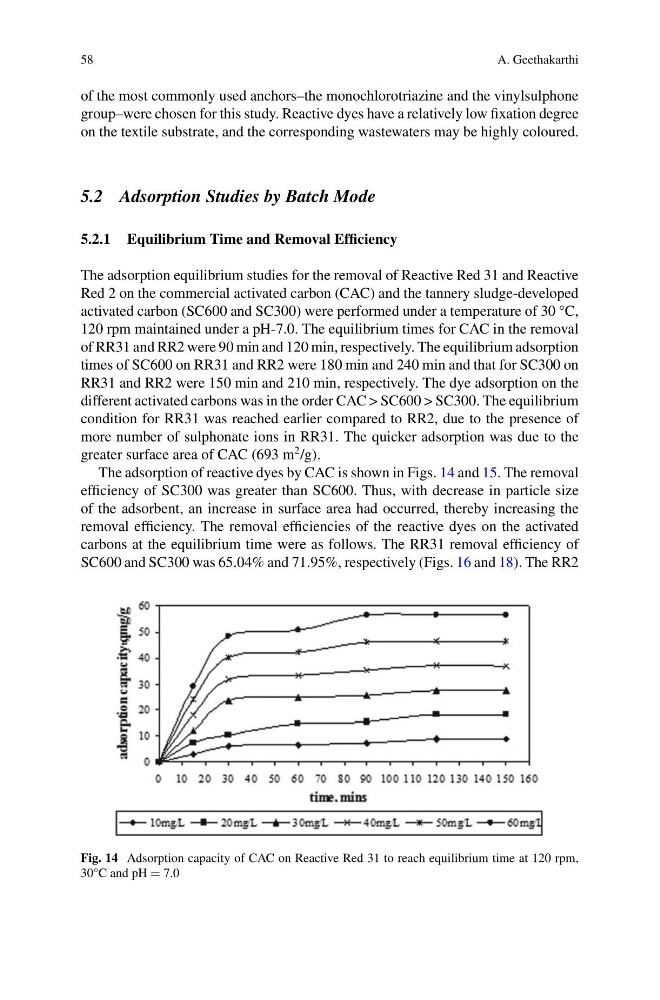
120 rpm maintained under a pH-7.0. The equilibrium times for CAC in the removal
of RR31 and RR2 were 90 min and 120 min, respectively. The equilibrium adsorption
times of SC600 on RR31 and RR2 were 180 min and 240 min and that for SC300 on
RR31 and RR2 were 150 min and 210 min, respectively. The dye adsorption on the
different activated carbons was in the order CAC > SC600 > SC300. The equilibrium
condition for RR31 was reached earlier compared to RR2, due to the presence of
more number of sulphonate ions in RR31. The quicker adsorption was due to the
greater surface area of CAC (693 m
2 /g).
The adsorption of reactive dyes by CAC is shown in Figs. 14 and 15. The removal
efficiency of SC300 was greater than SC600. Thus, with decrease in particle size
of the adsorbent, an increase in surface area had occurred, thereby increasing the
removal efficiency. The removal efficiencies of the reactive dyes on the activated
carbons at the equilibrium time were as follows. The RR31 removal efficiency of
SC600 and SC300 was 65.04% and 71.95%, respectively (Figs. 16 and 18). The RR2
Fig. 14 Adsorption capacity of CAC on Reactive Red 31 to reach equilibrium time at 120 rpm,
30°C and pH = 7.0
A. Geethakarthi
of the most commonly used anchors–the monochlorotriazine and the vinylsulphone
group–were chosen for this study. Reactive dyes have a relatively low fixation degree
on the textile substrate, and the corresponding wastewaters may be highly coloured.
5.2 Adsorption Studies by Batch Mode
5.2.1 Equilibrium Time and Removal Efficiency
The adsorption equilibrium studies for the removal of Reactive Red 31 and Reactive
Red 2 on the commercial activated carbon (CAC) and the tannery sludge-developed
activated carbon (SC600 and SC300) were performed under a temperature of 30 °C,
120 rpm maintained under a pH-7.0. The equilibrium times for CAC in the removal
of RR31 and RR2 were 90 min and 120 min, respectively. The equilibrium adsorption
times of SC600 on RR31 and RR2 were 180 min and 240 min and that for SC300 on
RR31 and RR2 were 150 min and 210 min, respectively. The dye adsorption on the
different activated carbons was in the order CAC > SC600 > SC300. The equilibrium
condition for RR31 was reached earlier compared to RR2, due to the presence of
more number of sulphonate ions in RR31. The quicker adsorption was due to the
greater surface area of CAC (693 m
2 /g).
The adsorption of reactive dyes by CAC is shown in Figs. 14 and 15. The removal
efficiency of SC300 was greater than SC600. Thus, with decrease in particle size
of the adsorbent, an increase in surface area had occurred, thereby increasing the
removal efficiency. The removal efficiencies of the reactive dyes on the activated
carbons at the equilibrium time were as follows. The RR31 removal efficiency of
SC600 and SC300 was 65.04% and 71.95%, respectively (Figs. 16 and 18). The RR2
Fig. 14 Adsorption capacity of CAC on Reactive Red 31 to reach equilibrium time at 120 rpm,
30°C and pH = 7.0