

40
A. Geethakarthi
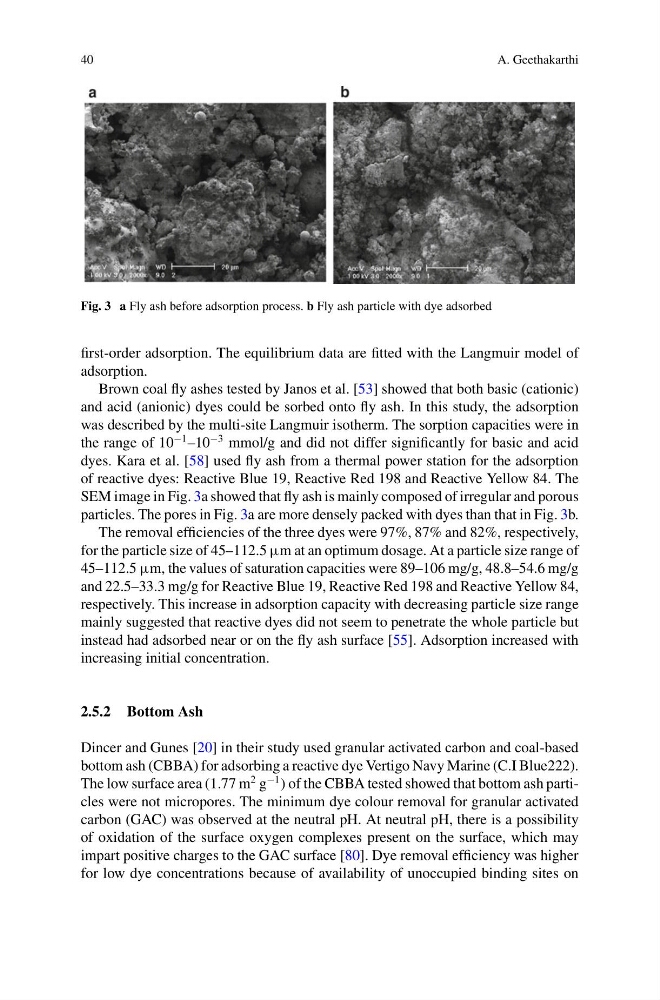
Fig. 3 a Fly ash before adsorption process. b Fly ash particle with dye adsorbed
first-order adsorption. The equilibrium data are fitted with the Langmuir model of
adsorption.
Brown coal fly ashes tested by Janos et al. [53] showed that both basic (cationic)
and acid (anionic) dyes could be sorbed onto fly ash. In this study, the adsorption
was described by the multi-site Langmuir isotherm. The sorption capacities were in
the range of 10
−1 –10
−3 mmol/g and did not differ significantly for basic and acid
dyes. Kara et al. [58] used fly ash from a thermal power station for the adsorption
of reactive dyes: Reactive Blue 19, Reactive Red 198 and Reactive Yellow 84. The
SEM image in Fig. 3a showed that fly ash is mainly composed of irregular and porous
particles. The pores in Fig. 3a are more densely packed with dyes than that in Fig. 3b.
The removal efficiencies of the three dyes were 97%, 87% and 82%, respectively,
for the particle size of 45–112.5 µm at an optimum dosage. At a particle size range of
45–112.5 µm, the values of saturation capacities were 89–106 mg/g, 48.8–54.6 mg/g
and 22.5–33.3 mg/g for Reactive Blue 19, Reactive Red 198 and Reactive Yellow 84,
respectively. This increase in adsorption capacity with decreasing particle size range
mainly suggested that reactive dyes did not seem to penetrate the whole particle but
instead had adsorbed near or on the fly ash surface [55]. Adsorption increased with
increasing initial concentration.
2.5.2 Bottom Ash
Dincer and Gunes [20] in their study used granular activated carbon and coal-based
bottom ash (CBBA) for adsorbing a reactive dye Vertigo Navy Marine (C.I Blue222).
The low surface area (1.77 m
2 g
−1 ) of the CBBA tested showed that bottom ash particles were not micropores. The minimum dye colour removal for granular activated
carbon (GAC) was observed at the neutral pH. At neutral pH, there is a possibility
of oxidation of the surface oxygen complexes present on the surface, which may
impart positive charges to the GAC surface [80]. Dye removal efficiency was higher
for low dye concentrations because of availability of unoccupied binding sites on
A. Geethakarthi
Fig. 3 a Fly ash before adsorption process. b Fly ash particle with dye adsorbed
first-order adsorption. The equilibrium data are fitted with the Langmuir model of
adsorption.
Brown coal fly ashes tested by Janos et al. [53] showed that both basic (cationic)
and acid (anionic) dyes could be sorbed onto fly ash. In this study, the adsorption
was described by the multi-site Langmuir isotherm. The sorption capacities were in
the range of 10
−1 –10
−3 mmol/g and did not differ significantly for basic and acid
dyes. Kara et al. [58] used fly ash from a thermal power station for the adsorption
of reactive dyes: Reactive Blue 19, Reactive Red 198 and Reactive Yellow 84. The
SEM image in Fig. 3a showed that fly ash is mainly composed of irregular and porous
particles. The pores in Fig. 3a are more densely packed with dyes than that in Fig. 3b.
The removal efficiencies of the three dyes were 97%, 87% and 82%, respectively,
for the particle size of 45–112.5 µm at an optimum dosage. At a particle size range of
45–112.5 µm, the values of saturation capacities were 89–106 mg/g, 48.8–54.6 mg/g
and 22.5–33.3 mg/g for Reactive Blue 19, Reactive Red 198 and Reactive Yellow 84,
respectively. This increase in adsorption capacity with decreasing particle size range
mainly suggested that reactive dyes did not seem to penetrate the whole particle but
instead had adsorbed near or on the fly ash surface [55]. Adsorption increased with
increasing initial concentration.
2.5.2 Bottom Ash
Dincer and Gunes [20] in their study used granular activated carbon and coal-based
bottom ash (CBBA) for adsorbing a reactive dye Vertigo Navy Marine (C.I Blue222).
The low surface area (1.77 m
2 g
−1 ) of the CBBA tested showed that bottom ash particles were not micropores. The minimum dye colour removal for granular activated
carbon (GAC) was observed at the neutral pH. At neutral pH, there is a possibility
of oxidation of the surface oxygen complexes present on the surface, which may
impart positive charges to the GAC surface [80]. Dye removal efficiency was higher
for low dye concentrations because of availability of unoccupied binding sites on